Ask how many cat breeds there are and the honest answer is a range. As of 2023 five major registries counted 45, 45, 50, 69 and 75, and each of them is right by its own rules. The question of how many cat breeds are there has no single answer because no single body decides what a breed is.
The number matters to anyone who tries to name a cat they meet. Cat Go, a walking game played with real cats, keeps a Catdex of 34 breeds, and that is one more count to set beside the registries.
How many cat breeds are there in each registry?
The Wikipedia page List of cat breeds gives the counts as of 2023. Domestic cats have been shaped by people into breeds and into domestic and wild hybrids, and many of these are recognized by cat registries. The registries are separate bodies, and each keeps its own list.
- The International Cat Association (TICA): 75 breeds.
- The World Cat Federation (WCF): 69 breeds.
- The Fédération Internationale Féline (FIFe): 50 breeds.
- The Cat Fanciers' Association (CFA): 45 breeds.
- The Governing Council of the Cat Fancy (GCCF): 45 breeds.
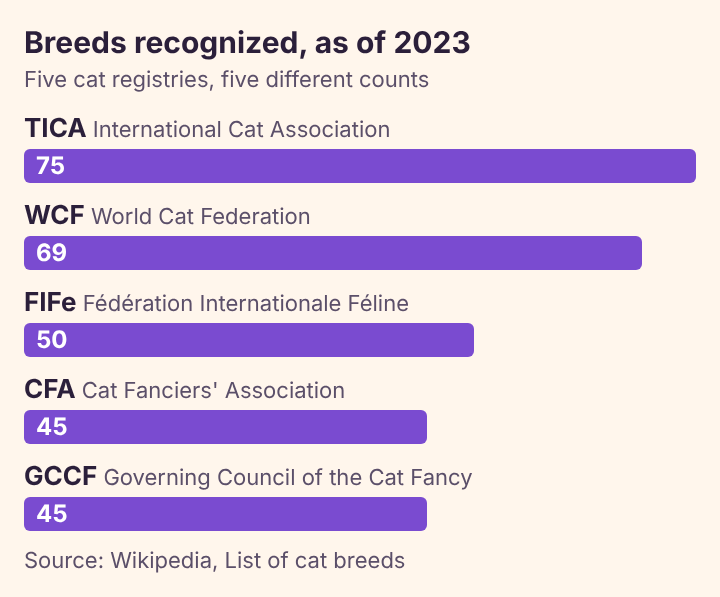
The gap between the highest and the lowest is 30 breeds. That is not a gap in the cats. It is a gap in the lists.
Why the registries disagree
A registry is a body that keeps records and sets the description a cat must match to count as a breed. The hobby around this work, the showing, breeding and appreciation of cats, is called the cat fancy. Each registry in the fancy makes its own choices, so the same cat can fall into different places depending on whose book you open.
The list page says this directly. A breed's classification and naming are not consistent from one registry to the next, which means that one animal may be thought of as different breeds by different registries. It may not be allowed to register with all of them, because that depends on its exact ancestry, but the labels still differ.
The Himalayan and the Javanese: one cat, several answers
Two examples from the same page show how the count moves. TICA treats the Himalayan as its own breed. The CFA treats it as a colorpoint variety of the Persian. A cat that is a breed in one list is a variety of another breed in the second list, so the Himalayan earns a line of its own in one book and not in the other.
The Javanese, also called the Colorpoint Longhair, is a colour variation of the Balinese in both TICA and the CFA. The World Cat Federation goes further. It merges the Balinese and the Javanese, along with the Colorpoint Shorthair, into a single breed it calls the Colourpoint. It then reuses the name Javanese for the Oriental Longhair. The page lists this as one of many overlaps in naming.
Names that sound older than they are
The names add to the confusion. The same page notes that many geographical and cultural names for cat breeds were chosen by Western breeders to sound exotic, and that they bear no relation to the breed's real origin. The Balinese, the Javanese and the Himalayan are its three examples.
So a name that points to a place is not evidence of where the breed came from. When you count breeds by name alone, you count what the breeders chose to call them.
Cats that belong to no breed
Most cats in a street or a home are not on any of the lists above. The page says that domestic short-haired and domestic long-haired are not breeds. They are terms used in the cat fancy for random-bred, non-pedigree cats, the ones called moggy or household cats, sorted only by coat length. Some registries, such as the CFA, allow these cats to be registered for the purpose of outcrossing.
The page warns against mixing them up with breeds that have similar names, such as the British Shorthair and the Oriental Longhair. A domestic shorthair is a short-coated cat of mixed ancestry. A British Shorthair is a breed with a written description.
A worked example: counting one small group of cats
Here is an invented case you can follow with a pencil. A volunteer writes down five cats seen over a week: a long-haired cat with a flat face and pointed colouring, a long-haired cat with a pointed coat and a different build, a short-coated grey cat of no particular type, a short-coated tabby, and a long-coated black cat of no particular type.
- Start with the three plain cats: the grey one, the tabby and the black one. Under the rule above they are domestic short-haired and domestic long-haired cats, so they are no breed in any book.
- Look at the flat-faced pointed cat. If the book is TICA's, it can be a Himalayan, a breed of its own. If the book is the CFA's, it is a colorpoint variety of the Persian.
- Look at the second pointed cat. In TICA's book and in the CFA's it is a Javanese, a colour variation of the Balinese. In the World Cat Federation's book it sits inside the single Colourpoint breed.
- Write down the answers. The same two cats get a different breed name depending on the book, and in the CFA's book one of them is not a breed of its own at all.
The cats did not change between the steps. Only the book did, which is why the question has a range for an answer.
How the Catdex fits beside the registries
The Catdex in Cat Go lists 34 breeds in four groups: Common, Uncommon, Rare and Very rare. The Common group holds only Domestic Shorthair and Domestic Longhair. The Uncommon group holds eight breeds, the Rare group sixteen and the Very rare group eight. Persian sits among the Uncommon breeds and Himalayan among the Rare ones, so the Catdex keeps both as separate entries.
When a cat is spotted, the game asks "Which breed is it?" and the player picks from the list. When no breed fits, the game says "Mixed breed is always a safe pick." That fits the lists above, where a household cat is not any breed at all.
Frequently asked questions
How many cat breeds are there in total?
There is no total. As of 2023 the registries counted between 45 and 75, and the lists overlap, so adding them would count some breeds more than once.
Which registry recognizes the most breeds?
As of 2023 it was TICA, with 75. The World Cat Federation followed with 69.
Is a domestic shorthair a breed?
No. Domestic short-haired and domestic long-haired are terms for random-bred, non-pedigree cats sorted by coat length. They are not breeds.
Why does the same cat have different breeds in different registries?
Registries set their own descriptions, and they treat related cats differently. The Himalayan is a breed to TICA and a colorpoint variety of the Persian to the CFA.
Do breed names show where a breed came from?
Not always. Western breeders chose many place names to sound exotic, and the names of the Balinese, the Javanese and the Himalayan are examples.
What a breed count really measures
A breed count measures decisions, not cats. Each registry decides which looks to describe, which neighbours to fold into one breed and which names to keep. Change the decisions and the count changes, while the cats on the street stay as they were.
That makes the useful question a smaller one. Rather than asking how many breeds exist, ask which registry's list you are reading and what it does with colour variants and with cats of no breed. With those two answers in hand, any number you meet makes sense.