You see a huge, shaggy cat on a garden wall and wonder if it is a Maine Coon. Knowing how to tell a Maine Coon from a regular cat comes down to four physical checks: size, coat, ears and paws, and tail. Each one raises the odds. None of them proves the breed, because a mixed breed longhair can carry every one of these traits. The only proof is a pedigree, a registered family tree.
The same question sits at the centre of Cat Go, a walking game played with real cats, where you photograph a cat you meet, pick its breed from a list, and the catch is kept with that breed and where you found it.
What makes a Maine Coon a breed at all
A breed is a paperwork fact before it is a looks fact. According to the Wikipedia article on moggies, every cat of a specific breed has a known, formally registered ancestry with a cat registry. A cat without that record is a mixed breed cat, often filed by vets and shelters as a domestic shorthair or domestic longhair.
The same article says the vast majority of cats worldwide have no pedigree ancestry, and that by a United States government figure, fewer than 2% of cats in that country are purebred and raised by breeders. So the plain starting point is this: a big fluffy cat you meet outside is far more likely to be a domestic longhair than a Maine Coon.
That does not make the checks useless. It means you read them as clues and keep the more common answer in mind until the clues stack up. For the wider picture of how registries count breeds, see how many cat breeds there are, and for the label most outdoor cats carry, see what a domestic shorthair cat is.
Check one: size, weight and slow growth
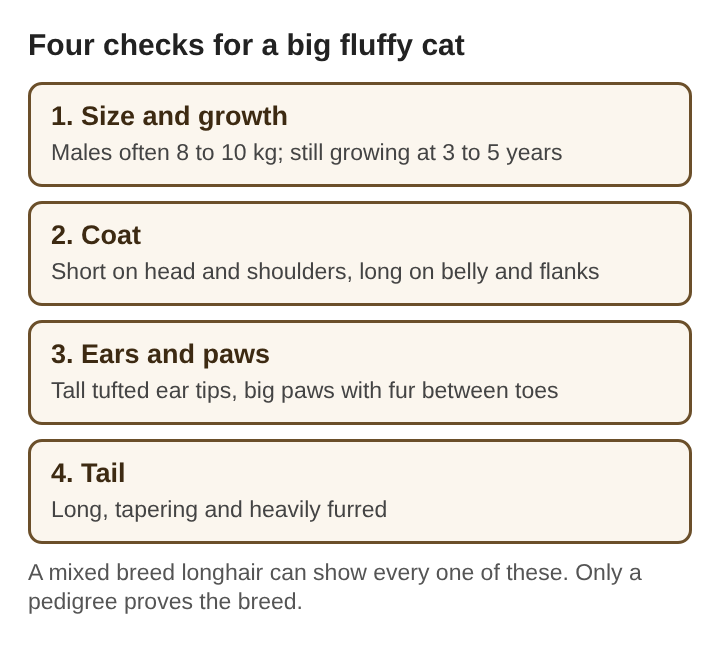
Size is the trait most people notice first. The Wikipedia article on the Maine Coon calls it one of the largest domestic breeds and the largest breed that is not a hybrid. On average, males weigh about 8 to 10 kg and females about 5 to 7 kg.
The body matters as much as the number. A Maine Coon has a solid, muscular, rectangular build with a broad chest. From the side it looks long rather than round. A regular cat that is simply overweight tends to look round in the middle, with a belly that swings, and a shorter frame.
Age changes the reading. Maine Coons grow slowly and usually reach full size at three to five years old, while most cats take about one year. So a young Maine Coon can look ordinary, and a large adult mixed breed cat can look impressive. If you know the cat is two years old and already very big, that is a stronger clue than size alone.
Check two: a coat that changes length across the body
A long coat on its own says little. What stands out on a Maine Coon is where the length sits. The coat is shorter on the head and shoulders and longer on the stomach and flanks, and some cats carry a ruff around the neck. The fur is soft and silky, with a light undercoat, so it tends not to mat as easily as some other long coats.
The coat also follows the seasons: thicker in winter and thinner in summer. A cat you see in July may look much less shaggy than the same cat in January. Judge the coat by its shape, short in front and long behind and underneath, rather than by how much fluff there is on one day.
Compare that with the domestic longhair. The moggy article says these cats come in every possible colour and pattern and can have fur up to six inches long, sometimes with a mane. Many longhaired mixed cats have an even coat all over, but some will match the Maine Coon pattern closely. The coat is a clue, never proof.
Check three: ears and paws built for snow
Maine Coons come from the harsh winters of New England, and their ears and feet show it. Their ears are heavily furred, with long tufts growing from inside, and many have the tall pointed tips often called lynx tips. Their paws are large, with long tufts of fur between the toes that give the feet extra spread on snow.
Look at the ears from the front and the side. Tufts that stand up past the tip of the ear are a good sign. Then look at the feet when the cat sits. Wide feet with fur poking out between the toes point the same way.
Some Maine Coons also have extra toes, a trait called polydactyly. The Maine Coon article says it was common in the original cats of New England but is not allowed in the show ring, so it is rare in show cats today. Extra toes also appear in many mixed breed cats, so they are not proof either.
Check four: a long, heavily furred tail
The tail is often the most convincing single trait. A Maine Coon's tail is long, tapering and heavily furred, and can reach about 36 cm. When the cat sits, the tail can wrap around its body. A regular cat's tail is usually shorter in proportion and less bushy, even on a longhaired cat.
Watch the cat walk away from you. A Maine Coon's tail looks full along its whole length, from the base to the tip.
How to tell a Maine Coon from a regular cat in a real meeting
Here is one worked example you can follow. You pass a large brown tabby cat sitting calmly on a doorstep. Stay where you are and look from a distance, without reaching for it.
- Size: it looks long rather than round, with a broad chest. One clue.
- Coat: the fur is short on its head and shoulders and long on its belly and back legs, with a ruff at the neck. Two clues.
- Ears and paws: the ears have tufts standing past the tips, and fur sticks out between the toes. Three clues.
- Tail: the tail is long and full to the tip. Four clues.
With all four, "possibly a Maine Coon" is a fair guess. It is still a guess. The cat could be a domestic longhair with the same traits, and the moggy article lists a Maine Coon style mane, toe tufts and ear tufts among the things a domestic longhair can have. If only one or two checks fit, the safer answer is a domestic longhair.
Cat Go reflects that caution. When you spot a cat, the game asks "Which breed is it?" and reminds you that most cats you meet are mixed breed and that rarer breeds are warier. When no breed fits, it says "Mixed breed is always a safe pick." Its Catdex of 34 breeds lists the Maine Coon in its uncommon group and the Domestic Longhair in its common group, which matches how often each turns up outside.
Other big fluffy breeds that get confused with it
Two breeds share much of the Maine Coon's look: the Siberian and the Norwegian Forest Cat. The Maine Coon article explains that the likeness does not come from close family ties. All three formed in harsh climates, and similar conditions produced similar traits: thick long coats, toe and ear tufts, big bodies and large feet. That process is called convergent evolution.
Telling these three apart by eye is harder than telling any of them from a regular cat, and owners usually rely on papers. If a cat passes all four checks, the honest label is "a Maine Coon type", unless you know its history. For a breed with a much clearer visual signature, see how to tell a Siamese cat from other breeds.
Frequently asked questions
Is every big fluffy cat a Maine Coon?
No. Most cats have no pedigree, and a domestic longhair can be large, with a mane and tufted ears and toes. Size and fluff raise the odds but never prove the breed.
How big does a Maine Coon get?
Males average about 8 to 10 kg and females about 5 to 7 kg. They keep growing until three to five years old, much later than most cats.
Do all Maine Coons have ear tufts?
Heavily furred ears with long tufts are typical of the breed, but how big the tufts are varies from cat to cat. A cat without tall tufts can still be a Maine Coon, and a mixed breed cat can have them.
Can a vet tell if a cat is a Maine Coon?
A vet can describe the cat's build and coat, but a breed is defined by registered ancestry. Without papers, records usually list a longhaired cat as a domestic longhair.
Reading a Maine Coon by its traits
The four checks work best together. A long rectangular body, a coat that is short in front and long behind, tufted ears and toes, and a full tapering tail make a strong case. One trait alone makes a weak one. Seasons change the coat, age changes the size, and a mixed breed longhair can share every feature. Treat the result as a likelihood, keep "domestic longhair" as the common answer, and let a pedigree, not a glance, settle the breed.