Knowing how to tell a Siamese cat from other breeds comes down to three signs read together: the colour points, the eyes, and the build. A pale cat with a dark face is not automatically a Siamese. Many breeds and plenty of ordinary mixed cats share that pattern. The question comes up constantly in Cat Go, a walking game where you photograph real cats you meet and keep each one with its breed and the place you found it. The game leaves the breed call to you, so the signs that separate a Siamese from a pointed lookalike matter.
How to Tell a Siamese Cat From Other Breeds: What Makes a Siamese
The Siamese is one of the oldest named breeds. It comes from Thailand, known as Siam before 1939. The Wikipedia entry on the Siamese cat traces it to the Wichianmat, a pointed landrace cat first described in the Tamra Maew, the Cat-Book Poems, and selectively bred since the end of the 19th century.
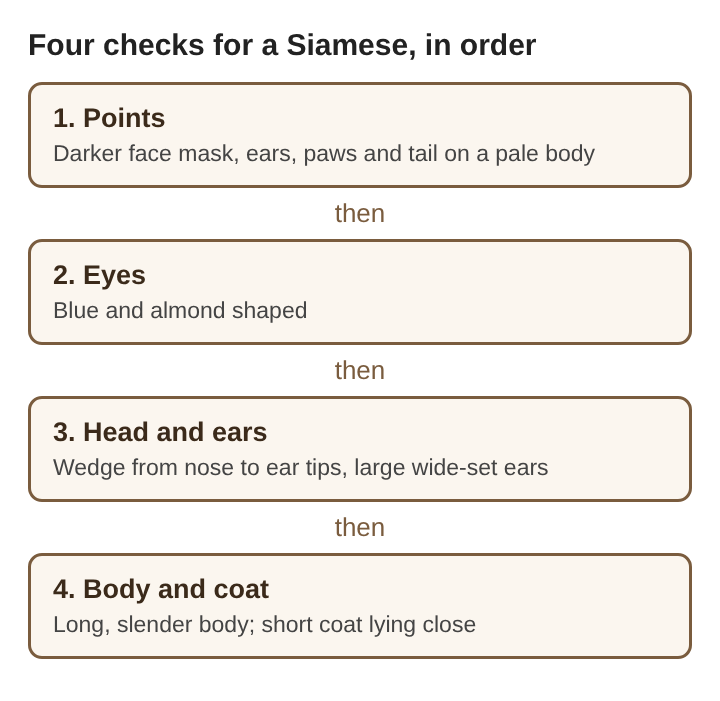
A Siamese is defined by a combination. It has a pointed coat, blue eyes, short fine fur that lies close to the body, and a long, angular frame. Registries write their own breed descriptions, and they do not always agree on where the Siamese ends and a related breed begins. The article on how many cat breeds there are and why the answer depends on the registry shows how the same cat can carry different names in different clubs.
Colour Points as the First Sign of a Siamese Cat
"Points" are the darker areas on the face, ears, legs, feet and tail. The rest of the body is much paler, usually cream, ivory or white. On a Siamese the contrast is sharp.
The pattern has a genetic cause. As the page on point coloration explains, it comes from a change in the enzyme tyrosinase, which helps make pigment. In pointed cats the enzyme only works at lower temperatures. The extremities of the body run cooler, so pigment forms there and the warm trunk stays light.
That one fact explains something that surprises many people: Siamese kittens are cream to white at birth. Their points become visible over the first few months of life, in the cooler parts of the body. A pale kitten with faint grey ears may turn into a sharply pointed adult. Two copies of the gene, one from each parent, are needed for the points to show at all.
The classic point colours are seal (a deep brown), chocolate, blue (a cool grey) and lilac (a pale pinkish grey). A seal point is the version most people picture.
Blue Almond Eyes and the Siamese Head Shape
A Siamese has light blue eyes. Other pointed breeds have blue eyes too: the Birman, for one, is known for its deep blue eyes. Blue eyes on a pointed cat therefore do not prove it is a Siamese.
The shape of the eyes helps more. A Siamese has almond-shaped eyes. Round, open eyes in a round face suggest a different breed or a mix.
The head is the next check. Look at the cat side-on and from the front:
- A modern show Siamese has a triangular head, forming a triangle from the tip of the nose to each tip of the ear. Its ears are large, wide-based and set toward the side of the head.
- A traditional Siamese, often called a Thai cat, has a modified wedge with a long, flat forehead, so the face is less extreme.
- A flat, pushed-in face points away from the Siamese entirely and toward Persian-type cats.
Many early Siamese were cross-eyed, and many foundation cats from Thailand had a kink in the tail. Breeders have largely bred both traits out, so their absence tells you nothing.
Modern and Traditional Siamese Body Types
The Siamese seen at shows changed a great deal over the last century. Breeders of the modern type aim for an elongated, tubular and muscular body, a long neck and a slender tail. The fur is short, glossy and fine, lies close to the body and has no undercoat.
The older body type is less elongated than the modern Siamese, though still longer than the average Western house cat. Some registries now treat these cats as a separate breed. The Thai cat is the name some clubs use for the old-style Siamese. Other clubs still call the same cat a traditional or "applehead" Siamese.
"Applehead" was first a dismissive nickname from breeders of the modern type in the 1950s. A medium-bodied, clearly pointed cat with blue almond eyes and a short coat fits this older Siamese well.
Siamese Cats Compared With Other Pointed Breeds
Several breeds carry the same point pattern. Each has a giveaway that sets it apart from a Siamese.
- Himalayan: a pointed cat with Persian type. It has a long, thick coat, a round head, and a flat face. The Himalayan cat came from crossing Siamese with Persians and is treated by some registries as a colour division of the Persian.
- Birman: a long, silky coat and white "gloves" on each paw. The gloves are the quickest way to rule out a Siamese.
- Ragdoll: bred in the United States from street cats, it carries the same colourpoint gene, with a longer coat than the Siamese.
- Balinese: in effect a long-haired Siamese, with the same cat but with a medium-length silky coat and a plumed tail.
- Oriental Shorthair: a close relative, developed to widen the range of Siamese coat patterns. The Siamese pointed colour scheme and blue eyes are what set it apart.
A short, sleek coat, no white anywhere, and a long face together are the strongest signs you are looking at a Siamese and not one of these.
Siamese Mixes and Pointed Domestic Shorthairs
The point pattern is not limited to pedigree cats. Ordinary domestic shorthairs can have seal points too. A cat can be pointed simply because both of its parents carried the gene, and neither parent needs to be a Siamese.
A pointed mix may have a rounder head, a heavier build, or points that blur into the body colour instead of standing out sharply. Without pedigree papers, nobody can say for sure that such a cat is a Siamese. Calling it a pointed mix is the honest answer. The article on what a domestic shorthair cat is explains why that label describes a coat and not a pedigree.
Choosing Siamese or Mixed Breed for a Pointed Cat
In Cat Go, you catch a cat by taking its photo. The game checks the photo for a cat and reads its coat. It then asks "Which breed is it?" and adds: "Most cats you meet are mixed breed. Rarer breeds are warier." You choose the breed from a list. When nothing fits, the game says "Mixed breed is always a safe pick."
Take a worked example. You pass a garden wall and see a cream cat with a dark brown mask, dark ears and a dark tail. Its head is round, its body is chunky, and the brown on its face fades softly into the cream. The points say pointed. The round head, heavy build and soft edges say it is probably not a Siamese. Mixed breed is the fair choice. A slim cat with a long face, very large ears, sharp seal points and slanted blue eyes is a different case. That cat is a strong Siamese candidate.
The game's breed list sorts the Siamese as uncommon. The Himalayan, Birman and Oriental Shorthair are rare, and the Domestic Shorthair is common. Treats are tossed inside the game. Tuna works much better on wary cats, and a startled cat leaves quickly, so calm tosses matter. Each catch is kept with its breed and the place you met the cat.
Meeting Siamese and Pointed Cats in a Neighbourhood
Most of the signs that separate a Siamese from a lookalike can be read from a few steps away: the sharpness of the points, the colour of the feet, the shape of the head and the length of the coat. You rarely need to get close to make a fair call.
With a real cat, keep your distance and let it decide whether to come closer. Do not feed, pick up or chase a cat that is not yours. The page on cat communication describes signals worth knowing. Cats slowly blink to show trust. Ears flattened against the head mean the cat feels defensive and wants space.
A pointed cat that stays on its wall and watches you with blue almond eyes has shown you nearly everything. Whether it turns out to be a Siamese or a pointed mix, the coat, eyes and build are enough to name it honestly.
Frequently asked questions
Are all cats with colour points Siamese?
No. The point gene appears in several breeds, including the Himalayan, Birman, Ragdoll and Balinese, and in many random-bred cats. Points show that a cat carries the gene, not which breed it belongs to.
Do Siamese kittens have their points at birth?
No. Siamese kittens are cream to white at birth because the pigment only forms in cooler parts of the body. The points become visible over the first few months of life.
Can a long-haired cat be a Siamese?
A Siamese has a short, close-lying coat. A cat with Siamese build and points but long fur is usually called a Balinese. A long-haired pointed cat with a flat face is more likely a Himalayan.
How can you tell a Siamese cat from other breeds at a glance?
Look for sharp points with no white on the feet, blue almond-shaped eyes, a short sleek coat and a long face with large ears. If the head is round, the body is heavy or the points blur into the body colour, the cat is more likely a pointed mix.