What is splash damage in tower defense? It is damage that spreads from the point where a shot lands, so one hit can hurt every enemy standing near it. A single-target tower picks one enemy and hits only that one. A splash tower hits a spot, and the spot can hold a crowd. That one difference decides where a splash tower earns its place and where it wastes its shots. In Two Towers, a castle defense game in the browser, you pick a pair of towers, add two more with gold and hold the city gate against knights, monks, kings and rams, stage after stage. With only a handful of towers to place, knowing what kind of damage each one deals, and where that damage is worth the most, matters.
What is splash damage in tower defense? One hit over an area
The Wikipedia glossary of game terms describes splash damage as damage from attacks with an explosive or other area of effect part, which affects the area around the point of impact. The enemy that takes the direct hit is hurt, and so is anyone close enough to the blast.
Two details from that definition shape how you use it. First, splash damage is usually separate from the damage of the direct hit. The enemy at the centre may take both, while the ones nearby take only the splash. Second, there is often damage falloff: the further an enemy stands from the centre of the blast, the less it loses.
So a splash shot is not one big number. It is a strong hit in the middle and a ring of weaker hits around it. How much it does in total depends on how many enemies are inside the ring.
Area of effect and single-target towers
Splash damage is one kind of area of effect, a term for attacks or other effects that touch multiple targets within a set area. The same glossary entry notes that the effect is often stronger on the target than on anything else it hits.
Most tower defense games mix two families of towers. Single-target towers put all their damage into one enemy at a time. They are steady and predictable, and they are what you want against one tough enemy that takes many hits to bring down. Area towers trade some of that focus for reach. Their damage per enemy is often lower, but it lands on several enemies per shot.
Neither family is better on its own. The question is always which one does more total damage against the enemies in front of it right now.
Why a crowd changes the sums
Tower defense is a strategy subgenre where the goal is to stop enemies reaching the exits, usually by placing defensive structures on or along their path. Enemies come in waves, and each wave usually has a set number and types of enemies. The same page calls the choice and placement of defenses an essential strategy of the genre.
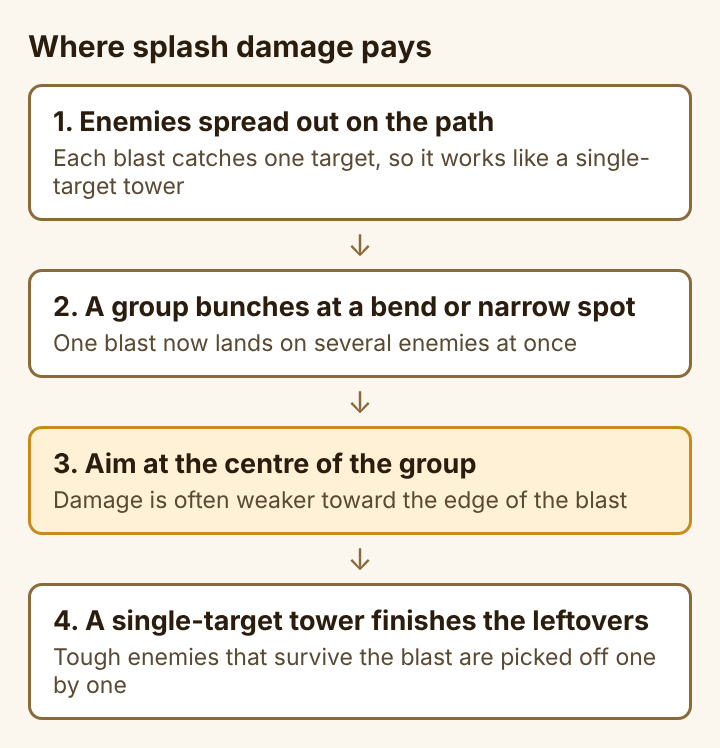
Waves are where splash damage comes into its own. When enemies walk the path one at a time with gaps between them, a splash shot catches one enemy and the blast lands on empty ground. It becomes a single-target tower with weaker hits. When a wave bunches together, every enemy inside the blast takes damage from the same shot.
Enemies bunch for plain reasons. A fast group catches up with a slow one ahead of it. A path narrows at a bridge or a gate. A tight bend makes the back of a line catch up with the front. A chokepoint in tower defense is one of the narrow spots where a crowd is forced together, and those are the spots where an area attack catches the most.
A worked example with made-up numbers
The numbers here are invented to show the sums. They are not taken from any game.
Take two towers that each deal damage once per second. Tower A is single-target and hits for 30. Tower B is a splash tower: it hits its target for 20, and every other enemy within the blast takes 10.
- A spread-out wave. Enemies walk in single file with wide gaps. Each blast from Tower B reaches one enemy, so it deals 20 per second. Tower A deals 30. Tower A wins.
- A loose group of three. Three enemies walk close together. Tower B deals 20 to the one it targets and 10 to each of the other two, 40 per second in all. Tower A still deals 30. Tower B is now ahead.
- A tight crowd of six at a bend. Six enemies pile up where the path turns. Tower B deals 20 plus five times 10, so 70 per second. Tower A still deals 30.
- One tough enemy left. After the crowd thins, a single enemy with a lot of health walks on alone. Tower B is back to 20 per second against Tower A's 30.
Nothing about either tower changed between the four steps. Only the spacing of the enemies changed. That is the whole case for splash damage: its value grows with every extra enemy inside the blast, and falls back when the crowd is gone.
Where to put a splash tower
Since the payoff depends on crowding, place a splash tower where enemies are already close together. Look for the places on a path where the line has to compress: a narrow gap, a sharp bend, the approach to a gate. A splash tower that covers the inside of a tight bend sees the group twice, once on the way in and once on the way out.
Aim matters too. With damage falloff, an enemy at the edge of the blast loses far less than one in the middle. A splash tower that reaches the centre of where the crowd forms catches more enemies at full strength than one that only clips the edge.
A longer path helps as well. Mazing in tower defense builds a winding route that keeps enemies in range for longer, and a route that winds back on itself also packs them closer together.
Pairing splash with a single target
Splash towers wear a crowd down. Single-target towers finish what is left. The two work best one after the other along the path: the area tower near where the crowd forms, and a focused tower further along, where the survivors arrive one or two at a time.
This order also covers the weakness of each. A wave of many weak enemies can swamp a single-target tower, because it can only hit one of them per shot. A single strong enemy shrugs off a splash tower, because most of its damage lands on empty ground around it. With both kinds on the path, each wave meets the tower that suits it.
The glossary entry on splash damage adds one more strength: it is particularly useful against targets that dodge well, because the blast still covers a target if the shot lands just beside it. An enemy that is hard to hit directly can still be caught by the area around the impact.
Frequently asked questions
Is splash damage the same as area of effect?
Splash damage is one kind of area of effect. Area of effect covers any attack or effect that touches every target within an area, and splash damage is the version that spreads out from where a shot lands.
What is damage falloff?
Damage falloff means a target further from the centre of a blast takes less damage than one in the middle. It is why aiming a splash attack at the centre of a crowd matters.
When is a single-target tower better than splash?
When enemies arrive one at a time or a single enemy has a lot of health. Then most of a splash blast lands on empty ground, and a tower that puts all its damage into one target does more.
Why do enemies bunch together on a path?
Faster enemies catch up with slower ones, and narrow gaps and tight bends force a line to compress. Those are the spots where splash damage catches the most.
Splash damage and the shape of a wave
Splash damage does not have a fixed value. The same blast is weak against a lone enemy and strong against a crowd, so its worth comes from where the enemies stand when it lands. The same glossary notes the other side of this for anyone on the receiving end: units packed in a dense formation take more area damage, though the gains of fighting together can outweigh that cost. A tower defense wave lives with the same trade. Reading the spacing of a wave, where it spreads out and where it bunches, tells you where an area attack will do the most work.