You have a problem, you have a hunch about its cause, and every time the problem shows up you notice the thing you suspected nearby. That feels like proof. Often it is not. Confirmation bias in problem solving is the habit of looking for cases that agree with the cause you already believe, while the cases that would show it wrong go unseen. The result is a fix aimed at the wrong cause, tried again and again, with a story that always seems to fit.
The way out is not more effort. It is a record. When every attempt and every outcome is written down, the cases that disagree with your hunch are still there to count. Problem Graph keeps that kind of record: a journal where a problem goes down in one line and each solution tried on it is marked worked, partly or failed, with failed solutions left on the map. A notebook can hold the same record. What matters is that the record includes the cases you would rather not see.
What confirmation bias in problem solving looks like
The psychologist Peter Wason described confirmation bias as a preference for information that fits a belief over information that opposes it. In everyday problem solving it shows up in a few familiar shapes:
- You remember the days the problem matched your theory and forget the days it did not.
- You only check for the cause you suspect, so you never see the other causes.
- You read an unclear result as support, because you already know what it should mean.
- You stop looking once one explanation fits, even when two or three others would fit as well.
None of these feel like mistakes from the inside. Each one feels like paying attention. That is why the bias lasts: it hides inside the same habits that good problem solving uses.
The number puzzle that named it
In 1960 Wason gave people three numbers, 2, 4 and 6, and told them the numbers fit a rule. They could offer their own sets of three numbers and hear whether each one fit, until they were ready to name the rule. The real rule was simply any three numbers in rising order.
Most people struggled. They settled on rules far more specific than the real one, such as "each number is two more than the last", and then offered sets that fit their own rule, such as 11, 13, 15. Every one came back as a fit, so their confidence grew. Very few offered a set that would break their rule, such as 11, 12, 19. That set would also have fit, and it would have shown at once that their rule was too narrow. Wason read the results as a preference for confirming a belief over trying to prove it false, and he coined the term confirmation bias.
A later puzzle of his, the Wason selection task, asks which of four cards must be turned over to check a simple rule about them. In Wason's study, fewer than 10% of people picked the right cards. The common mistake was the same: people turned over the cards that could agree with the rule and skipped the one that could break it.
Why a favourite explanation wins
Part of the pull is desire. Studies of motivated thinking describe people asking "Can I believe this?" of ideas they want to be true, and "Must I believe this?" of ideas they do not. A welcome explanation needs only a little support. An unwelcome one has to clear a much higher bar.
In a personal problem, the welcome explanation is often the one that is easy to fix, or the one that puts the cause outside you. "The noise next door keeps me awake" is easier to hold than "my evenings are the problem". So the noise gets noticed on every bad night, and the quiet bad nights fade from memory.
The habit is old. Francis Bacon, in the Novum Organum, blamed a biased reading of evidence for all superstitions, from astrology to omens. A hunch about a stubborn problem works the same way: the hits are remembered, the misses are not.
Where it slips into solving a problem
Confirmation bias can enter at three points.
- Naming the cause. The first plausible cause becomes the only one, and the search stops. A root cause analysis that asks "why" only along one path will find the cause it set out to find.
- Collecting evidence. You record the problem only on the days your suspect is present. The record then shows a perfect match, because you never wrote down the other days.
- Judging the fix. The problem eases, and the fix gets the credit, even if something else changed that week. Knowing if a solution really worked means writing down the baseline and the success line before you start.
Five steps to check a belief against the record
The fix for confirmation bias is to decide, before you look, what would prove your belief wrong, and then to look for exactly that.
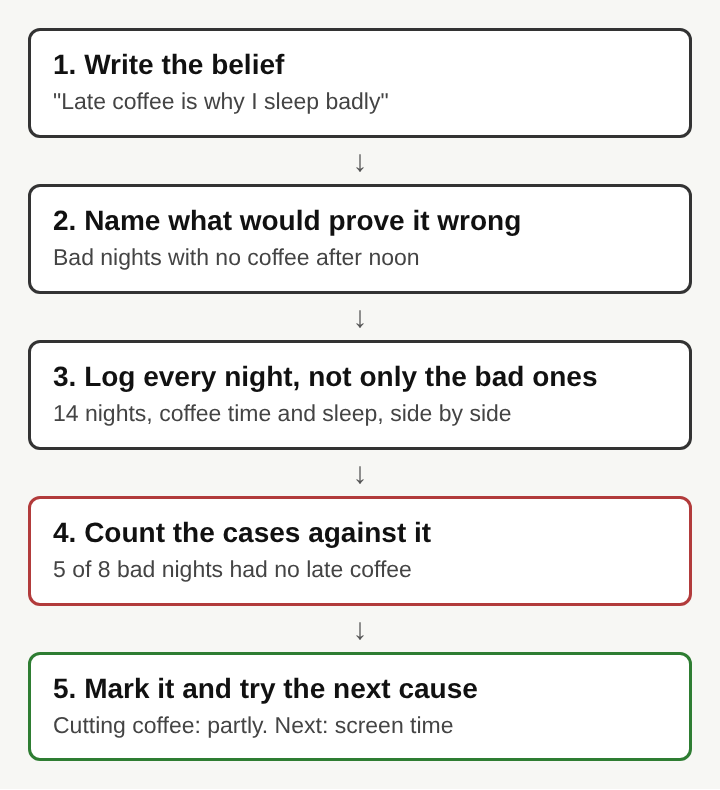
- Write the belief in one sentence. A belief kept in your head can shift to fit each new fact. A written one cannot.
- Name what would prove it wrong. Ask: if this cause is wrong, what would you see? Write that down too.
- Record every case, not only the bad ones. Note the problem on the good days as well, with the suspected cause present or absent.
- Count the cases against it. Put the numbers side by side. A belief that survives a real chance to fail is worth more than one that was never put at risk.
- Mark the outcome and move on. Record the fix as worked, partly or failed, and write the next suspect in place of the old one.
A worked example: the late coffee
Sam sleeps badly and is sure the cause is coffee after noon. Every bad night, Sam remembers the afternoon cup. The belief feels settled.
Sam puts it on paper: "Coffee after noon is why I sleep badly." Then Sam adds what would prove it wrong: bad nights with no coffee after noon, or good nights after a late cup.
For 14 nights, Sam notes two things each evening: the time of the last coffee, and whether the night was good or bad. At the end, the count reads:
- 8 bad nights in all.
- 3 of the bad nights followed a late coffee.
- 5 of the bad nights had no coffee after noon.
- Of the 6 good nights, 2 followed a late coffee.
The five quiet bad nights are the cases Sam had never noticed. Coffee may still play a part, but it cannot be the whole cause. Sam cuts the afternoon cup anyway, marks that fix as partly, and names the next suspect: screens in bed. The next two weeks of notes will check that one the same way, with the cases against it named first.
Without the record, Sam would have cut the coffee, still slept badly on most of those nights, and perhaps blamed a stronger brand. The belief would have survived because nothing was written down to stop it. A record of what you tried keeps the five quiet nights in view.
Frequently asked questions
What is confirmation bias in simple terms?
It is the habit of noticing and trusting the facts that agree with what you already believe, while missing or doubting the facts that disagree.
How does confirmation bias affect problem solving?
It makes the first likely cause feel proven, so people keep fixing the wrong thing. Evidence gets collected only where the suspect is present, and any improvement gets credited to the favourite fix.
Can confirmation bias be avoided completely?
Probably not, since it feels like ordinary attention from the inside. It can be reduced by writing the belief down, naming in advance what would disprove it, and counting every case.
Why does writing things down help against confirmation bias?
Memory keeps the cases that fit and drops the ones that do not. A written record keeps both, so the cases against a belief are still there to count.
Confirmation bias and the cases that go unseen
Confirmation bias is not a lack of evidence. It is evidence gathered in one direction. The cases that would change your mind are often already happening, on the quiet nights, the good days and the weeks when the fix was skipped. They go unseen because nobody asked for them.
The question that turns them up is short: what would you see if you were wrong? Ask it before you look, write the answer down, and count what you find. A cause that survives that question has earned its place. One that does not was only a story that fit.