If you have asked what is a chokepoint in tower defense, here is the short answer. A chokepoint is a narrow spot on the enemy route that every attacker has to pass through, and it is where your towers do the most work, because several of them can hit the same crowd at the same moment. The idea works in any game where you defend one goal against waves of attackers. Two Towers is one such game: you pick a pair of towers, add two more with gold, and hold the city gate against knights, monks, kings and rams, stage after stage.
Where the word chokepoint comes from
The term is older than video games. In military strategy, a choke point is a feature such as a valley, a narrow pass, a bridge or a strait that an army is forced to cross to reach its objective. Because the front narrows there, the attacker cannot bring its full numbers to bear at once. The same source notes that a choke point can let a smaller defending force use the ground itself as a force multiplier against a much larger opponent.
History gives famous cases. The defense of the pass at Thermopylae in 480 BC let an outnumbered Greek force hold off a far bigger Persian army for seven days, even though the Persians won in the end. At the Battle of Stirling Bridge, a force of around 2,300 men faced an army of roughly 9,000 to 12,000 at a narrow wooden bridge. In both, the defender chose ground where size counted for less.
What is a chokepoint in tower defense
Tower defense is a kind of strategy game where you stop enemies from reaching an exit, usually by placing defensive structures on or along their path. The genre treats the choice and position of those structures as its central skill. A chokepoint is simply the stretch of that path where the route is narrowest or where every enemy is forced to bunch up.
In a game with a fixed road, the chokepoint is often a gap between walls, a bridge, a tight bend or the entrance to the gate itself. In a game where you build the route from your own towers, you can make a chokepoint on purpose by leaving one small opening. Either way, the rule is the same: the fewer places an enemy can be, the easier it is to make sure every tower is aimed at it.
Why a narrow spot multiplies your towers
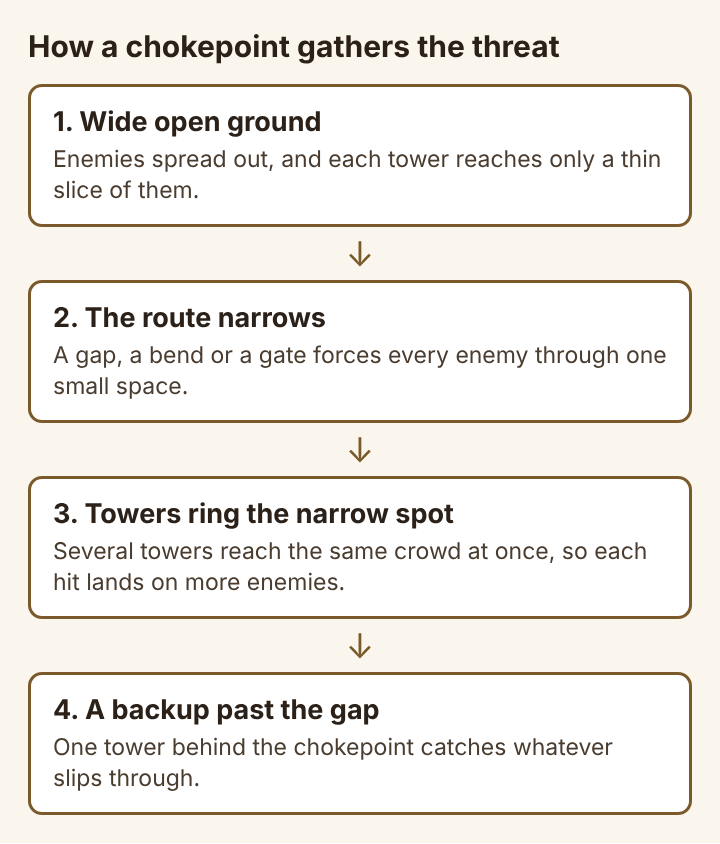
On open ground, enemies spread out. Each tower covers only a slice of the field, and a tower on the far edge may spend most of a wave with nothing in range. At a chokepoint, the spread disappears. If four towers can all reach the same narrow gap, then every enemy that walks through it is under fire from all four at once.
That has three effects you can feel in play:
- Overlap. More towers reach the same target, so enemies fall faster and fewer reach the gate.
- Crowding. Enemies bunch together in a tight space, so any attack that hits an area catches several of them.
- Predictability. You know where every attacker will be, so no tower is wasted guarding a side route nobody takes.
This is the game version of the force multiplier idea. A small number of towers, placed around one narrow spot, can hold back a much larger wave than the same towers spread across a wide field.
How to find a chokepoint on a new map
When you start a fresh stage, look at the route before you spend anything. Trace the path from where enemies appear to the goal you are defending, and ask a few questions:
- Where is the route narrowest? A gap between walls, a bridge or a doorway forces enemies into a line.
- Where does the route bend? A tight corner slows the flow and lets towers on the inside of the turn reach both the road in and the road out.
- Is there a single point every enemy must cross? When the route splits and rejoins, the place where the branches meet is often the strongest spot, because nothing can avoid it.
- How close is it to the goal? A chokepoint right at the gate is a last line. One a little further out gives you room for a second line behind it.
For a wider look at choosing spots, see where to place towers in a tower defense game. If you can shape the route yourself, mazing lets you combine a long path with a narrow one.
A worked example at a castle gate
Take a stage where the road comes out of a forest, crosses a wide field, narrows at a short bridge, then runs straight to the gate. You begin with two towers and enough gold for two more later.
A first instinct might be to put the opening pair near the forest edge, so they fire as soon as enemies appear. The trouble is that the field is wide, so the wave spreads, and each tower only reaches part of it. Instead, place both opening towers so their ranges cover the bridge. Every knight now crosses that bridge in single file, and both towers fire at the same target.
When the first gold comes in, add the third tower so it also reaches the bridge from the other side. Now three towers overlap on one narrow span. Keep the fourth tower for a second line between the bridge and the gate, so a fast enemy that slips across still has to pass one more tower. The result is a defense that spends nearly all of its time firing, rather than waiting for enemies to wander into range.
The steps you can follow on any map are short: find the narrowest crossing, stack your first towers on it, add new towers to the same spot until it is well covered, and only then build a backup behind it.
When a chokepoint lets you down
A chokepoint is strong, but it is not a guarantee. Three things can break it:
- Enemies that do not use the road. A common feature of the genre is the occasional air unit that ignores the layout of the board and heads for the goal, so a chokepoint on the ground does nothing to them.
- Enemies that soak damage. A slow, tough attacker can block the narrow spot while others pile up behind it, and if your towers cannot get through it, the whole crowd arrives at once.
- Nothing behind it. If every tower sits at one spot, a single gap in coverage lets enemies walk to the goal untouched. A backup line costs little and saves stages.
Thermopylae is a reminder here too. The pass held until a local man showed the Persians a path leading behind the Greek lines. A chokepoint only works while it is the only way through.
Frequently asked questions
Is a chokepoint the same as a bottleneck?
Mostly, yes. Military writing uses bottleneck as another name for a choke point, and in tower defense both mean a narrow spot every enemy must pass.
Should every tower go at the chokepoint?
No. Put most of your firepower there, but keep at least one tower behind it to catch enemies that get through. A defense with no second line fails the moment the first one does.
Can you make a chokepoint if the map has none?
In games that let you block the route with towers or walls, yes: leave one small opening and the route narrows there. On a fixed road, look for the tightest bend or the gate entrance instead.
Why do chokepoints work so well against large waves?
A large wave on open ground spreads out and only meets a few towers at a time. At a narrow spot, its size stops helping, because the whole wave has to pass through the same small space under the same towers.
Why the chokepoint stays central to defense
The reason chokepoints matter in a tower defense game is the same reason they mattered at a narrow bridge in Scotland or a coastal pass in Greece. Numbers help an attacker only when they can all fight at once. Narrow the front, and a smaller defense meets each attacker on its own terms. On every new map, the first useful question is not which tower to add but where the route forces enemies close together, because that one spot decides how much work each tower can do.