To validate a business idea is to find proof, before you build anything, that real people have the problem and will commit something to have it solved. A new product can fail for a plain reason: nobody wanted it badly enough. Validation is how you find that out in two weeks instead of two years. The "Your first business" part of AI Entrepreneur starts the same way, with finding a real problem, before building and launching.
The steps here work for any first business, whether it uses AI or not. They cost almost nothing except time and a little nerve, and none of them needs code, which is one reason the question of whether you need to code can wait.
Why validate a business idea before building it
Building feels like progress. You can see the screens, the features and the code piling up. But every week spent building rests on a guess you have not checked: that someone out there has this problem and cares enough to act.
The idea of a minimum viable product is an answer to that mistake. The term was coined in 2001 by Frank Robinson and made popular by Steve Blank and Eric Ries. It means a version with just enough features for early customers to use it and tell you what they think. The goal, as the Wikipedia page puts it, is to avoid building products customers do not want and to learn as much as you can about the customer for as little money as possible.
AI makes the mistake easier to make, not harder. You can now put together a working app in a weekend. That speed is useful, but it also means you can build the wrong thing faster than ever.
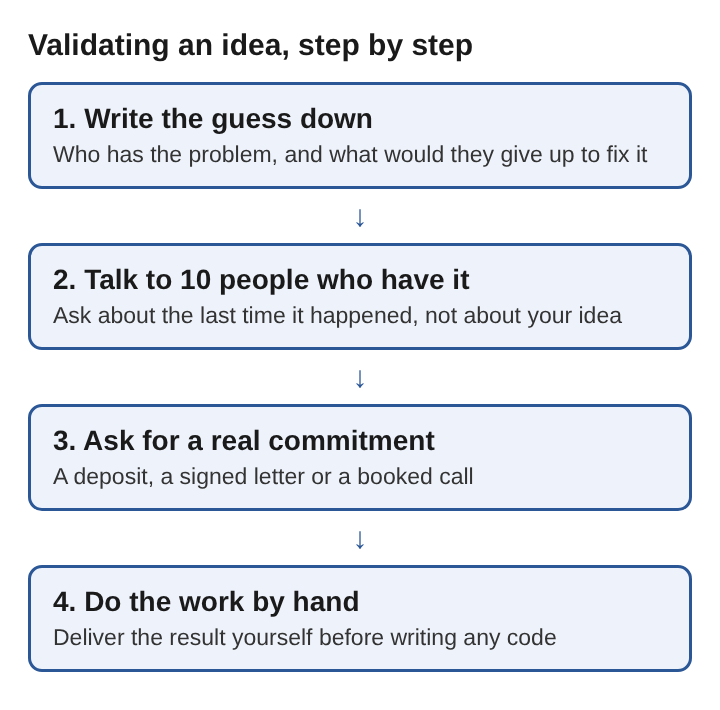
Write the guess down in one sentence
Before you talk to anyone, write your idea as a guess that could turn out false. A good shape is: "[Who] struggles with [what problem], and today they handle it by [current workaround]."
The last part matters most. If people have a painful problem, they are already doing something about it: a spreadsheet, a part-time helper, a stack of sticky notes, hours of their own evenings. A problem with no workaround is often a problem nobody minds.
Then write what would prove you wrong. For example: "If fewer than 3 of 10 people I talk to have tried to solve this in the last month, the problem is not painful enough." Setting the bar before you start keeps you honest later, when you badly want the answer to be yes.
Talk to people about their past, not your idea
The most useful thing you can do is talk to about 10 people who should have the problem. The hard part is how you ask.
If you describe your idea and ask "Would you use this?", most people say yes to be kind. That answer is worth very little. Ask instead about what already happened:
- When was the last time this problem came up for you?
- What did you do about it?
- What did that cost you in time or money?
- What have you tried that did not work?
Listen for specifics. "I lost a whole Saturday on it last month" is a signal. "Yeah, that sounds handy" is not. If people struggle to remember the last time the problem happened, it probably does not happen often enough to build a business on.
Finding these people is itself part of the work. In his essay Do Things That Don't Scale, Paul Graham wrote that the most common unscalable thing founders have to do at the start is recruit users by hand, one at a time, and he gave Airbnb as a classic example. The conversations you have now are the start of that.
Ask for a commitment, not a compliment
Kind words cost nothing. A commitment costs the other person something, which is why it tells you far more. Once a conversation shows the problem is real, ask for one small, real step:
- A deposit toward the first version.
- A signed letter saying they want it when it is ready.
- A second meeting with their manager or partner.
- An hour of their time to try a rough version.
Each of these means giving up money, time or a little reputation. People who will not give any of them are telling you something, however warm the conversation felt. People who do are your first early adopters. The Wikipedia page on minimum viable products notes that early versions usually go to just such people first, because they are more forgiving and more likely to give feedback.
Deliver the result by hand first
You can often deliver the outcome your product promises without the product. You do the work yourself, slowly and by hand, and the customer gets the result.
The lean startup page gives an early example. Nick Swinmurn wanted to know whether people would order shoes online. Instead of building a website and a large database of footwear, he photographed the stock in local shoe stores and posted the photos online. When someone placed an order, he got the pair from the store and shipped it himself. The demand turned out to be real, and only then did it make sense to build more.
Paul Graham makes a related point in the same essay: a startup can begin by doing work for a single user, close to what a consultant does when building something for one client. Doing it by hand shows you exactly which steps matter, which ones customers never notice, and what the product truly needs to do.
A worked example: an AI tool for restaurant menus
Say your idea is an AI tool that rewrites restaurant menus so dishes sound more appealing and list allergens clearly.
The guess: "Owners of small restaurants struggle to keep menus clear and up to date, and today they handle it by editing a document themselves a few times a year." The bar: if fewer than 3 of 10 owners have changed their menu in the last two months and found it a chore, stop.
The conversations: you visit 10 local restaurants in quiet hours. You ask when they last changed the menu, who did it and how long it took. Six changed it recently. Four of them mention allergen questions from customers as a real headache. Two say the menu is fine and they never think about it.
The commitment: you offer those four owners a rewritten menu within a week, for a small deposit. Two agree.
By hand: you rewrite both menus yourself, using a general AI chat tool and your own judgment, and you note every step. One owner asks for a second version for their lunch menu. The other prints it and asks what else you can do.
You still have no product. But you now know the allergen part is what owners care about, that a quick turnaround matters, and that at least two people will part with money for the result. That is far more than a finished app with no users would have told you.
Frequently asked questions
How many people should you talk to before building?
About 10 people who should have the problem is a useful start. If the same pain comes up again and again in those talks, you have a signal; if answers are all over the place, the problem or the audience is not clear yet.
Is a survey enough to validate a business idea?
A survey can show how common a problem is, but it rarely shows how much people care. A conversation about the last time the problem came up, followed by a request for a real commitment, tells you much more.
What if people like the idea but will not commit?
Treat that as a no for now. Go back to the conversations and look for a narrower group of people for whom the problem is sharper, or a different part of the problem they would act on.
Can AI help with validation?
AI can help you draft interview questions, sum up your notes and do the work by hand faster. It cannot tell you whether real people want the result; only those people can.
What a validated idea looks like
A validated idea is not one that sounds good to friends. It is a short written guess, a handful of conversations about real past problems, at least a few people who gave up money or time to get a fix, and a result you delivered yourself that someone wanted again. When you have those four things, building stops being a bet on a guess. It becomes the next step for people who are already waiting for it.