If you want to know how to start a stoic journal, the short answer is this: one notebook, two short sessions a day, and a handful of questions the Stoics asked themselves around two thousand years ago. You write a few lines in the morning to decide how you want to act. You write a few lines at night to check how it went. Most of the value comes from doing this often, not from writing well. Some people follow a ready-made structure to start. How to Find Your Meaning offers short lessons on Stoic philosophy, healthy habits and the story of who you are, and builds its daily practice around that same morning and evening shape.
What a Stoic Journal Is and Why the Practice Has Lasted
A Stoic journal is a written record of how you used your judgment each day. It is not a diary of events. The question is never only "what happened?" but "how did you respond, and was that response wise, fair, brave and measured?"
The best-known model is the Meditations of Marcus Aurelius. He was a Roman emperor, and he wrote notes to and for himself, to keep the Stoic doctrines he wanted to live by close at hand. They were a tool for his own moral improvement, not a book for readers. That matters for your own journal: the page is for you, so it can be blunt, repetitive and unpolished.
Seneca described a nightly habit of going back over his day, a method he credited to the philosopher Sextius. He describes the evening self-examination in his work On Anger. The practice lasted because it is small, private and repeatable. You need no teacher and no special setting.
How to Start a Stoic Journal With Very Little
You need less than you think.
- A place to write. A paper notebook, a notes app or a single text file all work. Pick the one you will actually open.
- A fixed time. Tie the morning entry to something you already do, such as making coffee. Tie the evening entry to brushing your teeth.
- A small set of prompts. Three or four questions you reuse. Variety is not the goal. Honest answers are.
- A short reading, if you want one. A paragraph from Epictetus, Marcus Aurelius or Seneca gives you something to react to on days when your mind is blank.
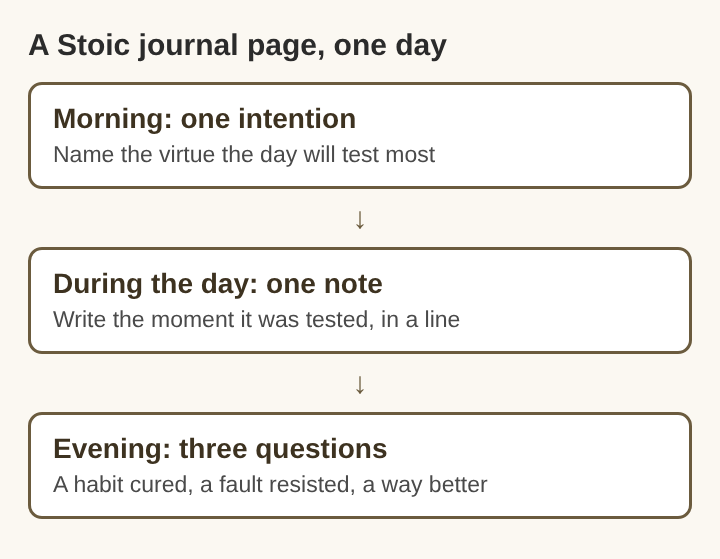
Keep the first week tiny. Five minutes in the morning and five at night is enough. If you skip a day, write the next one anyway and do not try to catch up.
Morning Stoic Journal Prompts for Setting Intentions
The morning entry looks ahead. You name what is likely to happen and decide in advance how you want to meet it. A good way to frame it is through the four Stoic virtues: wisdom, justice, courage and temperance. Choose one virtue per day and write with it in mind.
Useful morning prompts:
- What is the hardest thing on your schedule today, and which virtue does it call for?
- Who are you likely to find difficult, and how do you want to treat them anyway?
- What one small thing can you do today that matches the person you want to be?
- What might go wrong, and what would a calm response look like?
Here is a worked example. Say you have a meeting where a colleague often interrupts you. Your morning entry might read: "Virtue for today: courage. In the 2 p.m. meeting, if cut off, say once, calmly, that the point is not finished yet. No sulking afterwards." That is three short lines. It names the situation, the virtue and the exact action.
Some people add a short passage to read before writing. A daily practice of this kind can pair a morning question built on one of the four virtues with a passage from Epictetus, Marcus Aurelius or Seneca and one thing to try that day. The shape is worth copying even on paper: one question, one reading, one action.
Evening Stoic Journal Prompts for Reflecting on the Day
The evening entry looks back. Seneca's version, taken from Sextius, rests on three questions. In plain words: what bad habit did you deal with today, what fault did you resist, and in what way are you better than yesterday? There is a longer treatment of them in Seneca's three questions for the end of the day.
Other evening prompts that work well:
- Did you act on this morning's intention? If not, what got in the way?
- Where did you react before you thought?
- What did you do well that you want to repeat?
- What would you do differently if the same moment came again tomorrow?
Back to the meeting. Your evening entry might say: "Interrupted twice. The first time, silence. The second time, asked to finish, and it worked. The silence came from wanting to avoid tension. Tomorrow: speak up the first time." Notice the tone. It is factual, not harsh. Seneca's method was to look at the day plainly and then let it go, not to punish yourself.
Using the Dichotomy of Control on the Page
Epictetus taught that some things are up to you and some are not, an idea now called the dichotomy of control. Your judgments, choices and efforts are yours. Other people's opinions, the weather, your reputation and most outcomes are not. The Stanford entry on Epictetus names volition (prohairesis), your capacity to choose how you meet what happens, as one of the two central ideas he taught.
A journal makes this split visible. When something is bothering you, draw a line down the middle of the page. On the left, list the parts you control. On the right, list the parts you do not. Then write one sentence about what you will do with the left column, and one sentence accepting the right column.
For the meeting example, the left column might hold: how you phrase your point, whether you prepare, how you react to being cut off. The right column holds: whether your colleague changes, what the manager thinks, how the decision lands. Most worry lives in the right column. Seeing it written down often shrinks it. For more on the idea itself, see the dichotomy of control in Stoic philosophy.
Building a Stoic Journal Habit That Lasts
Most journals die in the second or third week. A few things help them survive.
- Lower the bar. One sentence counts as an entry. On a bad day, write "Virtue: patience" in the morning and "Partly" at night. That keeps the chain going.
- Reuse the same prompts. Repetition lets you compare days. You start to see patterns, such as losing patience every time you are hungry.
- Read back once a week. Spend ten minutes going over the past seven entries. Look for the habit that keeps showing up in Seneca's first question.
- Keep it private. Writing for an imagined reader makes entries vague. Marcus Aurelius wrote the Meditations for himself, and his notes are blunt because of it.
- Connect it to your body, too. Sleep, food and movement shape your mood and your patience. A line about how you slept helps explain a short-tempered day.
If you prefer a structured format, How to Find Your Meaning lets learners keep notes and answer questions as they go, and its health lessons draw on sources such as the WHO, the Smithsonian and Our World in Data. Whatever format you choose, the habit matters more than the tool.
Frequently asked questions
How long should a Stoic journal entry be?
A few sentences is enough for most days. Five minutes in the morning and five at night is a realistic starting point. Length matters far less than writing on most days.
What should a beginner write in a Stoic journal?
Start with one morning question about which virtue the day calls for, and Seneca's three evening questions about habits, faults and progress. Add a short passage from a Stoic author when you want something to respond to.
Is a digital Stoic journal as useful as a paper one?
Yes, if you open it every day. Paper can feel slower and more deliberate, while a phone is always nearby. Pick the one with the least friction for you.
How is a Stoic journal different from a gratitude journal?
A gratitude journal mainly lists good things. A Stoic journal looks at your own judgments and actions, asks what was in your control, and checks your conduct against the virtues. Gratitude can appear in it, but it is not the main purpose.
How a Stoic Journal Supports Finding Meaning in Daily Life
Meaning rarely arrives as one big answer. It builds up from small choices that match what you value. A Stoic journal makes those choices visible. Each morning you say who you want to be today. Each night you see whether you were that person, and where you fell short.
Over months, the entries turn into a record of your character. You see which virtues come easily and which you avoid. You notice the people and situations that pull you off course. You also see real progress, which is easy to miss without a written record. The Stoics held that virtue is the only true good, and enough on its own for a good life, as the Internet Encyclopedia of Philosophy entry on Stoicism sets out. A journal is where that idea stops being abstract and becomes something you check, line by line, every day.
It also keeps time in view. Writing each evening reminds you that this day is finished and will not return. That is not meant to be gloomy. It is a reason to use tomorrow's morning entry well.