Who was Epictetus and what did he teach? He was a Greek philosopher who was born into slavery, gained his freedom, and ran a school where he taught one hard idea: some things are up to you and most things are not, and your peace depends on knowing which is which. His lessons on control, judgment and duty still shape how people read Stoicism. If you want to bring these ideas into your own days, a set of short lessons on Stoic philosophy, healthy habits and the story of who you are pairs reading with a daily Stoic practice that includes passages from Epictetus.
Who was Epictetus and what did he teach? From slavery in Rome to a school in Nicopolis
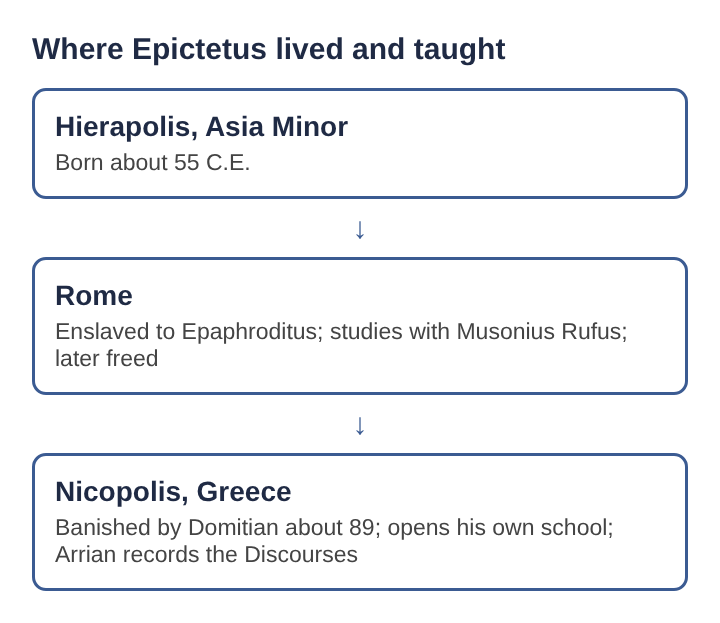
Epictetus was born in about 55 CE in Hierapolis, a town in Phrygia, in what is now south-western Turkey. As a boy he came to Rome as a slave, owned by Epaphroditus, a wealthy freedman who served the emperor Nero. Ancient sources say Epictetus was lame, and they differ on the cause.
While still enslaved, he was allowed to study with the Stoic teacher Musonius Rufus. At some point he was freed, and he began to teach philosophy in Rome himself. In about 89 CE, the emperor Domitian banished philosophers from the city. Epictetus moved to Nicopolis, in northwestern Greece, and opened a school there. The school gained a good name and drew many upper-class Romans. He taught there until his death, around 135 CE. The Stanford Encyclopedia of Philosophy entry on Epictetus covers these details, and the Internet Encyclopedia of Philosophy entry on Epictetus notes how few ancient references there are.
That life matters for his teaching. A man who had no legal control over his own body spent his career explaining what no one can take from you.
How the teachings of Epictetus survived in the Discourses and the Handbook
Epictetus wrote nothing for publication. His teaching was spoken, in a classroom, often in sharp exchanges with students, and the Internet Encyclopedia of Philosophy notes that some scholars question even this. What you can read today comes from Arrian, one of his students, who also wrote history.
Arrian produced two works. The first is the Discourses, records of exchanges between Epictetus and his students. Four books survive, though an ancient scholar reports that there were once eight. They are lively and blunt. Epictetus mocks, questions and pushes his students to stop talking about philosophy and start living it.
The second is the Enchiridion, usually translated as the Handbook. It is a short abstract of the Discourses, focused on the main themes of his ethics. Many readers meet Epictetus here first.
What Epictetus taught about what is up to you and what is not
The Handbook opens with the idea Epictetus is best known for. Some things are up to you: your judgments, your choices, what you want and what you try to avoid. Other things are not up to you: your body, your possessions, your reputation, the positions you hold, and what other people do.
He argued that most suffering comes from mixing these up. If you set your heart on something outside your control, you hand your peace to chance. If you put your effort into your own choices, nothing outside can defeat you. Modern readers call this the dichotomy of control, and the Stanford Encyclopedia of Philosophy entry on Epictetus sets out how it anchors his ethics.
Take a concrete case. You apply for a job. Whether you get it is not up to you. The hiring manager decides. What is up to you: how well you prepare, how honestly you answer, and how you respond to the result. Epictetus would tell you to put all your care into those parts and hold the outcome loosely. If you do, a rejection is a fact to deal with, not a judgment on your worth.
Epictetus had a name for the part of you that chooses: prohairesis, which the Stanford entry renders as "volition." For him, this faculty is the real self. Your body can be chained. Your choice cannot be forced.
Epictetus on impressions, judgments and freedom from disturbance
The second core idea is about impressions. An impression is the way something first appears to you. Someone cuts in front of you in traffic, and the impression arrives at once: that driver meant to insult you.
Epictetus taught that the impression is not the problem. The problem is agreeing with it without checking. In Stoic terms, you give it your assent, and the Internet Encyclopedia of Philosophy calls the training of it the discipline of assent. He argued that people are disturbed not by events but by their judgments about events, a point the Handbook makes early and plainly. The car in front of you is just a car. The anger comes from the judgment you add.
So his advice is to pause and question an impression before you accept it. Ask: is this about something up to you or not? Is your judgment accurate, or has a story been added? The Internet Encyclopedia of Philosophy treats making proper use of impressions as a central part of his teaching.
The goal is a calm the Greeks called ataraxia, freedom from disturbance. For Epictetus this was not numbness. It was the steady mind of someone who knows where their responsibility starts and ends.
Epictetus on roles, duties and living by reason
Epictetus did not teach people to withdraw from life. He taught that you find your duties by looking at your roles. You are a child of your parents, perhaps a sibling, a friend, a neighbor, a citizen. Each role carries obligations.
He pressed this point hard. If your brother treats you badly, you are still his brother, and your duty is to act as a good brother. His behavior is up to him. Yours is up to you. You do not get to drop your part because someone else dropped theirs.
Behind all of this sits reason. Stoics held that humans share in reason, and that living well means living in line with it. For Epictetus, that meant acting with justice, courage, self-control and good judgment in every role you hold. Those four are the four Stoic virtues, and he treated them as the only true goods. Wealth, health and status are things you can use well or badly, but they do not make you good.
Scholars often describe his teaching as having three areas of training: desire (wanting only what is up to you), action (doing your duties well) and assent (judging impressions correctly). The Internet Encyclopedia of Philosophy sets out these three topoi.
Daily habits drawn from the teachings of Epictetus
Epictetus cared about practice more than theory. The Discourses read as training sessions more than lectures, as the Internet Encyclopedia of Philosophy describes them. Here are habits built from his lessons.
- Sort the morning's worries. When you wake up, list what is on your mind. Mark each item as up to you or not. Put your effort into the first group.
- Catch one impression a day. When you feel a jolt of anger or fear, name the impression. Ask what judgment you are adding to the plain fact.
- Name your roles. Before a hard conversation, ask which role you are in. Parent, colleague, friend. Then ask what that role asks of you here.
- Go over the day. At night, look back at what you chose and how you judged, and note one thing to do better tomorrow. Some readers use three questions for the end of the day.
A daily routine can hold these habits in place. How to Find Your Meaning sets out a morning question tied to one of the four virtues, a passage from Epictetus, Marcus Aurelius or Seneca with one thing to try that day, and an evening with Seneca's three questions, which Seneca took from Sextius. That structure matches what Epictetus asked of his students: read a little, then act on it.
Frequently asked questions
Was Epictetus really a slave?
Yes. He was enslaved in Rome by Epaphroditus, a freedman in Nero's service, and was later freed. He studied philosophy with Musonius Rufus while still enslaved.
Did Epictetus write any books himself?
No. His student Arrian recorded his teaching in the Discourses and summed it up in the Enchiridion, or Handbook. Everything known of his thought comes through Arrian.
How is Epictetus different from other Stoic thinkers?
Epictetus was a teacher speaking to students, so the record of his work is direct and focused on training, as the Internet Encyclopedia of Philosophy describes. He puts the split between what is up to you and what is not at the very center.
Where should a reader start with the teachings of Epictetus?
The Handbook is short and covers the main ideas, so most readers start there. The Discourses give the fuller arguments and the voice of the classroom.
What the life and teachings of Epictetus mean for finding meaning today
Epictetus offers a plain answer to a hard question: where does a good life come from? Not from luck, status or comfort, since he had little of any of them for much of his life. It comes from how you use your choices.
That answer gives meaning a stable place to stand. Your job, your health and other people's opinions can all change without warning. Your effort to act well in your roles, to judge clearly and to want only what is yours to want stays in your hands. A person who was once owned by another man taught that this inner freedom belongs to everyone. Each day gives you the chance to practice it, one impression and one choice at a time.