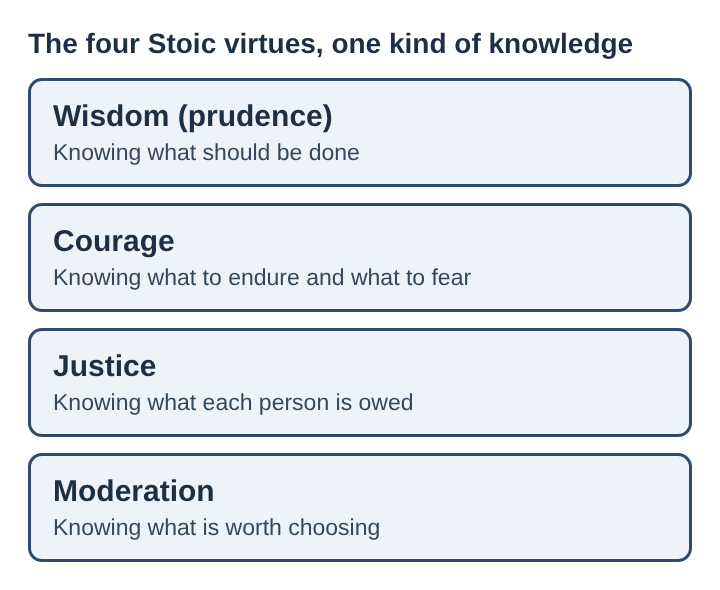
If you have asked what are the four Stoic virtues, the short answer is wisdom, courage, justice and moderation. The Stoics did not treat them as four separate habits to collect. They treated them as one kind of knowledge, aimed at four different parts of life: deciding, enduring, dealing with other people and handling what you want. Knowing that changes how you practice them.
Short lessons on Stoic philosophy and a daily practice built around these virtues can be found at How to Find Your Meaning, where each morning opens with a question about one of the four.
Where the four Stoic virtues come from
The list is older than Stoicism. According to the Wikipedia entry on the cardinal virtues, the four first appear in Plato's Republic, Book IV, where a good city is described as wise, brave, sober and just. Aristotle worked them out at length in the Nicomachean Ethics. The Stoics took the same four over, and the Roman writer Cicero later expanded on them.
What the Stoics added was a sharper claim about what a virtue is. That claim is the part that makes the Stoic version worth learning on its own terms.
Virtue as knowledge, not temperament
The Stanford Encyclopedia of Philosophy entry on Stoicism explains that the Stoics identified each virtue as a form of knowledge. Courage, for them, is the knowledge of what should be endured and what should be feared. It is not a feeling of boldness, and it is not a trait some people are born with.
This matters in practice. If courage were a mood, you could only wait for it. If it is knowledge, you can study it, check it and get better at it. A person who freezes before a hard conversation is not short of nerve so much as unclear about what is actually at stake.
The same entry notes a second Stoic claim: whoever has one virtue has them all. To know what is worth fearing, you must also know what is worth choosing and what should be done. The four are one understanding, seen from four sides.
What are the four Stoic virtues, one at a time
Wisdom
Wisdom, often called prudence or practical wisdom, is knowing what should be done. The Wikipedia entry describes it as the skill of telling the helpful from the harmful and seeing the right course in a given situation. Its opposite is folly. Wisdom is the virtue that steers the other three.
Courage
Courage is knowing what to endure and what to fear. For a Stoic, most of what people dread, such as embarrassment, loss of money or harsh criticism, is not worth fearing at all. Courage is seeing that clearly enough to act anyway.
Justice
Justice is knowing what you owe other people and acting on it. The Stoics gave this one wide reach: fairness, honesty and care toward others, including strangers. A wise person who treats others badly has not really understood what is good.
Moderation
Moderation, also translated as temperance or self-control, is knowing what is worth choosing. The Greek word, sophrosyne, can also mean sound-mindedness. It covers food, drink, spending and attention: wanting things in the right amount, for the right reasons.
Why the Stoics called virtue the only good
The boldest Stoic idea is that virtue is the only true good. The Stanford entry lays out their reasoning. Things like health, wealth, pleasure and reputation can help or harm depending on how they are used, so they are neither good nor bad in themselves. The Stoics called them indifferents.
Other schools disagreed. Plato's and Aristotle's followers held that virtue is needed for a good life but that external goods also count. The Stoics said virtue alone is enough for happiness, because it is the one thing fully in your power.
You do not have to accept the strong version to use it. Even as a working rule, it shifts the question you ask in a hard moment. Instead of asking how to protect your money or your image, you ask what a wise, brave, fair and moderate person would do here.
A worked example: one hard afternoon
Here is how the four virtues can guide a single ordinary situation. Suppose you lead a small team, and a colleague's mistake has cost a client. Your manager asks you, in front of others, what went wrong.
- Wisdom first. Before answering, ask what the situation actually calls for. The goal is to fix the problem and keep the client, not to win the moment.
- Courage next. The thing you fear is looking bad. The Stoic question is whether that is worth fearing. It is not; a clear, honest answer is what needs doing, even if it is uncomfortable.
- Then justice. You owe your colleague fairness. Describe what happened without blaming them in public, and take your share of the responsibility as their lead.
- Then moderation. Afterward you may want to vent, to snack through the evening or to replay the scene for hours. Moderation is choosing the right amount: one honest talk with the colleague, then rest.
Notice that none of the steps needed a special mood. Each one was a question about what is true and what matters. That is what the Stoics meant by calling virtue knowledge.
How to practice the four Stoic virtues each day
Because the virtues are knowledge, practice means asking and answering questions, then checking your answers against what you did.
- Morning: pick one virtue and ask where it will be needed today. A meeting may call for courage; a busy evening may call for moderation.
- During the day: when you feel pulled to react, pause and name which virtue the moment calls for.
- Evening: look back. Where did you act well, where did you fall short, and what would you do differently tomorrow?
Rotating one virtue per day keeps the practice small. Over a week, each of the four gets attention more than once, and you begin to see where they connect.
Frequently asked questions
Are the four Stoic virtues the same as the cardinal virtues?
Yes. The four cardinal virtues of wisdom, courage, justice and moderation came from Plato and Aristotle, and the Stoics adopted the same four, with their own claim that each is a form of knowledge.
Which Stoic virtue is the most important?
The Stoics held that the virtues cannot be separated: whoever has one has them all. Wisdom is often treated as the guide, because it is knowing what should be done.
Is temperance the same as moderation?
Yes. Temperance, moderation and self-control are all common translations of the Greek sophrosyne, which can also be rendered as sound-mindedness.
Do you need to believe virtue is the only good to practice Stoicism?
No. Many people use the idea as a working rule rather than a firm belief. Asking what a wise, brave, fair and moderate person would do is useful either way.
Living the four Stoic virtues as one
The four Stoic virtues are easy to list and hard to live, because each one asks you to see a situation clearly before you act. One of them is about deciding, one about enduring, one about other people and one about wanting. Treated as one kind of knowledge, they stop being four rules and become a single habit: in any moment, asking what is actually good, and doing it.