People who search what is stoicism and how do you practice it usually want two things: a plain definition, and something they can actually do tomorrow. Stoicism is an ancient Greek and Roman philosophy built on one claim: a good life comes from good character, and the only thing fully in your power is how you judge and respond to what happens. Practicing it means turning that claim into small acts you repeat in the morning, during the day and at night.
That daily structure is how some people now learn it. How to Find Your Meaning, for example, offers short lessons on Stoic philosophy, healthy habits and the story of who you are, paired with a daily Stoic practice meant to help learners live what they read. Its lessons come in three parts: Stoicism (Basic), Health (Intermediate) and You (Advanced).
What is Stoicism and how do you practice it? The core idea behind the ancient philosophy
The Stoics held that virtue is the only true good and vice the only true evil. Health, money, reputation and comfort are what they called "indifferents." You can prefer them and pursue them sensibly, but they do not make you good or bad. The Stanford Encyclopedia of Philosophy entry on Stoicism sets out this split between virtue and the indifferents, and it sits at the center of everything else the school taught.
This gives the philosophy its practical edge. If your character is the one thing that is truly yours, every situation becomes a chance to act well, whether the situation is good or bad. A lost contract and a won contract both ask the same question: how will you behave now? Practice is the habit of asking that question often enough that it becomes your first response.
Where Stoicism came from and why it still matters today
The school began in Athens around 300 BCE with Zeno of Citium, as the Stanford Encyclopedia notes. The name comes from the Stoa Poikile, the painted porch in Athens where the first Stoics met and taught, as the Internet Encyclopedia of Philosophy records. Most of what people read today comes from three later Roman writers. Seneca was a statesman and playwright who wrote letters and essays on how to live. Epictetus was born a slave, became a teacher, and had his lessons written down by a student. Marcus Aurelius was a Roman emperor whose private notebook survives as the Meditations.
Stoicism still matters because the problems it deals with have not changed. People still get angry at traffic, still fear what others think, still grieve, still chase status that does not satisfy. The Stoics wrote about these things directly and gave exercises for them, which is why their books read as practical advice rather than abstract theory.
The main Stoic principles: virtue, reason and living with nature
Stoic virtue has four parts: wisdom, courage, justice and temperance. Wisdom is knowing what is good, bad and neither. Courage is acting well in the face of fear or pain. Justice is treating others fairly and doing your part in the community. Temperance is self-control over desire. A fuller account of each, with ways to practice them, is in the four Stoic virtues and how to practice them.
Reason ties the virtues together. The Stoics believed that emotions follow from judgments. If you feel insulted, it is because you have judged that something bad has happened to you. Change the judgment and the feeling changes with it.
"Living in agreement with nature" is the school's summary of the good life. As the Internet Encyclopedia of Philosophy article on Stoicism explains, this meant living by reason, because reason is human nature, and accepting the larger order of events instead of fighting what cannot be changed. It does not mean living in the woods. It means acting as a rational, social person.
How to practice Stoicism in the morning: setting intentions and preparing for the day
Marcus Aurelius opens the second book of the Meditations by reminding himself that he will meet rude, ungrateful and difficult people that day, and that none of them can harm his character. The point is not pessimism. It is preparation, so that the hard moment does not catch you off guard.
A worked example. You have a tense meeting at ten. Before you open your email, ask one question: which virtue will this meeting need? Perhaps courage, to raise a problem nobody wants to hear. Perhaps justice, to give a colleague fair credit. Write one sentence: "At ten, say the problem clearly and once." That sentence is your intention.
The daily practice in How to Find Your Meaning is built the same way. The morning starts with a question tied to one of the four virtues, followed by a passage from Epictetus, Marcus Aurelius or Seneca with one thing to try that day.
How to practice Stoicism during the day: pausing before reacting and focusing on what you can control
Epictetus begins his Handbook by splitting the world into what is up to you and what is not. Your judgments, choices and efforts are up to you. Other people's actions, the weather, your reputation and the outcome of events are not. The Stanford Encyclopedia entry on Epictetus treats this split as the base of his teaching, and the dichotomy of control is the name most people know it by.
Epictetus also taught that people are upset less by events than by their judgments about events. So the daytime practice is a pause. It has four steps:
- Notice the first impression. A colleague sends a sharp email. Your first impression is "This is an attack."
- Do not agree with it yet. The Stoics called agreement "assent." You can hold the impression without accepting it as true.
- Sort it. The email and its tone are not up to you. Your reply is.
- Choose the reply that fits a virtue. A short, fair answer that addresses the actual question is justice and temperance in action.
This takes seconds once it is a habit. At first it takes effort, and you will often notice the impression only after you have already reacted. That is still useful. Noticing late is the step before noticing on time.
How to practice Stoicism at night: reflection and Stoic journaling
In his essay On Anger, Seneca describes a habit he took from the philosopher Sextius. At the end of each day, once the lamp was out, he went over his own conduct and asked himself three questions: which bad habit he had cured that day, which fault he had resisted, and in what way he had become better. The Stanford Encyclopedia entry on Seneca covers this work and his ethics more broadly, and Seneca's three questions for the end of the day goes through each question in detail.
Written down, the evening practice takes about as long as brushing your teeth. A sample entry after the tense meeting might read:
- Habit worked on: interrupting. Let the other person finish twice.
- Fault resisted: the urge to send a sarcastic reply to the email.
- Better in: raised the problem at ten, clearly, once.
Seneca's tone matters here. He was strict but not cruel with himself. The aim is to see the day clearly and plan the next one, not to punish yourself.
Common misunderstandings about Stoicism and emotions
The biggest one is that a Stoic feels nothing. The lowercase word "stoic" now means someone who hides pain, but the philosophy is different. The Stoics wanted to be rid of the passions, which they defined as feelings built on false judgments: fear that treats a loss of status as a disaster, or craving that treats money as the highest good. They kept, and valued, what they called good feelings: joy in acting well, sensible caution, and goodwill toward others.
A second misunderstanding is that Stoicism means passive acceptance. Seneca served in government and Marcus ran an empire. Accepting what is outside your control frees your attention for what is inside it, and that often means more action, not less.
A third is that Stoicism is self-centered. Justice is one of the four virtues, and the Stoics saw every person as part of one human community. A practice that makes you calmer but less fair has missed the point.
Frequently asked questions
Is Stoicism a religion?
No. Stoicism is a philosophy. The ancient Stoics did believe the universe is ordered by reason, which they sometimes called God, but the school had no worship or clergy, and people of many faiths and none practice it today.
Does practicing Stoicism mean suppressing emotions?
No. The practice works on the judgments that produce destructive emotions, not on hiding feelings after they arise. The Stoics kept good feelings such as joy and goodwill.
How long does it take to build a Stoic habit?
There is no fixed number of days, and it differs from person to person. Short daily repetition, one morning question, one pause during the day and three evening questions, matters more than long sessions done rarely.
Can Stoicism help with finding meaning in life?
It can give a clear answer to what matters: acting with wisdom, courage, justice and temperance in whatever role you hold. Many people find that this turns ordinary days, including hard ones, into material for a life they can stand behind.
Stoicism as a daily practice for a meaningful life
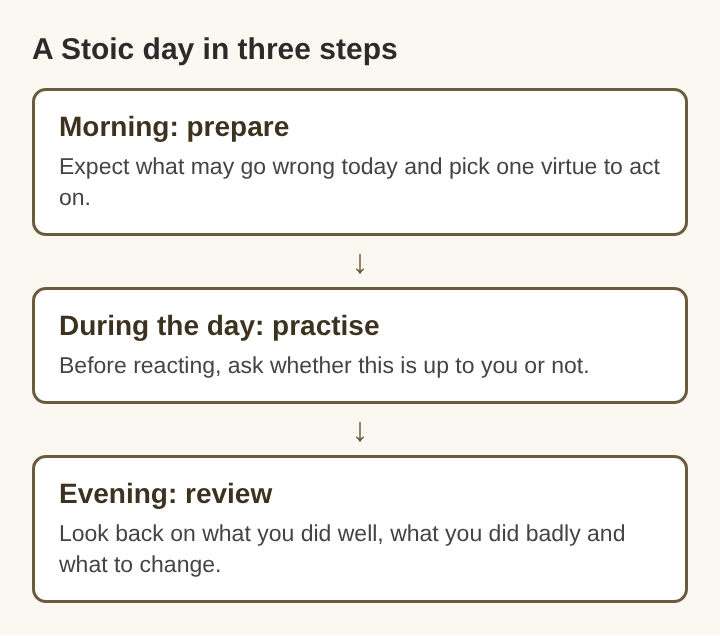
Stoicism is not a set of quotes to admire. It is a short loop you run every day. In the morning, you choose a virtue for what is coming. During the day, you pause, sort what is up to you from what is not, and act on your part. At night, you go over what you did and what you will do differently.
Meaning, in Stoic terms, does not wait on outcomes. It comes from the quality of your choices, and you make those choices every day, in small moments: a reply to an email, a fair word in a meeting, a few honest lines written before sleep. Repeat the loop long enough and the questions start to ask themselves.