Do you need to code to build an AI startup? For most first versions, no. You need to know which problem you are solving, who has it, and how to put a working version in front of them. AI Entrepreneur is a set of short lessons on becoming an entrepreneur in the age of AI. It covers the history that led here, how modern AI works, and how to build, launch and grow a business with it.
Do You Need to Code to Build an AI Startup?
It depends on what you sell. Two quite different businesses both get called an AI startup.
- A business that uses AI. You take an existing AI model, point it at a real problem, and wrap it in a service or product people want.
- A business that builds AI. You train new models or do original research. That is a different job, with a different answer.
For the first kind, code is one way to build the product, not a condition for starting.
Paul Graham's essay Do Things That Don't Scale says that with a small number of users you can sometimes get away with doing by hand what you plan to automate later, which lets you launch faster, and that most startups have to recruit their first users manually. That applies here. You can run the first version of an AI service with a chat window, a spreadsheet and email. A minimum viable product is a version with just enough features to be usable by early customers, who can then give feedback. Writing code is not needed to get that feedback.
How AI Went From Research Labs to Small Business Tools
Alan Turing asked whether machines could think, a question covered in what Alan Turing said about thinking machines. Later came the AI winters, periods of reduced funding and interest in AI research. They are covered in what the AI winters were.
Large language models changed how you give an AI system its task. The Wikipedia page on them describes few-shot prompting: in 2020 OpenAI researchers showed that their GPT-3 model could work out what format to use from a few question-and-answer examples placed in the input, with no fine-tuning. For a founder, the interface is the point. You can direct a capable model with written instructions and examples instead of a program.
What No-Code AI Tools Can Now Do for a Startup
No-code tools let you create software through a graphical interface and configuration instead of programming. Combined with AI models, they can cover a lot of early startup work:
- A landing page and a form that collects interest from possible customers.
- A spreadsheet that holds your customer list and what each customer asked for.
- An automation that moves information from one app to another, so a form entry becomes a row and an email.
- A chatbot that answers common questions from text you supply.
- Drafting, summarizing, sorting and rewriting text, which is the core of many AI services.
Here is a worked example. Say you want to sell a weekly summary of customer feedback to small restaurants. Week one, you ask five owners to send you their feedback messages. You paste them into an AI chat, ask for the three most common complaints and the three most common compliments, check the answer against the messages, and email it. No code is involved.
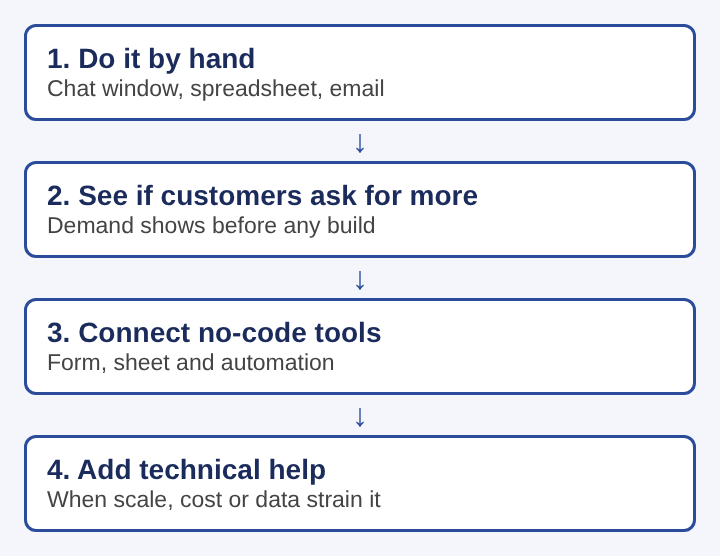
If owners keep opening the email and ask for more, you have evidence of demand. Then you can connect a form to a spreadsheet and an automation so the summary goes out without you pasting anything. You have a product, customers and a clear picture of what to build next, and you still have not written a line of code.
Where Coding Still Matters in an AI Business
No-code has limits, and it is better to know them before you hit them.
- Scale and cost. A manual or no-code setup that works for a few customers can become slow or expensive with many. Someone has to look at how the system is built.
- Reliability. AI models can give wrong or inconsistent answers. When a mistake is costly, you need checks, fallbacks and logging, and those are usually built in code.
- Security and private data. If your product handles personal or sensitive information, how that data is stored and who can see it matters a great deal.
- Custom connections. Some tools and systems your customers use will not connect to a no-code platform.
- Being hard to copy. If your product is only a prompt and a form, a competitor can rebuild it in an afternoon. Lasting advantage has to come from something a competitor cannot rebuild so quickly.
None of this means you must code on day one. It means that at some point a technical person, you or someone else, will probably become useful.
How Lessons Can Teach Building a Business With AI
AI Entrepreneur arranges its 12 courses in three parts: the history that led to modern AI, building your first business, and growing a company. The courses follow syllabi from Y Combinator, Stanford, MIT, DeepLearning.AI and Zero To Mastery.
A lesson takes about 9 minutes to read, with diagrams and short activities, and ends with questions. Questions from finished lessons come back later so they stick. Cards set out where people disagree. Lesson 1 is "Thinking Machines: Turing to the AI Winters", which connects directly to the history above. Taking lessons does not promise income, customers or any particular result. It gives you the vocabulary and the background to make your own decisions.
Skills a Founder Needs Besides Programming
If code is optional at the start, these are not:
- Finding a real problem. Paul Graham's essay How to Get Startup Ideas says the way to get startup ideas is not to try to think of them but to look for problems, preferably problems you have yourself, and that ideas which grow out of the founders' own experience, which Y Combinator calls organic, are how most of the most successful startups began.
- Talking to customers. Ask what they do now, what it costs them in time or money, and what they have already tried. Listen more than you pitch.
- Writing clear instructions. Working with AI is mostly the skill of saying exactly what you want, with examples of good and bad output.
- Checking the output. AI can sound confident and be wrong. Read what it produces, compare it with the source, and keep a short list of the mistakes you see most often.
- Basic arithmetic about the business. Know what each customer costs you to serve, including the cost of the AI itself and your own time, and what they give you in return.
- Selling. A product nobody hears about stays small, however well it works.
Hiring or Partnering With Technical People
When the manual version works and demand is clear, you are in a strong position to bring in someone technical. You are not asking them to build on a hunch. You can show customers, a working process and a list of what breaks.
A few habits make this go better:
- Start with a small, defined piece of work instead of a vague plan to build everything. For example: "Replace the step where I paste feedback into a chat window."
- Bring your process, not only your idea. Show the example outputs, the mistakes you caught and the questions customers asked.
- Ask for plain explanations. You do not need to read the code, but you should understand what the system does, what it costs to run and what could go wrong.
- Settle ownership early. Agree in writing who owns the work, the data and the accounts it runs on.
A technical partner is a decision about timing and fit. Some founders learn enough to build parts themselves. Others never do and still run a healthy business. What matters is that you understand the product well enough to direct the work and judge the results.
Frequently asked questions
Can a non-technical person start an AI business?
Yes, if the business uses existing AI models rather than building new ones. A first version can often run on a chat window, a spreadsheet and a simple form, which lets you find out whether customers want it before building anything.
When does a founder need a developer?
Usually when the manual or no-code version works but starts to strain: more customers, costly mistakes, sensitive data, or tools that will not connect. Having a working process and real customers makes that hire much easier to scope.
Can AI write the code for a startup?
AI can draft code, and many founders use it that way. The output still needs checking, and someone has to understand what it does, especially around security and private data.
Is learning to code still useful for a founder?
Yes, though it is optional. Even basic knowledge helps you judge what is easy or hard to build, talk clearly with technical people, and spot when a quote or a timeline does not make sense.
What is the difference between using AI and building AI?
Using AI means applying existing models to a customer problem. Building AI means training or researching new models, which requires deep technical skill and usually a technical co-founder.