What were the AI winters? They were two long stretches, roughly 1974 to 1980 and 1987 to 2000, when money and belief in artificial intelligence drained away after the field had promised too much. The record of those years is useful to anyone who builds on AI today, because it shows how a promising approach can lose its funders without ever being disproved.
The history is the opening of the course "The Road to the Age of AI" in AI Entrepreneur, whose first lesson is titled "Thinking Machines: Turing to the AI Winters". It sits in the first of the site's three parts, which covers the history that led to modern AI before it turns to building.
What were the AI winters and when did they happen
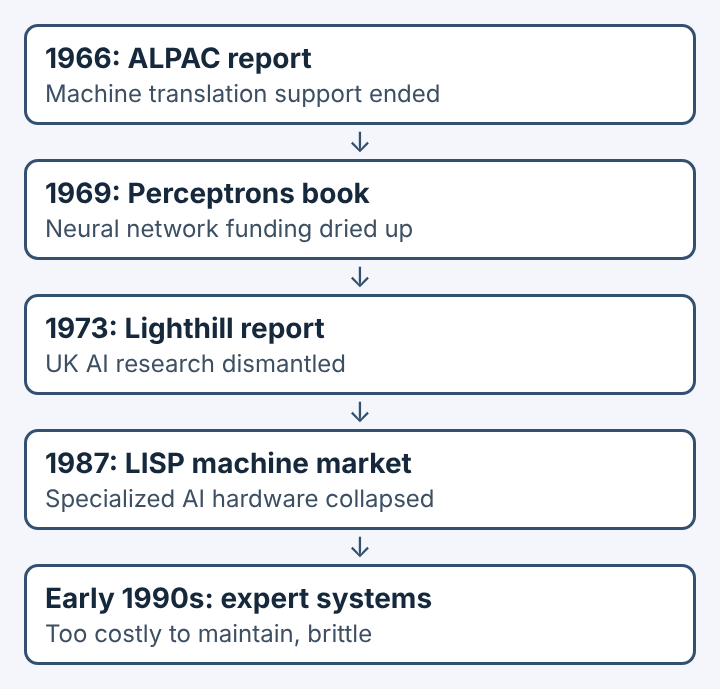
According to the Wikipedia entry on AI winters, there were two major winters. The first lasted from about 1974 to 1980 and the second from about 1987 to 2000. Between and around them came several smaller episodes: the failure of machine translation in 1966, the criticism of perceptrons in 1969, a collapse in the market for specialized AI computers in 1987 and the abandonment of many expert systems in the 1990s.
A winter, in this sense, is not a pause in thinking. It is a drop in funding, hiring and public belief. Researchers kept working in many places. What changed was who was willing to pay for it and how the field described itself.
Where the name came from
The phrase first appeared in 1984, as the subject of a public debate at the annual meeting of the AAAI, the American Association of Artificial Intelligence. Roger Schank and Marvin Minsky, two leading researchers who had lived through the 1970s winter, warned the business community that enthusiasm for AI had spiraled out of control in the 1980s and that disappointment would certainly follow.
So the name was a forecast before it was a label. The market for specialized AI hardware then collapsed in 1987, three years after their warning.
The first winter: translation, perceptrons and the Lighthill report
Three events from the 1960s and early 1970s mark the first winter. In 1966 the Automatic Language Processing Advisory Committee, ALPAC, reported that machine translation was more expensive, less accurate and slower than human translation. After spending about 20 million dollars, the National Research Council ended all support.
In 1969 Marvin Minsky and Seymour Papert published Perceptrons), a book about the limits of a simple kind of neural network. The criticism did not apply to networks with several layers, but nobody in the 1960s knew how to train one, and backpropagation was still years away. Funding for neural network work was hard to find through the 1970s and early 1980s, until work by John Hopfield, David Rumelhart and others revived interest in the middle of the 1980s.
In 1973 the UK Parliament asked Sir James Lighthill to evaluate AI research in Britain. The Lighthill report criticized the failure of AI to achieve its grandiose objectives and named the problem of combinatorial explosion, also called intractability. It led to the dismantling of AI research in the UK. The work survived in only a few universities until Alvey, a government project, funded AI again from 1983 with 350 million pounds, in response to Japan's Fifth Generation project.
Why funders pulled back from basic research in the 1970s
Funding rules mattered as much as the failures. The Mansfield Amendment of 1969 required DARPA, the United States defense research agency, to fund mission-oriented direct research rather than basic undirected research. Researchers now had to show that their work would soon produce useful military technology, and AI proposals were held to a very demanding bar.
The lesson for a founder is plain. When a field's income depends on one funder with a fixed purpose, a change in that purpose can end the work whatever the results are.
The second winter: expert systems and LISP machines
The 1980s boom was built on expert systems. An expert system has a knowledge base of facts and rules and an inference engine that applies the rules to the known facts to deduce new ones. They were the first commercial systems to use a knowledge-based design. The best-known, XCON at Digital Equipment Corporation, was estimated to have saved the company 40 million dollars over six years, and companies around the world began to build their own.
Then the supporting market broke. LISP machines were general-purpose computers built to run the Lisp language efficiently, and in 1987 the market for this specialized AI hardware collapsed. General workstations from companies such as Sun Microsystems offered a powerful alternative, and by the early 1990s most commercial LISP companies had failed.
The software had its own problem. By the early 1990s the earliest successful expert systems proved too expensive to maintain. They were difficult to update, could not learn and were brittle, which means they could make grotesque mistakes when given unusual inputs. Japan's Fifth Generation project, which set aside 850 million dollars in 1981, had not met its goals by 1991.
Was there really a winter? A historian's objection
The story is not told the same way by everyone. The historian Thomas Haigh argues that there was no AI winter, because through the 1970s the number of AI researchers kept growing and the rate of discovery sped up. On his account the funding cuts of 1974 touched only the largest laboratories and projects, a very small share of people in the field by 1975.
Both views can be held at once. A small number of big programs lost their money, and the field as a whole kept growing. The word winter fits the mood of funders and the press better than it fits the daily work of every researcher.
A worked example: reading a promise with the winters in mind
This example is invented. A founder is offered a tool built on a promising AI approach and is asked to base a business on it. The record gives three questions to put to it.
- What does the demo stand for? Machine translation and the Fifth Generation project both promised far more than they delivered. Ask what the tool does on unusual inputs, not on the demo's inputs, since brittleness was the fault of the expert systems.
- Who pays, and for what purpose? The 1969 funding rule shows how a single funder can change the terms. A business with many customers is less exposed than a lab with one sponsor.
- What does it cost to keep it working? XCON saved a great deal, and still the early expert systems cost too much to maintain. Count the upkeep of updating and correcting the tool, not only the build.
None of these questions says the tool will fail. They say where earlier tools failed, so a founder can look at those places first.
Frequently asked questions
How many AI winters were there?
Two major ones, from about 1974 to 1980 and from about 1987 to 2000, plus several smaller episodes such as the end of machine translation funding in 1966.
What caused the first AI winter?
Several things together: the ALPAC report on machine translation, the criticism of perceptrons, the Lighthill report in the UK and a change in DARPA's funding rules.
What is an expert system?
It is a program with a knowledge base of facts and rules and an inference engine that applies those rules to deduce new facts. Expert systems drove the 1980s boom and proved costly to maintain.
Is AI in a winter now?
The Wikipedia entry says enthusiasm has generally increased since the early 1990s, and that interest in machine learning brought a dramatic rise in funding from about 2012, leading to the present AI boom.
Who named the AI winter?
The phrase first appeared in 1984, in a public debate at the AAAI meeting, where Roger Schank and Marvin Minsky warned that disappointment would follow the enthusiasm of the 1980s.
What the AI winters left behind
The winters did not end the field. Through the 2000s many researchers deliberately called their work by other names, such as machine learning or intelligent systems, to keep distance from AI's poor reputation. From about 2012 interest in machine learning grew sharply and funding followed.
What stayed from the two winters is a pattern. A small result is announced as a large promise, money arrives faster than the technology can use it, a hardware or funding base is pulled away and belief falls further than the facts justify. Funding for neural networks had dried up after 1969, and interest in them revived in the middle of the 1980s.