People still ask what did Alan Turing say about thinking machines, because his answer was stranger and more practical than the usual summary. He did not claim that machines are conscious. He called the question "can machines think?" too vague to argue about, and proposed a game about behavior to take its place. That shift still shapes how people judge AI tools when they build a business. AI Entrepreneur, a set of short lessons on becoming an entrepreneur in the age of AI, opens with this same history, because the ideas behind today's tools start with Turing.
What did Alan Turing say about thinking machines?
Turing was a British mathematician and computer scientist who lived from 1912 to 1954. You can read about his life and work on the Alan Turing page on Wikipedia.
His central claim about thinking machines came in 1950. As the Stanford Encyclopedia of Philosophy entry on Turing's proposal records, he held that the question whether machines can think is itself "too meaningless" to deserve discussion. In its place he offered a question about behavior: can a machine play a certain game so well that a person cannot reliably tell it from a human?
He also predicted that the way people use words would change. The same entry quotes him saying that at the end of the century the use of words and general educated opinion would have altered so much that one could speak of machines thinking without expecting to be contradicted. That is a claim about language and opinion, not about what happens inside a machine.
Computing Machinery and Intelligence in 1950
The source for all of this is a paper called "Computing Machinery and Intelligence," published in 1950. The Wikipedia page on the paper gives an outline of its sections.
The paper is not a technical manual. It is an argument written in plain prose, with a game, a list of objections, a prediction and a proposal for how to build such a machine. Each part matters for how AI developed, so each is worth going through.
The imitation game and what it was meant to show
The Stanford entry describes the game this way. The players are a man, a woman and a human interrogator. The interrogator sits in a room apart from the other two and tries to work out which is the man and which is the woman. Turing then asked what happens if a machine takes the place of one of the players.
Written answers matter here. Only the quality of the replies can be judged, not a voice or an appearance. The game was meant to give people something concrete to look at instead of an argument about definitions.
He made a specific prediction too, quoted in the same entry. He expected computers to play the imitation game so well that an average interrogator would have no more than a 70 percent chance of making the right identification after five minutes of questioning. It was a modest claim about conversation.
Turing's replies to objections about thinking machines
Turing did not wait for critics. In the 1950 paper he listed the objections he expected and answered them one by one. Two of them still come up in every discussion of AI.
- Various disabilities. Critics said a machine can never be kind, make mistakes, enjoy strawberries and cream or learn from experience. Turing noted that a computer with enough storage can behave in an astronomical number of different ways.
- Lady Lovelace's objection. The pioneer Ada Lovelace had written that the Analytical Engine has no pretensions whatever to originate anything and can only do what it is ordered to perform. The objection says computers are incapable of originality.
He also dealt with a theological objection, which held that building a thinking machine would usurp the power of creating souls. The point is the method. He took each objection seriously and answered it, which is a habit any founder can use when weighing doubts about a new tool.
Learning machines and the child machine idea
The part of the paper that looks most modern comes near the end. Turing considered how to produce a machine that could play the game. As the Wikipedia page on the paper summarizes, he asked whether it would be more appropriate to program a child's mind instead of an adult's and then subject it to a period of education. He likened the child to a newly bought notebook, simple enough to be easier to program.
The idea is that a machine would not be given a rule for every case. It would start simple and be taught. That is close in spirit to how current AI systems are made, with training in place of hand-written rules.
From Turing to modern AI: the history that followed
Turing died in 1954. In 1956 the Dartmouth Summer Research Project on Artificial Intelligence took place, which the Dartmouth workshop page calls widely considered the founding event of artificial intelligence as a field.
Early optimism was high, and progress did not always match it. The AI winter page lists setbacks that followed, such as a large decrease in AI research in the United Kingdom in 1973 in response to the Lighthill report, and cutbacks to academic AI research by DARPA in 1973 and 1974.
This history is where AI Entrepreneur begins. It is organized as 12 courses in three parts, called "How we got here," "Your first business" and "Growing a company," and Lesson 1 is "Thinking Machines: Turing to the AI Winters." A lesson takes about 9 minutes and mixes reading, diagrams and short activities, followed by questions. Questions from finished lessons return later so the material sticks. The courses follow syllabi from Y Combinator, Stanford, MIT, DeepLearning.AI and Zero To Mastery.
How thinking machines shape starting a business with AI
Turing's habit of judging a machine by what it does has a direct use for anyone starting a business. Suppose you run a small online shop and want an AI assistant to answer customer emails. You do not need to settle whether it understands anything. You need to know whether its answers hold up.
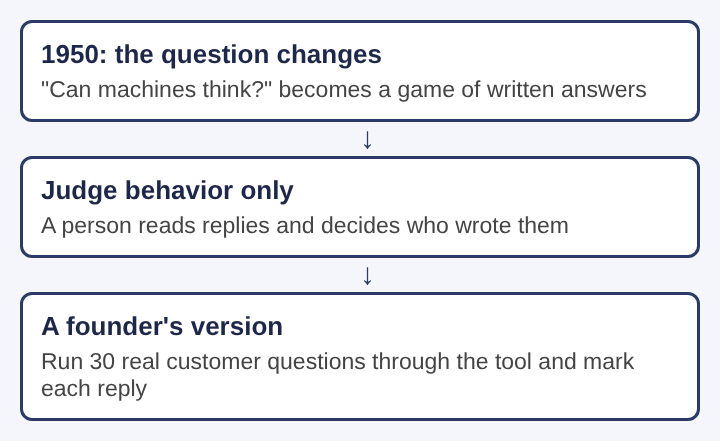
So take thirty real questions your customers have sent. Run them through the assistant. Have someone who knows your shop read the replies and mark each as correct, wrong, or risky. That is the imitation game applied to a business task: judge the behavior, on the task that matters, with a person doing the judging.
The history also gives a caution. The setbacks on the AI winter page followed a period of high expectations, so a founder does well to plan around what a tool does today, not what it is said to promise.
Building a business with AI after Turing
The practical lesson from Turing is a way of working. Pick one task in your business, such as answering customer emails or drafting product descriptions. Collect real examples of that task. Judge what the AI produces against those examples, and keep a record of how often a person has to correct it.
Then repeat the loop. Add the corrections to the examples, look at whether the results improve, and widen the task only when they do. That is the same step Turing took in 1950: replace a vague question about intelligence with a concrete one about behavior, and let the evidence decide what the tool is good for.
Frequently asked questions
What did Alan Turing say about thinking machines?
In his 1950 paper "Computing Machinery and Intelligence," Turing called the question "can machines think?" too meaningless to deserve discussion and replaced it with the imitation game. The game asks whether a machine's written replies can be told apart from a human's.
Did Alan Turing think machines would ever be called intelligent?
He predicted that by the end of the century people would speak of machines thinking without expecting to be contradicted. His specific prediction was narrow: an average interrogator would have no more than a 70 percent chance of a correct identification after five minutes of questions.
Why does the history of AI matter for starting a business with AI?
It shows how the question of machine thinking became a field, and how setbacks such as the 1973 decrease in UK AI research followed high expectations. That helps a founder judge a tool by what it does on real work.
What happened to AI research after Turing?
The 1956 Dartmouth workshop is widely considered the founding event of AI as a field. Setbacks later came in the early 1970s, when UK research fell and DARPA cut back academic AI.