People ask what does tabby mean in cats because the word is everywhere: on shelter cards, in breed descriptions and in the way a neighbour describes the striped cat on the wall. Tabby is not a breed. It is a coat pattern of stripes, swirls, spots or banded hairs, and it nearly always comes with a letter M on the forehead. The pattern shows up on pedigree cats and on ordinary house cats alike, so once you can read it you can describe almost any cat you meet. In Cat Go, a walking game where you photograph a real cat, lure it with food and catch it, each catch keeps its breed and the place you found it, and coat patterns come up on nearly every walk.
What does tabby mean in cats: a coat pattern, not a breed
A tabby cat is any domestic cat whose coat shows the tabby pattern: an M-shaped mark on the forehead and stripes by the eyes, on the cheeks, along the back and around the legs and tail. The word describes how colour is laid out on the body. It says nothing about the cat's ancestry.
The word itself started with cloth. Tabby first meant a striped silk, from the French tabis, a name traced back to the Attabiya district of Baghdad, known for its striped silk. English speakers were calling striped cats tabby cats by the 1690s.
A tabby can be a Maine Coon, a Bengal or an American Shorthair. Far more often it is a cat with no pedigree at all, and the pattern is common among non-pedigree cats around the world. If those labels are new, read what a mixed breed cat is called and why domestic shorthair is a coat label and not a breed. A striped cat with a short coat on your street is most likely a domestic shorthair tabby.
The M on the forehead and the other marks to check first
Before you decide which tabby pattern a cat has, confirm that it is a tabby. These marks show up on nearly every tabby, whatever its body pattern:
- The M. Dark lines on the forehead form a letter M above the eyes. This is the quickest sign.
- Lines from the eyes. A dark line runs back from the outer corner of each eye, and one or more cross each cheek.
- Bright eye rims. The fur close around the eyes is often lighter than the rest of the face.
- Barred legs. Stripes cross the legs, even when the body pattern is spots.
- A ringed tail. Bands of colour wrap the tail.
Here is a case to follow. A grey cat sits on a garden wall ten metres away, side on to the hedge, so you can't see its flanks. Its face shows an M and a dark line leading back from each eye, and its tail has rings. That is enough to call it a tabby. The body pattern can wait until the cat turns, and when it does, the next section tells you what to look for.
The four tabby patterns: mackerel, classic, spotted and ticked
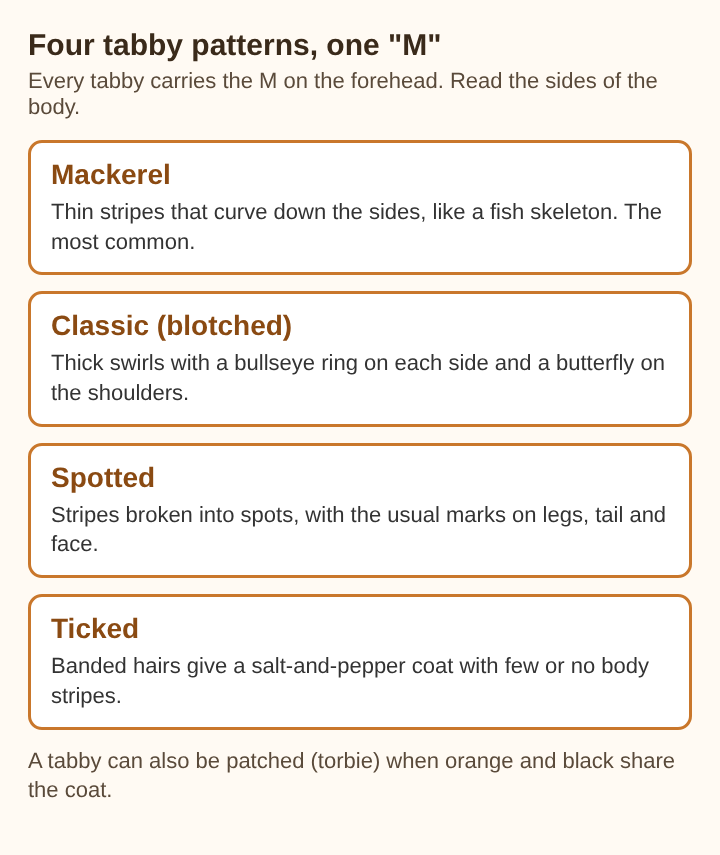
The four known patterns differ on the body. The face, legs and tail look much the same on all of them.
Mackerel tabby
A mackerel tabby has thin stripes that curve gently down its sides, sometimes broken into bars on the flanks and belly. The pattern is also called a fishbone tabby, after the fish. Mackerel is the most common tabby pattern.
Classic tabby
A classic tabby, also called blotched, has thick curving bands in swirls instead of thin stripes. Look at the side of the body for a mark like a bullseye. Look at the shoulders for a light butterfly shape, and along the spine for three thin stripes. Many American Shorthairs show this pattern.
Spotted tabby
A spotted tabby has its stripes broken into spots, thought to come from a modifier gene acting on the mackerel pattern. The legs, tail and the M on the forehead keep their usual marks. Spots appear in breeds such as the Bengal, the Egyptian Mau and the Maine Coon.
Ticked tabby
A ticked tabby has few or no stripes on its body. Each hair carries bands of colour, so the coat looks evenly flecked, like salt and pepper. Faint bars may still show on the lower legs, face and tail tip, and the M stays. Under cat coat genetics, ticked tabbies are rare among random-bred cats outside Asia, but fixed in breeds such as the Abyssinian and the Singapura.
The genes behind the pattern, and why orange cats show it
Whether a cat shows its tabby pattern at all depends on a gene called agouti. A cat with at least one working copy shows the pattern. A cat with two non-agouti copies is a solid colour, such as plain black, and its pattern is mostly hidden. Hidden is not gone: a faint ghost of the stripes can often be seen on kittens, and on adults in bright, slanted light.
Which pattern shows is decided by a separate tabby gene. Mackerel is dominant over classic, so a cat needs two classic copies to show swirls. The ticked form is dominant over both, so a cat with even one ticked copy has a ticked coat.
Orange cats are the exception. The orange colour sits on the X chromosome, and it is not hidden by the non-agouti gene. So every red or ginger cat shows tabby markings, even if faintly. Because the orange gene is on the X chromosome, roughly 75% of ginger cats are male.
Tabby, torbie and caliby: patched coats
A female cat can carry orange on one X chromosome and black on the other, so both colours appear in patches. With the tabby pattern showing in those patches, the cat is a patched tabby, called a torbie. Add white areas and the cat is called a caliby.
Two questions sort these coats:
- Is there more than one base colour? If orange and dark areas share the coat, you are looking at a tortoiseshell coat of some kind.
- Do the dark patches carry stripes or the M? If they do, it is a torbie. If they are solid, it is a plain tortoiseshell.
For the same X chromosome reason, a male cat can't be a tortoiseshell or a torbie unless he has two X chromosomes.
Reading tabby coats while catching neighbourhood cats
In the game, a cat is caught by taking its photo. While the photo is checked, the game looks for a cat and reads its coat; with no cat in the shot, it says "No catch this time." It does not name the breed for you. After a cat is spotted, it asks "Which breed is it?" and adds: "Most cats you meet are mixed breed. Rarer breeds are warier." You pick the breed from a list, and when none fits, it says "Mixed breed is always a safe pick."
This is where tabby knowledge helps and where it can mislead. Say you photograph a sandy cat with a ticked coat and no body stripes. Ticking is fixed in the Abyssinian, one of the rare breeds in the Catdex. But a ticked coat alone does not make a cat an Abyssinian; body shape, ears and coat length count too. A spotted moggy is not an Egyptian Mau, and a big brown tabby is not always a Maine Coon (see how to tell a Maine Coon from a regular cat).
The Catdex sorts its 34 breeds into four groups, and its common group holds Domestic Shorthair and Domestic Longhair, where most striped street cats belong. Every cat you catch is kept with its breed and the place you met it, and tabby details such as white paws or the shape of a side swirl help you tell two brown tabbies apart.
Pattern reading works from a distance, which suits the cat. A tail that flicks or twitches signals agitation, and a fluffed tail signals a cat that feels unsafe, as the page on cat behaviour describes. Stay calm, keep your distance and take the photo without reaching for the cat. Never feed, pick up or chase a cat that is not yours. The M, the eye lines and the tail rings are all visible from a few metres away.
Frequently asked questions
Is a tabby cat a breed?
No. Tabby is a coat pattern found across many breeds and on most non-pedigree cats. A cat's breed comes from its ancestry, not from its stripes.
Are all orange cats tabbies?
Yes. The gene that hides the tabby pattern on black fur does not hide it on orange fur, so every red or ginger cat shows some tabby marking, even when it is faint.
Can a solid black cat have tabby stripes?
Underneath, yes. A solid black cat still carries a tabby pattern, and faint ghost stripes can show on kittens and in bright, slanted light.
Which tabby pattern is most common?
Mackerel, the thin curving stripes. Ticked coats are the opposite case: rare among random-bred cats outside Asia, though fixed in a few breeds.
What tabby means in cats, in short
A tabby is a cat with a striped, swirled, spotted or ticked coat, almost always marked with an M on the forehead, lines from the eyes, barred legs and a ringed tail. Agouti decides whether the pattern shows, a separate gene decides which of the four it is, and orange fur shows it whatever agouti says. Torbies and calibies lay tortoiseshell patches over the same pattern. Tabby tells you how a coat is laid out, not where a cat comes from, and most tabbies you pass on the street are ordinary mixed breed cats whose pattern you can read from a calm distance.