The corner tile in 2048 is the one thing most players protect above all else, and when it slides out of its corner, many players give up on the board. Most boards can still be saved. What you do in the next two or three moves decides whether the board settles back into shape or comes apart. The fix depends on one question: what is sitting in the corner now?
The same problem shows up in Evolved 2048, the 2048 puzzle played on a Rubik's cube, where you slide the front face, twist rows to bring tiles in from the other sides, and keep building past 2048. A big tile on the front face can be pulled out of place there too, and the same recovery steps apply, with a few extra moves the cube allows.
Why the corner matters so much
The Wikipedia page on 2048) describes the best-known approach: keep the largest tile in one chosen corner and fill the row beside it with other large tiles. When that row stays full, you can move in three directions and the big tile never leaves its corner. The same page gives a second rule: no small tile should be cut off from other small tiles by a large one.
Both rules point at the same aim. Large tiles belong along one edge, in falling order, so each merge feeds the next. Small tiles stay together in the open part of the board, where they can meet and grow. The corner tile is the anchor of that whole order. Once it moves, the row behind it no longer points anywhere useful.
Programs written to play 2048 lean on the same ideas. The Wikipedia page notes that their position checks often favour empty squares, plenty of possible merges, large tiles on the edge, and tile values that rise steadily in one direction. A corner tile that drifts toward the middle breaks most of those at once.
How the corner tile slips out
On a 4 by 4 board, tiles slide as far as they can until they hit another tile or the wall. If your big tile sits in the bottom left corner and the left column has an empty square above it, an upward slide carries it away. That usually happens for one of three reasons:
- The edge row was not full, so the only legal moves were the ones you were trying to avoid.
- You slid in the fourth direction by habit, without checking the column above the corner.
- A merge in the edge row opened a gap, and the next slide dragged the big tile along with it.
After any slide, a new tile appears in a random empty square. The Wikipedia page puts the odds at a 2 nine times out of ten and a 4 the rest of the time. So the empty corner you just left behind is now one of the squares where a new 2 might land.
Recovering the corner tile in 2048, step by step
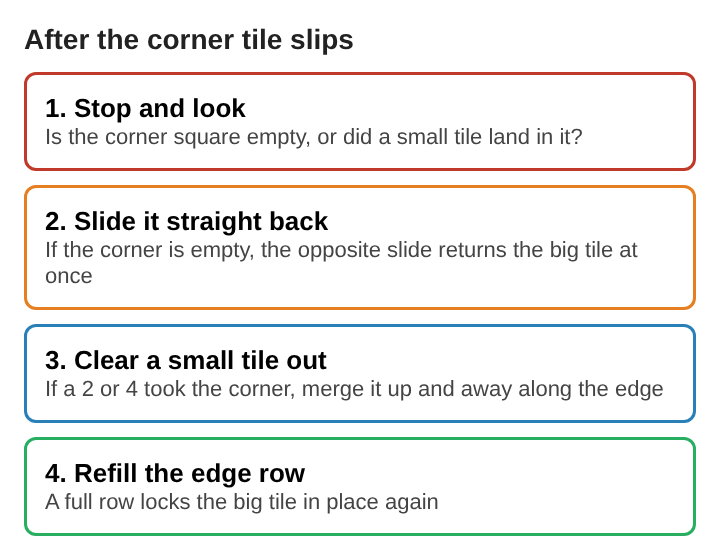
Stop and look. Before any move, check the corner square. It is either empty or it holds the new tile that spawned there. Those two cases need different answers.
If the corner is empty, slide straight back. The opposite slide returns the big tile at once. If it went up, slide down. Do it before anything else: every extra move is another chance for a new tile to drop into that square.
If a small tile took the corner, move it out by merging. A 2 or a 4 in the corner cannot be lifted out. It has to be merged with a matching tile and then pushed along the edge, or built up where it stands. Look for a matching tile in the same row or column and slide toward the corner so the two meet.
Refill the edge row. Once the big tile is home, fill the squares beside it. A full edge row is what keeps the corner tile from slipping on the next forced move.
A worked example on a 4 by 4 board
Take an invented position. Your 256 sits in the bottom left corner. The bottom row reads 256, 128, 32 and an empty square. You have no good left or down move, so you slide up. The 256 rises one square in the left column, and a new 2 appears in the bottom left corner it just left.
The corner now holds a 2. Sliding down would push the 256 back toward the bottom, but the 2 is in the way, so the 256 stops one square above it. That is not a return; it is a stack with a small tile at the base.
Look along the bottom row instead. Suppose it now reads 2, 2, 32 and an empty square: the new 2 in the corner and an older 2 beside it. A left slide merges the two 2s into a 4 in the corner. Now the corner holds a 4 with the 256 above it. Build the 4 into an 8 the same way, using tiles that arrive along the bottom row. You will not clear the corner in one move, and that is fine. The aim is to keep every small tile in the bottom row merging toward the corner until the corner tile is large enough to take its place in the order, or until a sideways slide opens the corner and the 256 can drop back in.
Meanwhile, keep the left column full so the 256 cannot slide further up. Each move that keeps both the bottom row and the left column full narrows the board's choices, and narrow choices are what stop a second slip.
Thinking a move ahead after a slip
Recovery is about chance as much as order. The Wikipedia page on expectiminimax describes a search built for games that mix choice and luck: a version of minimax with extra chance steps that weigh the expected result of a random event, such as where a new tile lands.
You do not need a search tree to use the idea. Before a move, ask where the new tile could appear and how bad each spot would be. If the only empty square after your move is the corner, that move is risky. If the move leaves two or three empty squares away from the corner, a new tile is far more likely to land somewhere harmless.
Getting a big tile back on a cube
On a cube the same rules apply to the front face, but with more room to fix things. In the main mode, slides move only the front face, and every slide or twist adds a 2 or a 4 on the front when there is space. Turning the whole cube costs nothing and adds no tile, so you can look at every side before you act.
That free look matters after a slip. A tile that matches the small one now blocking the corner may be on a side face. A twist turns one row or column a quarter and carries its tiles to the next face, so a matching tile can land next to the blocker. One twist can do what several slides on a flat board would, though a twist still adds a new tile like a slide does.
For the order that keeps the big tile in place after it is back, the snake strategy in 2048 lays out one winding path from the biggest tile down.
Frequently asked questions
Is the game lost when the corner tile moves in 2048?
No. If the corner is still empty, the opposite slide puts the tile straight back. If a small tile took the corner, it takes a few merges to clear, but many boards recover.
Which direction should you never slide in 2048?
With the big tile in the bottom left, sliding up is the risky one when the left column has a gap. Keep the bottom row full and you rarely need it.
Why does a new tile land in the empty corner?
A new tile appears in a random empty square after every move, so an empty corner is one of the places it can land. Moving the big tile back quickly gives it fewer chances.
Should you move the big tile to a new corner instead?
Only when the old corner cannot be cleared and the new corner has its edge row ready. Moving a large tile across the board usually breaks the order behind it.
Why the corner tile in 2048 is worth a slow move
A slipped corner tile calls for patience more than speed. The board still holds its large tiles in roughly the right places, and the small tiles still have room to meet. The only thing lost is the anchor, and anchors come back with careful moves: one look at the corner, one straight slide when it is empty, a short chain of merges when it is not. The habit that prevents the next slip is the same one that wins the game, a full edge row beside the biggest tile, so that three directions always stay safe and the fourth is never needed.