You look at a pair of hiking boots on one shop's site, then see boot ads on a news site an hour later. That is behavioral targeting at work. So what is behavioral targeting in advertising? It is the practice of choosing which ad to show a person based on what that person did before: the pages they read, the links they clicked, the searches they ran and the things they purchased. The ad is picked for the person, not for the page they are reading.
What is behavioral targeting in advertising, step by step
Behavioral targeting centers on what people do online, and it rests on a simple bet. Someone who read three articles about tents is more likely to click a tent ad than a random visitor is. To act on that bet, an ad system has to recognize the same person across many visits and many sites, and it has to remember what they did each time.
Not every ad system works this way. Some leave the reader's history out and store nothing about who is reading. One example is vlvd ads, a small ad service that places one ad at a time on a family of game and learning websites, with no cookies and no tracking of visitors. It shows what an ad system looks like when the reader's history is left out entirely.
The data behavioral targeting collects: browsing, clicks, searches and purchases
Behavioral targeting runs on four main kinds of activity:
- Browsing: which pages you open, how long you stay on each one and which sites you return to.
- Clicks: the ads, links and product listings you tap.
- Searches: what you type into a site's search box, and sometimes the search that brought you to a page.
- Purchases: what you add to a cart, what you complete an order for, and what you leave behind.
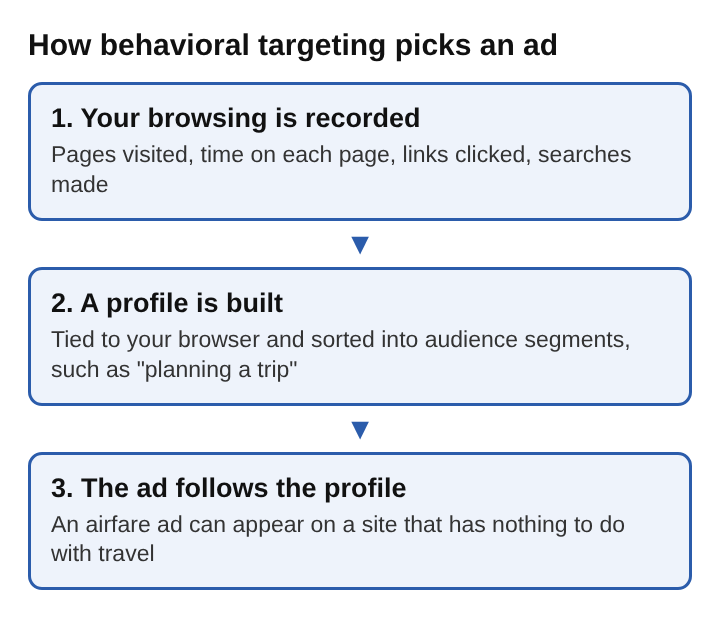
Here is how it adds up. On a Tuesday evening, a reader searches for "beginner road bike." They read two comparison articles on different sites, open a cycling forum, and add a helmet to a cart on a sports shop's site but do not finish the order. Each step may be recorded by a different company. On its own, each record says little. Put together, they say: interested in cycling, new to it, close to a purchase, has not finished one yet. That combined picture is the profile advertisers want.
How behavioral targeting builds a profile with cookies and pixels
To combine those records into one profile, the ad system needs a way to tell that the same person did all of them. Two tools do most of that work.
Cookies. A cookie is a small piece of text a site asks the browser to store and send back later. When an ad company's code runs on thousands of sites, it can set its own cookie with an ID in it. Every site that loads that code lets the company read the same ID again. That is the basis of the third-party cookie and cross-site tracking.
Pixels. A tracking pixel is a tiny image or script placed on a page. When the page loads, the browser requests it, and that request tells a server which page was opened and, with a cookie attached, by which ID. Shops put pixels on order confirmation pages so ad companies learn who completed a purchase. A closer look at how a tracking pixel reports back shows how little code it takes.
With an ID in place, the profile builds up in steps:
- A page loads with ad code or a pixel on it.
- The code reads an existing ID or sets a new one.
- The visit, click or purchase is logged against that ID.
- The ID is sorted into groups, such as "cycling" or "shopping for a bike."
- When the person opens another page with ads, the ad request carries the ID, and advertisers who want that group can bid to show their ad.
Advertising networks have the widest view, because they serve ads across many sites and can piece together a picture of who their readers are likely to be.
Behavioral targeting and retargeting: how the two differ
Retargeting is a narrow form of behavioral targeting. It shows you ads because you visited the advertiser's own site. Go back to the reader with the helmet in the cart. When the sports shop shows that same helmet on a news site the next day, that is retargeting. Why one ad follows you comes down to the shop's own pixel and a cookie.
Behavioral targeting reaches further. A bike brand the reader has never visited can still show them an ad, because the profile built from many sites places them in the "cycling" group. Retargeting needs a visit to the advertiser. Behavioral targeting only needs enough history to guess an interest.
Privacy problems with behavioral targeting and why consent banners appear
The problems come from how the profile is made and where it goes.
- It is hidden. Most people cannot see which companies hold an ID for them or what is filed under it.
- It reveals more than it seems to. Browsing can point to health worries, religion, money trouble or a pregnancy, even if no one typed those words.
- It is hard to undo. Once a profile has been copied between companies, deleting it in one place does not delete it everywhere.
Those worries are behind the consent rules that explain why websites ask about cookies: the banner is where a site asks before the tracking can begin.
Alternatives to behavioral targeting: ads chosen with no reader profile
Contextual advertising chooses an ad based on the page being read, scanning its words for a match. A lesson about fractions gets an ad that fits a learning page. A game page gets an ad that fits a game page. No history is needed, so no ID is needed. There are several ways websites can show ads without cookies, and contextual matching is one of the most direct.
The service mentioned at the start leaves the person out in its own way. People who see its ads get no cookies and no visitor ID. When a site asks for an ad, it sends only three things: the site's own name, the kind of ad it wants, and which ads were already shown in that visit. The browser keeps that last list until the tab closes, so the same ad is not shown twice. Nothing about who the reader is goes along with it.
Take a learner who finishes a lesson and gets a full-screen ad. The system knows the site's name, that the slot is full-screen, and which ads that tab has already seen. It does not know the learner's name, their other visits, or their searches. There is no profile to build because there is nothing to attach one to.
A few other details keep the design small:
- Three formats: a banner inside the text, a small tab in the corner, and a full-screen ad when a reader finishes a lesson.
- A short, fixed shape: a headline of up to 40 characters, one sentence of up to 90, and a button of up to 18. The picture is the advertised page's own share image, its
og:image. - Nothing about people reaches advertisers: every ad, picture included, loads from the service's own address, so an advertiser never sees who viewed it. A click goes straight to the advertised page.
- Counts, not profiles: views and clicks are counted per ad, per site, per day, as numbers only, and the advertiser sees those daily totals.
- A person checks every ad before it runs, usually within two working days. Ads for gambling, adult content, weapons, crypto and trading, politics, health or medical claims, and get-rich or money-making claims are refused, and an ad must describe the page it links to truthfully.
Human checks fill a gap that behavioral targeting leaves open. When nobody knows who will see an ad, the content of the ad itself carries more weight, so a person reading it first matters.
Frequently asked questions
Is behavioral targeting the same as personalized advertising?
Mostly, yes. Personalized advertising is the broader term for ads chosen for a specific person, and behavioral targeting is the main way that is done, using past activity. Ads chosen from a profile's age or location alone are personalized too, but less dependent on behavior.
Does behavioral targeting still work without third-party cookies?
Partly. Any record that links visits to one browser or account can still feed a profile, such as the data a site keeps about its own signed-in users. Without a shared cookie, though, each company sees less of a person's browsing.
Can behavioral targeting be turned off?
It can be reduced. People can decline non-essential cookies on consent banners and block third-party cookies in browser settings. Neither removes profiles that companies already hold.
Why is behavioral targeting a privacy concern?
Because the profile is built from what people do without seeing it happen. A record of pages, searches and clicks can point to private matters the person never chose to share with an advertiser.
Behavioral targeting in advertising: what it gives up in privacy for relevance
Behavioral targeting trades one thing for another. It gives advertisers a better guess about who might care, and in return it needs a lasting record of what people read, click, search and purchase, That record is the source of every privacy problem it raises, and of the consent banners that now sit on so many sites.
Ads without tracking make the opposite trade. They give up the guess about the person and keep the reader's history out of the system entirely. The ad is chosen without a profile, the counts are totals, and what the reader did yesterday stays with them. Which trade a site makes decides how much its readers have to give before an ad appears.