Can websites show ads without cookies? Yes. A cookie is one way to recognize a person, and an ad can be chosen without recognizing anyone. The page can say what kind of ad it has room for, the ad service can pick one, and the only thing kept afterward is a count. The ad service vlvd ads works this way: it shows one small ad at a time, sets no cookies on the people who see the ad and keeps no visitor id.
The rest is a closer look at what a cookie does in advertising, what replaces it, and what the replacement cannot do.
What a cookie does in an ad system
The Wikipedia entry on behavioral targeting describes advertising built on what a person does online. Its main data source is the cookie, a small piece of information passed between a server and a browser that lets a person be identified or followed over time.
With cookies, a site can record which pages someone views, how long they stay on each, which links they click and what they search for. Those records become a profile, and the entry says profiles let publishers group visitors with similar interests into segments. An ad is then matched to the segment, not to the page.
The same entry names other ways to collect comparable activity: web beacons, third-party ad-serving software and device identifiers such as IP addresses. Removing the cookie alone does not remove the following. What matters is whether anything in the system lets one visit be tied to the next.
Ads chosen by the page, not the person
The other long-standing approach is contextual. The Wikipedia entry on contextual advertising calls it a form of targeted digital advertising in which automated systems choose ads from the content of the site and what the user is viewing right now. The system scans the page for keywords and phrases and shows ads tied to those terms.
The entry gives a plain case: a sports website might show ads for memorabilia or tickets. Search engines work in a similar way, matching ads to the words in a query. Nothing in that match needs to know who the reader is. The same page gets the same kind of ad for everyone who opens it.
So the choice is between asking "what is this person like?" and asking "what is this page about?". Cookies answer the first question. The page answers the second.
What a site can still tell an ad service
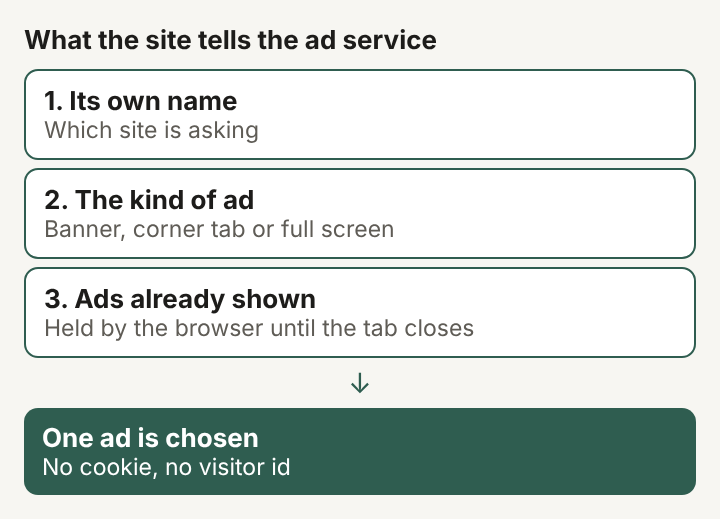
An ad service that sets no cookies still needs a few facts to place an ad at all. According to its privacy page, the sites tell it three things: their own name, the kind of ad wanted, and which ads were already shown in this visit.
That is all. It is a short list, and none of it describes a person. The third item is kept in the browser until the tab closes, and it exists for one reason: the same ad is not shown twice in one visit.
The kind of ad matters because there are different places for an ad to appear. The service has three formats, shown on its demo page: a banner inside the text, a small tab in the corner, and a full-screen ad when a reader finishes a lesson. A site asking for a banner gets a banner, and the page decides where it goes.
Can websites show ads without cookies? A visit from start to finish
An invented reader makes the steps concrete. Call the reader Mara. She opens a lesson on a learning site, and nothing about her is known to anyone.
- The lesson page needs a banner. It asks the ad service for one and says three things: its own name, "banner", and an empty list of ads already shown.
- The service picks one ad and sends it back. The ad and its picture are loaded from the service's own address, ads.vlvd.net, so the advertiser's server is never involved in showing it.
- Mara scrolls to the end of the lesson, and the page asks for a full-screen ad. This time the list holds the banner already shown, so the service picks a different ad.
- Mara closes the tab. The list of shown ads, which the browser held, disappears with it.
- The service adds two views to that day's total for that ad on that site.
If Mara comes back tomorrow, the service has nothing to say about her, because there was never anything about her to keep. Her second visit starts with an empty list, the same as her first.
Counting without knowing who
Advertisers still want to know whether an ad does anything. The privacy page says the service counts views and clicks per ad, per site, per day, and that these are numbers only. A click goes straight to the advertised page, and the advertiser sees the ad's views and clicks for each day.
Because every ad, its picture included, is loaded from the ad service and not from the advertiser, the advertiser never sees who viewed it. The advertiser learns that an ad was seen a number of times on a given day, which is enough to judge whether it is worth keeping, and nothing more.
What a person checking every ad changes
A system with no profile of the reader has one more thing to rely on: the ad itself. Here, a person checks every ad before it is shown, usually within two working days. An ad is a headline of up to 40 characters, one sentence of up to 90 and a button of up to 18, so there is little room to hide anything in it.
The service also turns away some kinds of ad outright: gambling, adult content, weapons, crypto and trading, politics, health or medical claims, and get-rich or money-making claims. An ad has to describe the page it links to truthfully. With no data on the reader, a limit on what an ad may say becomes one of the few controls left, and it applies to every reader equally.
What ads without cookies cannot do
This approach gives up things, and they should be named.
- No follow-up. An ad cannot chase a reader across sites or pages, because nothing links the visits.
- No interest segments. The ad matches the page and the kind of slot, not a guess about the person.
- Coarse counts. Totals per ad, per site and per day cannot say how many different people saw an ad, only how many times it was shown.
- Repeat limits stop at the tab. The record of shown ads is dropped when the tab closes, so a reader can see the same ad again on a later visit.
For small ads on pages whose subject is clear, these limits cost little. For a campaign that depends on recognizing individuals, they cost the whole method. Which one fits depends on what the advertiser wants to learn and what the reader is willing to share.
Frequently asked questions
Can websites show ads without cookies?
Yes. The page can state its own name and the kind of ad it wants, and the ad service can choose from that alone. Counting views and clicks as totals needs no cookie either.
Is contextual advertising the same as ads without cookies?
Not exactly. Contextual advertising chooses ads from the content of the page and what the user is viewing. That choice does not need a cookie, but a service could still add one for other purposes. Cookie-free is a property of the whole system, not of the method alone.
Does removing cookies remove tracking?
Not by itself. Web beacons, third-party ad-serving software and device identifiers such as IP addresses can collect comparable activity. The question is whether anything lets one visit be tied to the next.
How does an ad avoid showing twice without a cookie?
The browser keeps a list of the ads already shown in the current visit and passes it along with the next request. The list is dropped when the tab closes, so nothing about the reader outlasts the visit.
What do advertisers see in a system like this?
Views and clicks for each ad, for each day, as numbers. They do not see who viewed the ad, because the ad and its picture are loaded from the ad service and not from the advertiser.