If you want to know how to study from a textbook chapter, focus on what you do after you read it. Most people read the chapter, read it again, and feel ready. A few days later most of the details are gone. A better use of your time is to pull the material back out of your own head, by answering questions with the book closed. One way to get those questions is Study Shot, which turns a photo of a textbook page into multiple-choice practice questions and explains every answer. The method works with or without it.
Why rereading a textbook chapter rarely sticks
Rereading feels productive. The second time through, the text reads smoothly, the terms look familiar, and the diagrams make sense. That smoothness is the problem. It tells you that you can recognize the material when it is in front of you. It does not tell you that you can produce it when the page is gone, which is what a quiz or a class discussion asks of you.
Memory also fades fast without use. Hermann Ebbinghaus described this as the forgetting curve: memory of newly learned material declines over time when there is no attempt to keep it, often by half within days or weeks. For a closer look at why, see whether rereading is a good way to study.
How to study from a textbook chapter: preview it first
Spend five to ten minutes on the chapter before you read a full paragraph. Read the headings, the bold terms, the summary at the end, and the questions the author put after the last section. This gives you a map, so each section has a place to go when you read it.
Then turn each heading into a question. This step comes from SQ3R, a reading method introduced by Francis P. Robinson in 1941, with five steps that begin by surveying the chapter and asking questions before any reading. Say you have a biology chapter with a section titled "The light reactions." Your question becomes: "What happens in the light reactions, and where in the cell?" Now you read with a purpose. You are looking for an answer, not just moving your eyes down the page.
Read one section at a time, then close the book and recall it
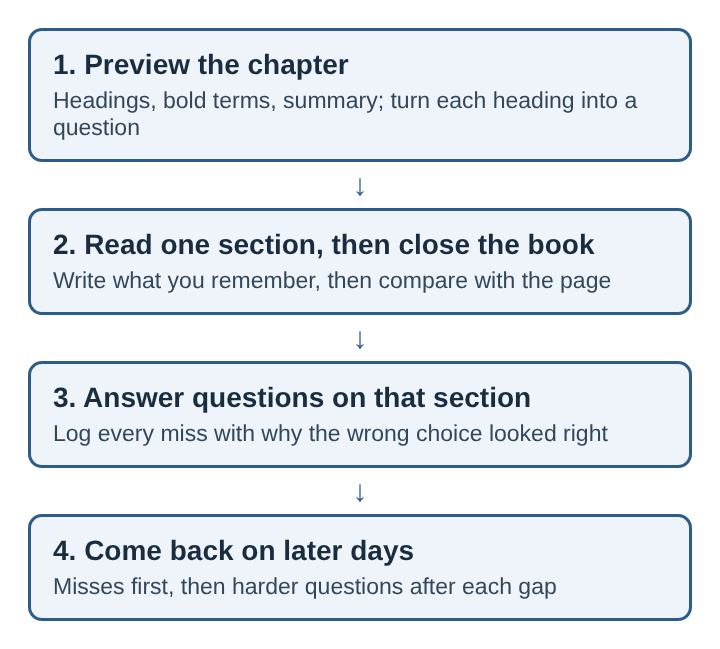
Do not read the whole chapter in one pass. Read one section, then close the book. On a blank sheet, write what you remember: the main claim, the key terms, and one example. Say it out loud if writing is slow. Then open the book and compare.
The gaps you find are the most useful part. If you wrote three terms and the section had five, you now know which two to go back to. This is active recall, and it works partly because producing an answer yourself leaves a stronger memory than reading it. Researchers call this the generation effect.
Keep each recall short. Two or three minutes per section is enough. The goal is not a perfect summary. The goal is to find out what you can and cannot bring back on your own.
Turn each textbook section into practice questions
Writing from memory is a good start, but questions give you more structure. A good practice question asks you to explain, compare or apply, not just repeat a definition. "What is a chloroplast?" is fine for day one. "Why would a plant cell with damaged chloroplasts struggle to make sugar?" makes you connect two ideas.
Multiple-choice questions are useful when the wrong options are believable. A wrong option that names a nearby term, such as the mitochondria when the answer is the chloroplasts, forces you to separate two things that are easy to mix up. The questions at the end of a chapter help, but there are usually only a handful, and they rarely cover every section. Writing your own takes time. There is more on that in how to make practice questions from your notes.
Making practice questions from textbook pages with Study Shot
If writing questions by hand is slowing you down, a photo of the page can do that part. The process has three steps. You take a photo of a page, or pick one already on your phone. You choose a level. Then you answer one question at a time, and each answer is checked right away and explained.
There are four levels. Basic, Intermediate and Advanced each stay at one depth. Tiered is a ladder that climbs through all three. A quiz has between 5 and 20 questions, from the basics to the hardest. Quizzes can be made in 50 languages.
A few details matter for studying a full chapter:
- Every quiz is saved in a library with its page photo, so you can take the same quiz again on a later day.
- If a question looks wrong, you can flag it in one tap and it gets checked. Always compare a doubtful question against the textbook itself.
- It runs on a phone and a computer.
- A quiz can be shared by link, and the person who opens it gets their own copy to take, which helps if you study with a classmate.
A practical way to use it: take one photo per section. On the first day, use Basic to check that you have the core facts. Later in the week, switch to Tiered so the questions climb toward harder material.
Learn from every wrong answer in the chapter
A wrong answer is the most useful thing a study session can give you. It shows exactly where your understanding breaks. Do not just note the right letter and move on.
When you miss a question, do three things. Read the explanation. Find the sentence in the textbook that answers it. Then write one line in a mistake log: what the right answer is, and why your choice seemed right at the time. That second part matters. If you picked the mitochondria because both organelles deal with energy, write that down. The confusion you name is the confusion you fix.
Go back to your missed questions first in the next session. If you get one right twice in a row on different days, you can drop it from the log. There is more on this habit in how to learn from the questions you get wrong.
Space out recall of the textbook chapter over several days
Three short sessions on three different days do more than one long session on a single night. This is the spacing effect: learning is more effective when study sessions are spaced out than when they are crammed together, a pattern first identified by Ebbinghaus. Each gap lets you forget a little, and bringing the material back after that gap strengthens it more than recalling it while it is still fresh.
Recall after a gap feels harder, and that is part of why it works. The effort is what researchers call a desirable difficulty: a kind of struggle that slows you down now but helps you remember later. If a session feels easy, the gap was probably too short. The article on what the spacing effect is and how it shapes study covers how to set the gaps.
Frequently asked questions
How long should one textbook chapter take to study?
Plan for one longer first session to preview, read and recall section by section, then several short sessions of 15 to 30 minutes on later days. The total time spread across a week tends to matter more than any single sitting.
Should you highlight a textbook chapter?
Highlighting is fine for marking where answers live, but it is not studying on its own. It keeps your attention on the page instead of on what you can recall without it, so use it to find material for questions, not as the main activity.
How many practice questions does one chapter need?
Aim for enough to cover every section at least once, with a few harder questions on the parts you missed. For a typical chapter that often means a handful of questions per section, repeated over several days.
Do written notes from a textbook chapter help recall?
Notes help most when you write them from memory after closing the book, then fill the gaps from the text. Copying sentences straight from the page builds familiarity, not recall.
A one week plan for studying a textbook chapter
Here is how the steps fit together across seven days for a single chapter.
- Day 1: Preview the chapter and turn each heading into a question. Read one section at a time, closing the book after each one to write what you remember. Make a set of basic questions for every section.
- Day 2: Answer the basic questions without looking at the book. Start a mistake log for every miss, with the reason your wrong choice seemed right.
- Day 3: Rest from this chapter. The gap is part of the plan.
- Day 4: Answer your logged misses first. Then work through harder questions that ask you to explain, compare and apply.
- Day 5: On a blank sheet, write the whole chapter's main ideas from memory, section by section. Open the book only afterward to check.
- Day 6: Rest again, or work on a different chapter.
- Day 7: Run a full set of questions from easiest to hardest. Anything you still miss goes to the top of your list for next week, when the chapter gets one more spaced session.
Rereading is not the main activity anywhere in this plan. You open the book only to check your recall and to fix the gaps your questions reveal. That shift is the core of studying a textbook chapter: less time looking at the page, more time showing yourself what you can bring back without it.