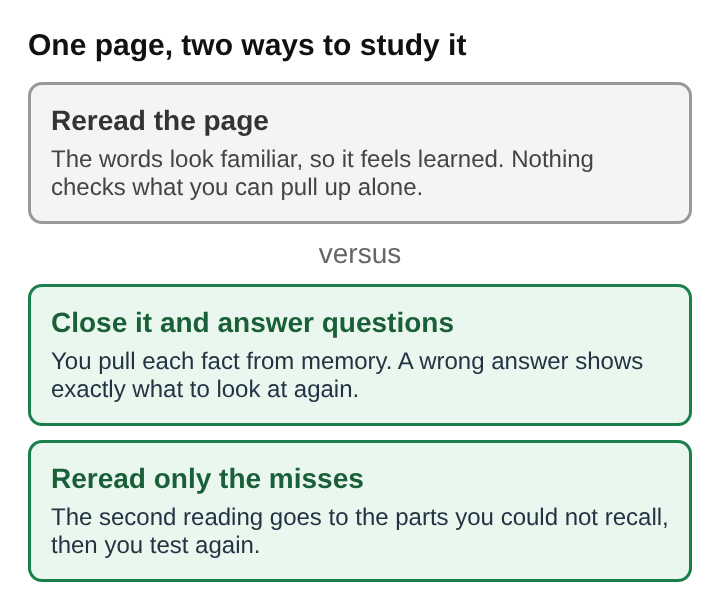
Is rereading a good way to study? On its own, not very. Rereading a chapter makes every line feel familiar, and that feeling is easy to mistake for knowing the material. The research on memory points to a better use of the same hour: close the page, try to answer questions about it, and then reread only the parts you could not recall.
That second step is where a tool such as Study Shot fits: it takes a photo of a page from a textbook, your notes or a worksheet and turns it into multiple-choice questions with every answer explained. Used that way, a second reading stops being the whole plan and becomes the follow-up to a quiz.
Why rereading feels like it works
Rereading is the most natural thing to do before an exam. The book is open, the highlights are there, and each pass goes faster than the last. By the third time through, the sentences read smoothly and nothing seems surprising.
The trouble is what that smoothness measures. The Wikipedia article on desirable difficulty describes exactly this case: a student may feel they are learning while rereading because the words are more familiar on the second or third read, but familiarity does not mean the material has been processed and learned. Recognising a sentence when it is in front of you is a different skill from producing the idea when the page is gone.
An exam asks for the second skill. Nobody hands you the paragraph and asks whether it looks familiar. You get a question and a blank space, or four choices that all sound plausible.
Is rereading a good way to study? The research
Psychologists have compared rereading with self-quizzing for decades, under the name retrieval practice, also called active recall. The core finding is that long-term memory improves when part of the study time is spent pulling information out of memory rather than putting it back in. The same article notes that recalling what you already know helps learning more than only reading or passively studying, and helps even more when the recall is hard.
One detail explains why rereading keeps its reputation. In these studies, material that was simply restudied is often recalled better on a quiz given right away. Material that was practised by recall pulls ahead as time passes. So if you reread the night before and check yourself five minutes later, rereading looks strong. A week later, the picture flips.
The article also reports that retrieval practice leads to less forgetting than studying and restudying, and that it helps uncover misconceptions and errors. Rereading cannot do that last part, because it never asks you to commit to an answer that could turn out to be wrong.
Effort as a feature, not a flaw
Quizzing yourself feels worse than rereading. You stall, you guess, you get things wrong. That discomfort is part of why it works. Researchers call it a desirable difficulty: a condition that takes more effort during study but improves long-term performance. The same source gives rereading as its main example of a task that creates an illusion of learning because it is easy to complete, and contrasts it with flashcards, which force you to generate the answer.
Not every difficulty helps. Studying in a noisy room is hard for no good reason. The useful kind is effort spent on retrieval: reaching for a fact, a definition or a step in a process and either finding it or finding the gap.
When rereading still earns a place
None of this means you should never read a page twice. Rereading has real uses:
- The first pass. You have to read something once to have anything to recall. A careful first reading is not wasted time.
- Dense material. A hard proof or a long argument may need a second slow reading before you can follow it at all.
- After a miss. Once a question shows you what you got wrong, going back to that exact paragraph is the most useful rereading there is.
The difference is direction. A blind reread covers every line with the same attention. A targeted reread goes straight to the part a question exposed, and you read it with a specific gap to close.
A worked example with one textbook page
Take a biology page on photosynthesis, two days before a quiz. Here is the same 30 minutes spent two ways.
The reread plan. You read the page three times. By the end, you can glance at the diagram of a plant cell and nod along. The word chloroplast looks familiar. You feel ready.
The quiz-first plan.
- Read once, carefully. Ten minutes, with the page in front of you.
- Close the book and answer questions. Use questions you wrote yourself, a set from the back of the chapter, or questions made from a photo of the page. One question on the Study Shot home page, made from a textbook page on photosynthesis, asks: "Where in a plant cell does photosynthesis take place?" The choices are the mitochondria, the chloroplasts, the nucleus and the cell wall.
- Check each answer right away. Suppose you pick the mitochondria. The right answer is the chloroplasts. You now know exactly which line of the page did not stick, and that you had confused two parts of the cell.
- Reread only the misses. Go back to the paragraph about where photosynthesis happens and read it with that confusion in mind.
- Quiz yourself again later. The next day, answer the same questions with the book closed and see what held.
Both plans use the same page and roughly the same time. Only the second one tells you what you actually know, and only the second one aims the rereading at something.
How to swap rereading for recall
You do not need to change everything at once. A few small shifts move most of your study time toward retrieval:
- Turn headings into questions. Before reading a section, write its heading as a question. After reading, close the book and answer it out loud or on paper.
- Cover and recall. Hide a page and write down everything you remember about it. Then compare and mark what was missing.
- Use multiple-choice with care. Choices that are all plausible make you tell close ideas apart. Read the explanation for every answer, including the ones you got right by guessing.
- Space the quizzes. Recalling the same material again after a day or a few days shows what lasts, which is what an exam measures.
- Keep the misses. A short list of questions you got wrong is a better revision guide than a highlighted chapter.
There are more ideas on writing your own questions in how to make practice questions from your notes, and on what to do after a wrong answer in how to learn from the questions you get wrong.
Frequently asked questions
Is rereading a waste of time?
Not entirely. A first careful reading is necessary, and rereading a part you just got wrong is useful. Rereading a whole chapter again and again, with no recall in between, gives the least return for the time.
Why does rereading feel so effective?
Each pass makes the words more familiar, and familiarity feels like knowing. Recognising a sentence on the page is easier than recalling the idea with the page closed, which is what an exam asks for.
Is highlighting better than rereading?
Highlighting and rereading both mostly involve recognising text rather than recalling it. Research on retrieval practice compares both unfavourably with retrieving information from memory.
How should rereading follow a practice quiz?
Go straight to the paragraphs behind the questions you missed and read them with your wrong answer in mind. Then answer the same questions again a day or two later.
Rereading with a purpose
Rereading is not the enemy of good study; aimless rereading is. The page you read three times will feel known, but only an attempt to recall it shows whether it is. When the second reading comes after a question, it stops being a comfort and becomes a repair: one paragraph, one gap, read with a reason. Most of the value of a study session sits in that order, recall first and reading again second.