What is active recall? It is the habit of pulling an answer out of your own memory before you look at the page. You close the book, ask yourself a question, and answer it from what you can bring back. Only then do you open the book and check. The effort of bringing the answer back is the part that does the work.
Most study time goes the other way. You read a chapter, read it again, and highlight the lines that look important. The page is always in front of you, so you never find out what you could produce without it. Active recall flips that order: the question comes first and the page comes second.
A page you already have can become the questions. Study Shot turns a photo of a page from a textbook, notes or a worksheet into multiple-choice practice questions, and explains every answer. You can also write your own questions by hand. Either way, the method is the same.
What is active recall in plain terms
Psychologists study the effect behind it under the name retrieval practice, and active recall is one of its other names. The idea is that long-term memory is stronger when part of your study time goes to retrieving information from memory, not only to taking it in again.
The idea is old. The history of retrieval practice goes back to Francis Bacon, who wrote about it as early as 1620: a text read through many times sticks less well than one read fewer times with tries at reciting it in between. William James described the same pattern in his 1890 book The Principles of Psychology. When you almost know something, waiting and recalling it pays better than looking at the book again.
So active recall is not a special tool or a brand of flashcard. It is a single move you can make with any material: hide the answer, try to produce it, then check.
Why rereading feels better than it works
Rereading has a trap built in. The second time through a page, the words are familiar. Familiar feels like known. But recognising a sentence when you see it is not the same as producing it when the page is shut.
The research on desirable difficulty names this problem. Robert A. Bjork coined the term in 1994 for learning conditions that take more effort but improve long-term performance. Rereading notes or a textbook is the common example of a task that gives an illusion of learning, because it is easy to finish and the words look familiar. Making yourself recall a definition is harder, and that extra effort is what helps it stay.
This is why active recall often feels worse while you do it. You get stuck. You get things wrong. A session can feel slow next to a smooth reread. That discomfort is a sign the method is doing its job, not a sign it is failing.
How to use active recall in five steps
You can run one round of active recall on any section of a book or set of notes. Keep each round short so the gaps stay easy to find.
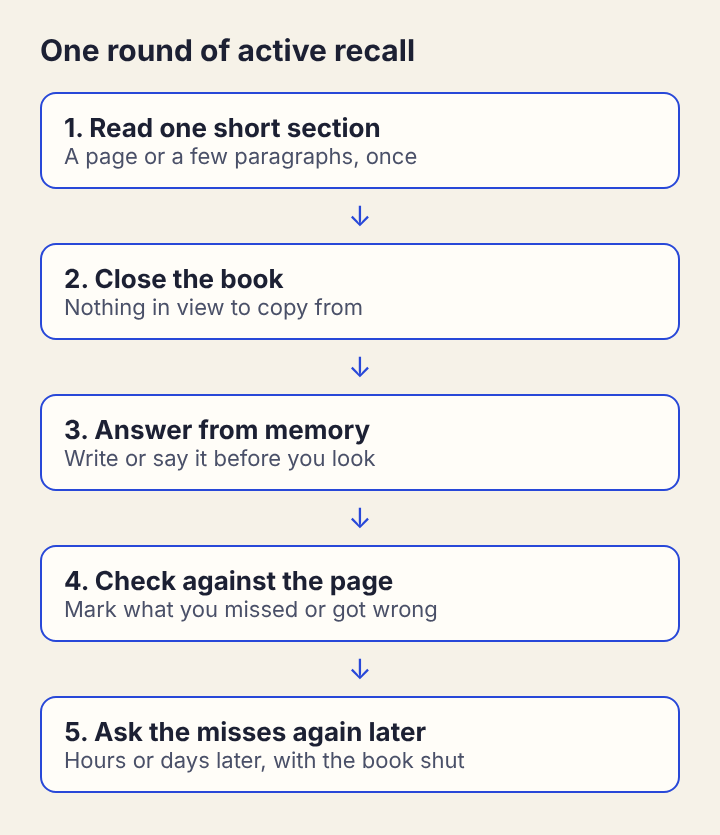
- Read one short section. A page or a few paragraphs, read once with care.
- Close the book. Put the page out of sight so there is nothing to copy from.
- Answer from memory. Ask yourself questions about the section and write or say each answer before you look.
- Check against the page. Open the book and mark what you missed or got wrong.
- Ask the misses again later. Come back hours or days later with the book shut and try the marked questions first.
The check in step 4 matters. Research on retrieval practice finds that feedback helps, and that a recall task with some difficulty plus feedback beats studying or quizzing yourself without it. Recall with no check can leave a wrong answer in place.
A worked example with one textbook page
Say you are studying a biology page about photosynthesis. You read it once. Then you close the book and ask: where in a plant cell does photosynthesis take place?
Before looking, you write down an answer. Maybe you write "chloroplasts". Maybe you hesitate between that and the mitochondria, because both words came up in the same chapter. Now open the page and check. The answer is the chloroplasts.
If you got it right with no doubt, move on. If you hesitated, mark it. That hesitation tells you the two words sit too close together in your memory, which rereading would never have shown you.
This exact question appears on the Study Shot home page as a multiple-choice item, with the mitochondria, the chloroplasts, the nucleus and the cell wall as the four choices. A quiz made from a page like this one can be set at Basic, Intermediate, Advanced or Tiered, a ladder through all three, and has 5 to 20 questions. Each answer is checked right away and explained, which covers step 4 of the round. The quiz is kept with its page photo, so step 5, asking again later, is a matter of taking it again.
Does the question format matter
The format matters less than the act of retrieval. The research summary on retrieval practice notes that it is the process of retrieving that aids learning. It also notes that short-answer questions and essays tend to show greater gains than multiple-choice questions.
That gives a simple way to mix them. Multiple-choice questions are quick and cover a whole page fast, so they work well for a first pass and for spotting weak areas. For anything you missed, try a harder form next time: cover the choices and write the answer before you look at them. You turn a recognition question into a recall question with your hand.
Any language works, too. Recall is about your own memory, not the language of the page.
How often to practise recall
One round is useful. Several rounds spread out are better. The retrieval practice research notes that spacing the retrieval later adds to the effect, though a long delay also gives you more time to forget. A practical pattern is a first round the same day, a second round a day or two later, and a third about a week after that.
Start each later round with the questions you marked. Those are the ones still at risk. Questions you got right twice with no doubt can wait longer. For more on what to do with a miss, the companion piece on learning from the questions you get wrong goes through sorting a miss and coming back to it.
Frequently asked questions
Is active recall the same as flashcards?
Flashcards are one way to do active recall, since you see the prompt and answer it before you turn the card. The method itself works with any question, written or spoken, about any page.
How long should one round of active recall take?
Keep it short enough that you can still see the gaps clearly, often one section or a few pages. Ten or fifteen minutes on a single section is usually easier to check than an hour on a whole chapter.
What if you cannot remember anything when the book is closed?
That is useful information, not a failure. Read the section again, close it, and try one or two simple questions before moving to harder ones.
Is active recall better than rereading?
Research on desirable difficulty points to rereading as a task that feels like learning because the words look familiar. Recall takes more effort and tends to hold up better over time.
Why active recall works when the page is out of sight
Active recall works because it asks your memory to do the job it will have to do later, with no page to lean on. Each time you bring an answer back, you find out whether it is really there. Each miss shows you where to look next. Over a few spaced rounds, the gap between what feels familiar and what you can actually produce gets smaller, one question at a time.