Meditations by Marcus Aurelius: notes nobody was meant to read
Meditations by Marcus Aurelius is one of the most read books of ancient philosophy, yet it was never written for readers. It is a set of private notes a Roman emperor wrote to himself, in Greek, to keep a few Stoic ideas in front of his own eyes. If you have seen single lines from it on a poster or a phone screen, you have met the book in the form it least resembles: as slogans pulled out of a working notebook.
The Wikipedia entry on the Meditations describes it as a collection of personal writings that record his private notes and his reflections on Stoic philosophy. Its Greek name, Ta eis heauton, means roughly "things unto himself". The question most people bring to it is simple: what did he actually write, and why? The short answer is that he wrote reminders. The longer answer is in what those reminders keep coming back to.
Short lessons on Stoic philosophy, with a daily practice built around passages from Epictetus, Marcus Aurelius and Seneca, are the core of How to Find Your Meaning, where each day's passage comes with one thing to try that day.
Where and when the twelve books were written
Marcus Aurelius was Roman emperor from 161 to 180 AD. The Meditations entry says he wrote the work in twelve books, in Koine Greek, as a source of guidance for his own self-improvement. Much of it may have been written at Sirmium, in what is now Serbia, where he spent long stretches planning military campaigns between 170 and 180 AD.
Some of it was written in camp. Notes inside the text place the first book in the country of the Quadi, by the Granova (the Hron River in modern Slovakia), and the second book at Carnuntum. It is unlikely he ever meant the books to be published. The work has no official title of its own, and the passages run from a single sentence to long paragraphs, not in any clear time order.
The Stanford Encyclopedia of Philosophy entry on Marcus Aurelius adds that the title Meditations comes from a modern editor, Casaubon, and that the earliest known mentions of the work are Byzantine. A tenth-century bishop, Arethas, called it the writings "to himself". Scholars now broadly agree that Marcus wrote for his own moral improvement: to remind himself of the Stoic doctrines he wanted to live by and make them concrete.
Book I: a list of what others gave him
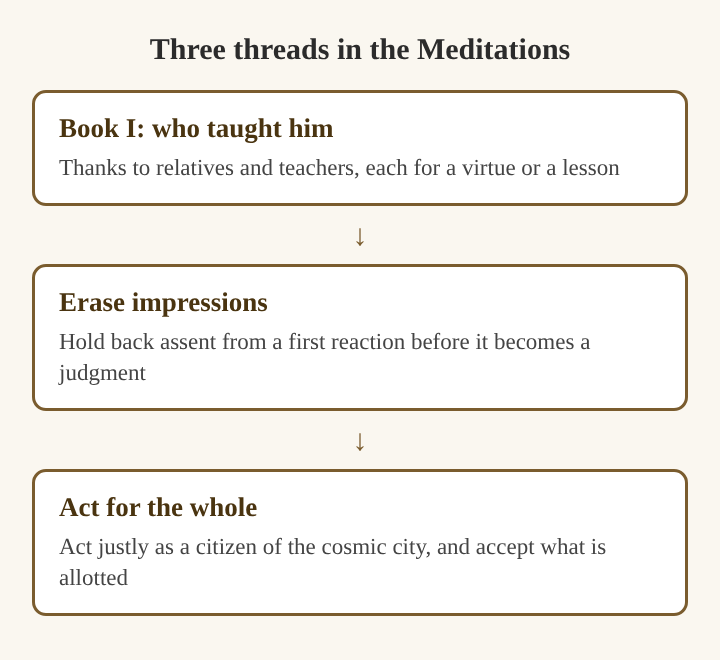
The first book reads differently from the other eleven. It is a list of thanks. Marcus names relatives and teachers one by one, and for each he records a virtue they showed or a lesson he took from them. Among them are his Stoic teachers Rusticus, Apollonius and Sextus. The book closes by thanking the gods for giving him such examples and the conditions that helped him grow.
This matters for how you read the rest. Before he gives himself a single instruction, Marcus sets down where his character came from. The rest of the work assumes that a good life is learned from people, kept up by practice, and easily lost if you stop paying attention.
The doctrines he kept reminding himself of
The Stanford entry lists the core beliefs Marcus kept returning to. The world is governed by Providence. Happiness lies in virtue, and virtue is wholly in your own power. You should not be angry at the people around you, but see them as kin. Behind these sits the Stoic view that only virtue is good, only vice is bad, and most of what people worry about (money, reputation, comfort, even health) is neither good nor bad in itself.
He did not argue for these ideas the way a treatise would. He repeated them, sharpened them, and came back to them when life pressed on him. Two pressures show up again and again: how near death always is, and how irritating other people's faults can be. Those are the moments the notes were written for. Much of this rests on the Stoic line between what is up to you and what is not.
The style follows from the purpose. Much of the work is short and blunt, close to a slogan. The Stanford entry notes that, for someone who already holds a teaching, a brief saying is enough to call it back to mind. A long proof is not needed when the aim is to remember, not to persuade.
Erasing impressions before they become judgments
One instruction recurs across several books: erase your impressions. To see what he meant, you need a piece of Stoic theory. On the Stoic account, things in the world make impressions on the mind, and you can then give or withhold your assent. A judgment is what you get when you assent to an impression. The impression itself is not voluntary. The assent is.
So Marcus could not wipe a first reaction out of his head. What he could do was refuse to sign off on it. When a colleague said something sharp, the impression "this person has wronged me" arrived on its own. Whether it hardened into anger depended on whether he agreed with it. The Wikipedia entry puts a central theme the same way: much of what troubles a person sits in their own judgment, and that part can be stripped away.
Acting justly as a citizen of the whole
The other half of the work faces outward. Marcus tells himself that two things matter: acting justly and welcoming what falls to him. Acting justly, for him, means acting for the community. Wherever you live, the Stanford entry reports him saying, you live as a citizen of the cosmic city, the whole human race taken as one state.
From this he draws a duty to do good for all people, since each person is a fellow citizen whose welfare is part of the whole. It also rules out hating anyone, even one person. For an emperor who spent his last years at war, this is a striking set of notes to keep. They read less as a description of how he lived and more as a reminder of how he meant to.
Using one entry on an ordinary day
The Meditations was a practice before it was a book, so the clearest way to understand it is to try the practice once. Here is a worked example with an invented but common situation.
- Morning. Before work, write one line to yourself in your own words: other people will be careless today, and they are still kin. Write it as an instruction, not a hope.
- The moment. At ten, a coworker sends your draft back with a curt note. The impression arrives at once: "they think you are incompetent".
- Withhold assent. Notice the impression and name it as an impression. You do not know what they think. You know the note was short.
- Act for the whole. Ask what the shared work needs. Fix the two points that are fair, and reply plainly about the third.
- Evening. Write two lines: what the impression was, and whether you assented to it. That entry is your own version of what Marcus did on campaign.
Nothing in these steps needs a quotation. That fits the work. The Stanford entry points out that Epictetus advised writing down, every day, the responses you ought to have to the situations you meet. Marcus did exactly that, and a Stoic journal is the modern form of the same habit.
Frequently asked questions
What language did Marcus Aurelius write the Meditations in?
The Meditations entry records Koine Greek, not Latin, even though he was a Roman emperor. The notes were for his own guidance, so he chose the language that suited him.
Did Marcus Aurelius mean to publish the Meditations?
Almost certainly not. The notes were written to himself, and the title Meditations was given later by a modern editor.
How many books are in the Meditations?
There are twelve books. The first is a list of people he thanks for their example, and the passages in the rest do not follow a clear time order.
What is the main idea of the Meditations?
That virtue is the only real good and lies in your own power, and that much distress comes from your own judgments. Alongside that runs a duty to act justly for all people as fellow citizens of one world.
Why the Meditations still reads as a private notebook
The Meditations has lasted not because it is a finished system but because it shows a person working. The same few ideas appear again and again, in slightly different words, because the writer needed them again and again. Death is near, so do not waste the day. Other people's faults are theirs, so do not add your anger to them. Your first reaction is not yet your judgment, so you can still decline it.
Read as a list of quotes, the book can seem repetitive. Read as a notebook, the repetition is the point. Each entry is one more attempt to remember something that is easy to know and hard to keep. That is why it rewards being read slowly, a few entries at a time, and why its most useful lesson may be the plain habit behind it: writing down, in your own words, what you mean to remember tomorrow.
How to Find Your Meaning
Find what your life is for. Visit findyourmeaning.vlvd.net