Ask what did the Reformation change in Europe, and the short answer is faith, power and the reach of print. In 1500 most of Western Europe belonged to one church led by the pope in Rome. Within a century and a half that church had split into rival confessions, rulers had taken charge of religion inside their own borders, and the printed page had shown it could outrun any authority that tried to stop it. The story runs through a handful of people, one technology and more than a hundred years of argument and war.
The people behind it are part of a longer story of how ideas and faiths spread. Learn 100 Influential People gives short lessons on the 100 people who most shaped human history, from Moses to the web, and one of its intermediate courses, Reformers and Reasoners of Faith, sits in a part about how ideas, faiths, inventions and markets spread. Its cards set out where researchers disagree, and every lesson lists its sources.
Europe before the Reformation: one church and a money problem
Around 1500 the Western church touched almost every part of life. It ran the sacraments that marked birth, marriage and death, and it claimed the final word on what scripture meant. It also needed money. In 1515 Pope Leo X granted a special indulgence to raise funds for building St. Peter's Basilica in Rome. An indulgence was a grant from the church that reduced the punishment owed for sin, and preachers sold this one widely in Germany.
Complaints about the church were not new. The Reformation had forerunners, earlier reform movements inside Western Christianity that were put down or stayed local. What changed after 1517 was that the complaint found a wide audience, a protector and a fast way to travel.
Martin Luther, the Ninety-five Theses and the break with Rome
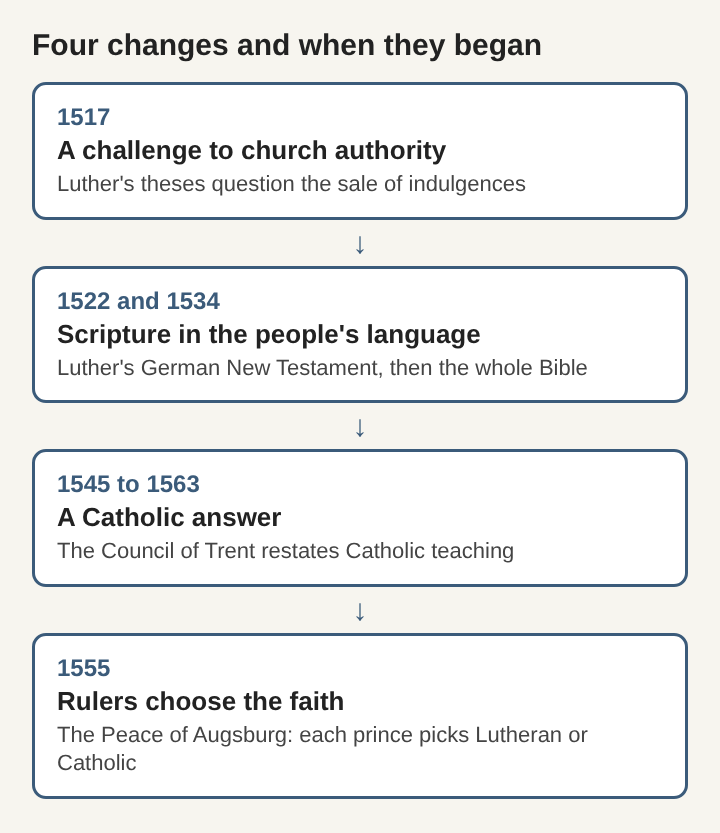
On 31 October 1517 Martin Luther, a young professor at Wittenberg in Saxony, published his Ninety-five Theses. The Stanford Encyclopedia of Philosophy entry on Luther describes them as an attack on the church's teaching on indulgences, which he thought fell short of what the Bible says about repentance. The famous image of Luther nailing them to a church door is itself an open question among historians, which is a useful reminder that even the best-known scene of the Reformation rests on thin evidence.
The dispute grew fast. Luther came to argue that a person is made right with God through faith, not through efforts to obey the law or payments to the church, and that scripture outranks the pope. The pope held back at first, because Luther's patron was Frederick the Wise, the Elector of Saxony, and Rome did not want to lose him. In 1521, at the Diet of Worms, Luther refused to take back his views. The Edict of Worms then condemned him as a heretic and banned anyone in the Empire from spreading his ideas. Frederick kept him safe anyway.
How the printing press carried the Reformation across Europe
Earlier critics had been silenced locally. Luther was not, largely because of the printing press, which Johannes Gutenberg had developed around 1440. Print let information spread quickly across Europe and lowered the cost of texts, and it fed both the Reformation and later the Scientific Revolution.
Two things made print decisive:
- Speed. A pamphlet could reach other cities before church authorities had answered the last one.
- Language. Reformers wrote in the language people spoke, not only in Latin. Luther's German New Testament came out in 1522 and the whole Luther Bible in 1534, so a household could read or hear scripture without a priest translating it.
Church leaders understood the danger. They had tried to license printers before Luther, and the effort to control what people read became part of the Catholic response.
Zwingli, Calvin and the many Reformations
The Reformation was never one movement. In Zurich, Huldrych Zwingli led a reform of his own, and in Geneva the French reformer John Calvin built what became the Reformed tradition. They disagreed with Luther on communion: Lutherans held that Christ is bodily present in the bread and wine, while the Reformed saw a spiritual presence. That one disagreement kept the Protestant camp divided for generations.
In England, Thomas Cranmer led the Reformation, and in Scotland John Knox did, both within the Reformed line. Because the movements differed so much, many historians now speak of Reformations in the plural, parallel efforts rather than one plan. The four changes that mattered most can be set out in order.
How the Reformation moved power to kings and princes
The Reformation shifted power away from Rome and toward the rulers of each land. Once a ruler could decide the faith of a territory, the church inside it answered to that ruler.
Follow one small German prince in the 1540s to see how the choice worked. If he turned Lutheran, he set the church in his lands and stopped answering to Rome, but he risked the emperor's anger. If he stayed Catholic, he kept the emperor's favour but might face Lutheran towns of his own. The Peace of Augsburg of 1555 settled the question by law within the Holy Roman Empire: each ruler chose either Lutheranism or Catholicism as the faith of his state. Subjects who disagreed were given time to move to a land that shared their faith, though serfs were mostly left out of that right. Calvinism was not allowed at all.
The principle was later summed up as cuius regio, eius religio, "whose realm, his religion". The prince's choice became the people's faith, and religion became a matter of the state.
Wars of religion and the Peace of Westphalia
Augsburg did not end the fighting. France went through the French Wars of Religion from 1562 to 1598, between Catholics and Protestants. The Thirty Years' War, from 1618 to 1648, drew in much of Central Europe.
The Peace of Westphalia closed that war in 1648 and finally made room for Calvinism next to Lutheranism and Catholicism. Many scholars see Westphalia as the start of the modern system of sovereign states. Others argue that this reading was added in the nineteenth and twentieth centuries. Historians also disagree on when the Reformation ended at all: 1555, 1618 and 1648 are each named.
How the Reformation changed family life and work
Protestant clergy could marry. In 1525 Luther married Katharina von Bora, a former nun, and the married pastor became a familiar figure in Protestant towns.
Work gained a new meaning as well. In 1905 the sociologist Max Weber argued in The Protestant Ethic and the Spirit of Capitalism that the Protestant, and above all the Calvinist, ethic pushed people to work hard in ordinary trades and build their own enterprises, which helped capitalism grow in Northern Europe. Historians and economists have argued over the thesis ever since.
Frequently asked questions
Why did the Reformation start in Germany?
The Holy Roman Empire was split into many states, so no single ruler could crush a movement the way a strong king might. Luther also had the protection of Frederick the Wise, and German printers spread his work quickly.
What was the Catholic response to the Reformation?
The Counter-Reformation, often dated from the Council of Trent, which met from 1545 to 1563. The council restated Catholic teaching on scripture, salvation and the sacraments and condemned Protestant views.
Did the Reformation make Europe more tolerant?
Not at first. Augsburg let rulers choose a faith for their subjects, not let each person choose, and more than a century of war passed before Westphalia gave room to a third confession.
What did the Reformation change in Europe in the long run?
It ended religious unity in Western Europe and put churches under the authority of states. It also spread scripture in everyday languages and opened a slow road toward living with rival faiths.
What did the Reformation change in Europe and the modern world?
The Reformation broke the claim that one institution could speak for all of Western Christianity. In its place came several churches, each tied to a state or a community. That plurality was not tolerant at first. It took more than a century of war before rulers accepted that rival faiths had to live side by side.
Its effects reached past religion. Ideas in print kept moving after the authorities had tried to stop them. Rulers learned they could govern without Rome's approval, a lesson that movements in the Age of Revolutions later turned against kings themselves. And the claim that each person could read and judge scripture fed later arguments about conscience and schooling.
Whether the change came from a few remarkable people or from deeper forces is its own debate, close to the questions raised by the great man theory of history. Luther, Zwingli and Calvin made choices that mattered. They also worked inside a world of presses, princes and grievances that gave those choices their reach, and Europe's map of faiths still carries its outline.