If you have asked what was the age of revolutions, the short answer is a stretch of about eighty years, from the 1760s to 1849, when uprisings in the Americas and Europe pulled down kings and wrote constitutions in their place. Historians date it from the American Revolution to the crushed revolts of 1848 and 1849. Learn 100 Influential People gives the period a course of its own, The Age of Revolutions, among its Intermediate courses on how ideas spread and changed the world.
The useful way to read the period is as a chain, not a list. Each revolution borrowed words, flags and plans from the one before it. Once you see the links, the dates stop being a pile of numbers and start telling one story.
What was the age of revolutions, in one sentence
The Wikipedia summary of the Age of Revolution describes it as a period from the late 18th to the mid 19th centuries in which major revolutionary movements broke out across most of Europe and the Americas. Its lasting mark was a change in how states were run: from absolutist monarchies to representative governments with a written constitution, and the creation of nation states.
Two ideas carry most of the weight here. The first is that power should come from the people and be written down, so a ruler cannot simply change the rules. The second is that a people who share a language and a history should have a state of their own. The revolutions of the period pushed one idea, the other, or both at once.
Where the name comes from
The label is younger than the events. The British historian Eric Hobsbawm made it popular with his book The Age of Revolution: Europe 1789 to 1848, published in 1962, as the same Wikipedia page records. Hobsbawm argued that France gave the century its ideas, to the point that a tricolour of some kind became the emblem of almost every new nation.
He went further. In his reading, world politics from 1789 to 1917 was largely a struggle for and against the principles of 1789. That is a strong claim, and other historians date the period differently, starting it in 1765 with the American quarrel with Britain. Both choices agree on the core: the decades around 1800 changed what a government was supposed to be.
The American start and the French explosion
The American Revolution, from 1765 to 1783, is usually treated as the starting point, and it drew on the ideas of the Enlightenment, according to the Age of Revolution article. France, the Netherlands and Spain helped the new United States break away from Britain. A colony had broken away and written its own constitution, and the world watched it work.
France followed in 1789, and its revolution spread across Europe through its wars. In 1799 Napoleon took power and went on to conquer most of the continent. He carried some new ideas with him, such as equality before the law and a written civil code, yet his hard military occupation set off national rebellions, most of all in Spain and Germany. The man who exported the revolution also taught other peoples to resist a foreign ruler.
Haiti, Spanish America and the Atlantic chain
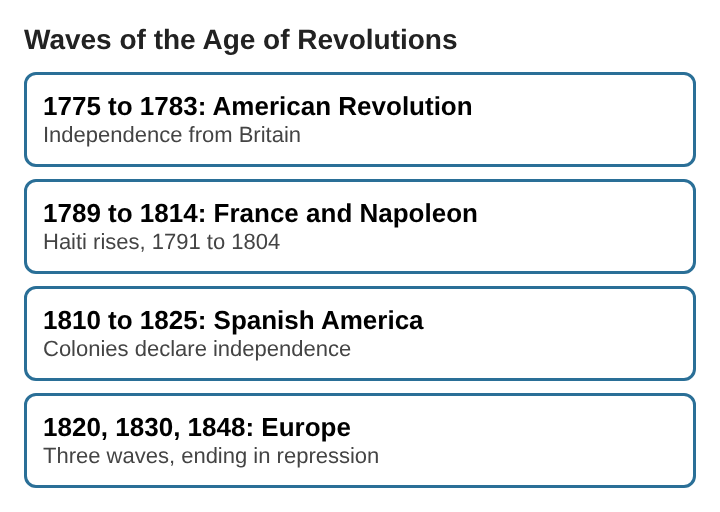
The revolutions did not stay in Europe and North America. The list of revolutions in the period runs from the United States (1775 to 1783) and the Polish Lithuanian Commonwealth (1788 to 1792) to France and French controlled Europe (1789 to 1814), Haiti (1791 to 1804), Ireland (1798) and Spanish America (1810 to 1825). The revolutionaries in these places knew of each other, and to some degree copied each other.
Haiti matters most to anyone tracing who was left out of the first promises. There, enslaved people rose against colonial rule in the 1790s and built a self-governing state by 1804. Further south, Spain had been weakened by the Napoleonic Wars and could not hold its American colonies, and almost all of them declared themselves free of Spain between 1810 and 1820. A war in Europe had opened the door for a whole continent.
Reading the waves: a worked example
A simple way to make sense of any revolution in the period is to ask three questions about it, in order, using the dates from the Age of Revolution page.
- What did it want? A written constitution, freedom from an empire, or national unity.
- What did it borrow? Which earlier revolution gave it its words, symbols or chance.
- How did it end? A new state, a restored king, or defeat.
Take the Spanish American wars against Spain. What did they want? Freedom from Spanish rule. What did they borrow? The American example of a colony becoming a republic, and the chance created when Napoleon's wars broke Spanish power at home. How did they end? With nearly all of Spain's mainland colonies self-governing by the 1820s.
Now run the same three questions on the European revolts of 1820. They wanted constitutions in Portugal, Spain and the Italian states, and self-rule in Greece. They borrowed the French language of rights. Most of them ended under pressure from the great powers, which had formed the Holy Alliance at the Congress of Vienna in 1814 and 1815 precisely to stop revolutions and restore the old monarchies. The same three questions sort a messy decade into a clear pattern: ideas travel fast, but the old order fights back.
1830, 1848 and the end of the era
Continental Europe was shaken twice more, in 1830 and in 1848. The revolutions of 1848, also called the springtime of the peoples, spanned almost two years, from January 1848 to October 1849, and they remain the most widespread revolutionary wave in European history. Their aims varied, but they generally opposed absolute monarchy and feudalism.
In 1848 the democratic demands often merged with movements for national unity, in Italy, Germany, Poland and Hungary among others. Most of these revolts were put down by force, and that violent repression is the point at which historians close the era, as the Age of Revolution article notes. The kings survived 1848, yet the ideas of written rights and national states did not go away.
Frequently asked questions
When did the Age of Revolutions start and end?
It is usually dated from the American Revolution, which began in 1765, to the defeat of the revolutions of 1848 and 1849. Some historians, following Hobsbawm, start it in 1789 with France.
Why is it called the Age of Revolutions?
Because so many revolutions happened in one connected period, across Europe and the Americas. The name was made popular by Eric Hobsbawm's 1962 book.
Was the Industrial Revolution part of it?
The Industrial Revolution ran through the same decades and is often listed among the period's outcomes. The name Age of Revolutions, though, usually means the political uprisings.
Who were the leading figures of the period?
The best known include the leaders of the American and French revolutions, Napoleon, the leaders of the Haitian Revolution and the liberators of Spanish America. Each one drew on ideas first argued in the Enlightenment.
Why the Age of Revolutions still shapes politics
Most countries today have a written constitution, claim that power comes from the people, and see themselves as a nation with a right to its own state. Those three habits were rare in 1760 and common by 1850. The Age of Revolutions is the period when they moved from pamphlets into law, often at great cost, and the arguments it started, about who counts as the people and how far rights extend, are still being settled now.