What was the age of revolutions? It is the name historians give to the decades from the 1760s to 1848, when uprisings in North America, France, Haiti and Spanish America overturned kings and colonial rule. In the same years, new machines in Britain changed how goods were made. The Age of Revolution is usually framed as one connected wave rather than a string of separate events. People, pamphlets and armies moved across the Atlantic and carried arguments with them.
The period gets its own course in a set of short lessons on the 100 people who most shaped human history. That course, The Age of Revolutions, sits in the intermediate part, which follows how ideas, faiths, inventions and markets spread and changed the world. The period itself raises three questions: what drove it, where it broke out, and what it left behind.
What Was the Age of Revolutions? Dates and Definition
There is no single agreed start or end date. Most accounts begin with the American colonists' revolt against Britain in the 1770s and close with the uprisings that swept Europe in 1848. Some historians start with the French Revolution of 1789 instead.
The term was popularized by the British historian Eric Hobsbawm, as the overview of the Age of Revolution notes. His book, published in 1962, covered Europe from 1789 to 1848. The same overview names the change the period is known for: from absolute monarchies to representative governments with written constitutions, and the creation of nation states.
A working definition has three parts:
- Political: rule by hereditary monarchs and distant empires gave way, in several places, to governments that claimed to rest on the will of the people.
- Social: old legal ranks, such as nobility, serfdom and in some places slavery, came under direct attack.
- Economic: factory production, steam power and wider markets began to reshape work and trade.
Enlightenment Ideas Behind the Age of Revolutions
The revolutions did not start from nothing. They were influenced by the new ideas of the Enlightenment, as the overview of the Age of Revolution puts it.
A few books did much of the work. John Locke's Two Treatises of Government came out anonymously in 1689, after the Glorious Revolution, and asked what makes a ruler's power rightful. Jean-Jacques Rousseau made the general will of citizens the measure of legitimate law, a claim the Stanford entry on Rousseau examines along with its problems. Questions like these turned obedience from a habit into something a ruler had to justify.
Arguments about rightful rule are far older than the 18th century, and some reach back to the thinkers covered in who the most important Greek philosophers were.
The American Revolution and the Opening of the Age of Revolutions
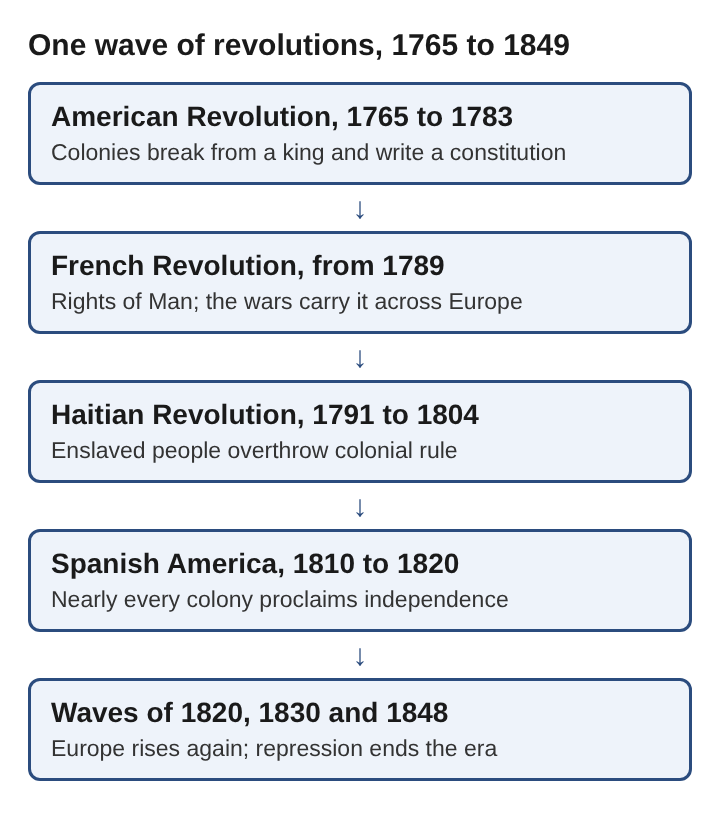
The American Revolution grew out of disputes over taxes and representation in the 1760s. The overview of the period dates it from 1765 to 1783 and calls it the usual starting point of the whole age. In January 1776, Thomas Paine published Common Sense. It was a short, blunt pamphlet, printed in Philadelphia, that argued for a full break with the British crown.
The war ended in 1783, and the new United States went on to write its own constitution.
The French Revolution at the Center of the Age of Revolutions
The French Revolution began in 1789. The crown could not raise new loans, and in August 1788 it announced that the king would summon the Estates-General, a body that had last met in 1614. When it met in 1789, its commoners declared themselves a National Assembly.
In August 1789 the Assembly passed the Declaration of the Rights of Man and of the Citizen. Its title alone shows the shift: rights belonged to people and citizens, not only to the crown.
Napoleon Bonaparte took power in 1799 and conquered most of continental Europe. He brought equality before the law and a civil code to the lands he took, yet his military occupation set off national rebellions in Spain and Germany, as the overview of the Age of Revolution records.
France sits at the center because its ideas and its wars reached so far. Its upheaval also opened the question that drove events in the Caribbean: did the rights of man apply to everyone?
Haiti and Latin America in the Age of Revolutions
Saint-Domingue was France's Caribbean colony, worked by enslaved Black Africans. In 1791 they rose up against French colonial rule.
The Haitian Revolution lasted more than a decade. It ran from 1791 to 1804. On 1 January 1804, in the city of Gonaïves, Jean-Jacques Dessalines declared the former colony free of France and renamed it Haiti, after the Arawak name for the island.
Spanish America followed. The Napoleonic Wars left Spain too weak to hold its American colonies, and almost all of them broke away from Spanish rule between 1810 and 1820. Revolution then spread back to southern Europe in 1820, with uprisings in Portugal, Spain, Italy and Greece.
The Industrial Revolution and the Economy of the Age of Revolutions
The overview of the period lists the Industrial Revolution among its outcomes, beside the end of feudalism and the rise of republicanism. Machines and steam power moved more and more work into factories, and the engineer James Watt is one of the names tied to that change.
The ideas about markets shifted too. Adam Smith published The Wealth of Nations in 1776, the same year as Paine's pamphlet. The record of the book gives the date, 9 March 1776, and its aim: to explain the principles by which commercial and industrial societies work.
Industry produced new wealth and new grievances, and both were in the air when Europe rose again in 1830 and 1848.
How Ideas Spread Across Borders During the Age of Revolutions
The clearest way to see the period as one wave is to follow a single idea from place to place. Take a reader who starts with Bolívar and asks where his ideas came from. The chain runs like this:
- Locke publishes his Two Treatises of Government in 1689, asking what makes a ruler's power rightful.
- Paine turns that into plain language for colonists in January 1776 with Common Sense.
- The French Assembly writes universal rights into law in August 1789, in the Declaration of the Rights of Man and of the Citizen.
- Enslaved people in Saint-Domingue rise in 1791 against French colonial rule, opening the Haitian Revolution.
- Haiti declares itself a free state on 1 January 1804.
- In Haiti, Simón Bolívar befriends the Haitian leader Alexandre Pétion. After promising to abolish slavery in Spanish America, he gets military support from Pétion and returns to Venezuela.
Putting those events in order shows that each step depended on the one before. Ideas traveled by pamphlet, by soldiers who had fought abroad, and by exiles who moved from one revolution to the next.
Questions that ask learners to put events in order are one of the formats used in Learn 100 Influential People, where a lesson takes about nine minutes. Its cards set out where researchers disagree, and each lesson lists its sources so a learner can read the original work.
That disagreement matters here. Historians argue about how much credit belongs to famous leaders and how much to crowds, soldiers and the enslaved. The debate over the great man theory of history runs right through this period.
Frequently asked questions
When did the Age of Revolutions start and end?
The overview of the period dates it from 1765 to 1849, with the American Revolution as the usual starting point. Hobsbawm's book instead starts at the French Revolution of 1789 and ends in 1848.
Who coined the term Age of Revolutions?
The British historian Eric Hobsbawm popularized it with his 1962 book, The Age of Revolution: Europe 1789 to 1848.
How did the Scientific Revolution shape the Age of Revolutions?
The Scientific Revolution changed how Europeans studied nature in the century before. The revolutionaries were influenced by the Enlightenment that followed it, as the overview of the Age of Revolution notes.
Were the revolutions of 1848 part of the Age of Revolutions?
Yes, in most accounts they close it. The revolutions of 1848, also called the springtime of the peoples, merged democratic demands with movements for national unity in Italy, Germany, Poland and Hungary. Their violent repression marked the end of the era.
The Lasting Legacy of the Age of Revolutions
The period left behind ideas that most modern states still claim to follow. Written constitutions, the split of power between branches, and rights held by every citizen all came from it. So did the claim that a government's authority comes from the people it governs.
It also left unfinished arguments. The French and American declarations spoke of universal rights while many people were still excluded. Haiti showed that the enslaved would claim those rights by force if they had to, as the record of the Haitian Revolution makes clear. The struggles over slavery, voting, women's rights and labor that filled the 19th and 20th centuries were fought largely in the language the revolutionaries had written.
The economic side lasted just as long. Factories, steam and global markets grew into the industrial world. The questions they raised, about who benefits from new wealth and what workers are owed, are still argued today.