If you are asking what is a minimum viable product, the short answer is this: it is the smallest thing you can put in front of real people that shows you whether your idea deserves more of your time. A minimum viable product, or MVP, is not a cheap copy of the finished product. It exists to answer one question, and that question sets its size. AI Entrepreneur is a set of short lessons on how to build, launch and grow a business with AI, and the history of AI that led here.
What is a minimum viable product, in plain terms
The Wikipedia entry on the minimum viable product defines an MVP as a version of a product with just enough features to be usable by early customers, who can then give feedback that guides what gets built next. "Minimum" refers to your effort. "Viable" refers to whether it delivers something real to the person using it.
An MVP is judged by what you learn, not by what you ship. A founder who spends four days on a rough version and learns nobody wants it has the same answer as one who spent four months, and time left to try again.
The same entry gives a second definition: the version of a new product that lets a team collect the most validated learning about customers with the least effort. Because it pairs "most" with "least", there is no formula; each founder judges how small is small enough.
Where the minimum viable product idea came from
According to that entry, the term was coined and defined in 2001 by Frank Robinson and later made popular by Steve Blank and Eric Ries. Blank's position was that the core of the method is checking the beliefs behind a product by asking customers whether they want it, and changing course when a belief turns out to be false. The entry adds why this matters: the main cause of startup failure is a lack of market need.
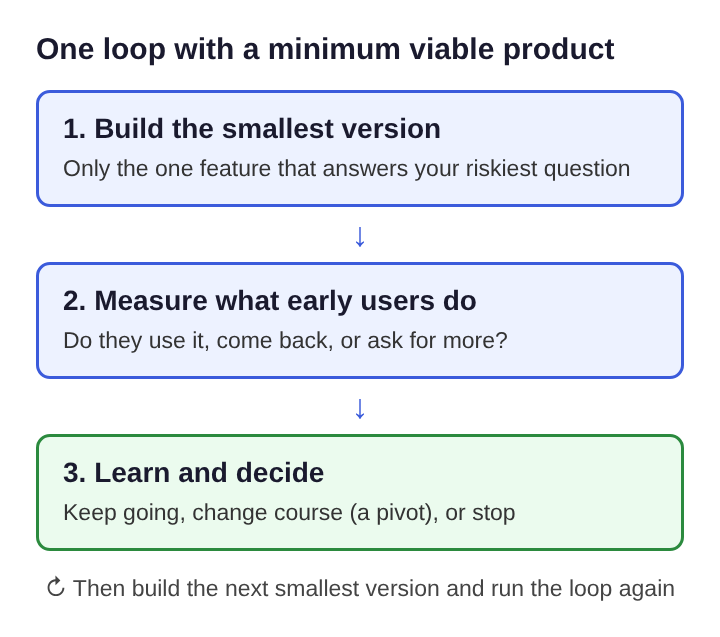
Ries carried the idea into the lean startup method, set out in his book The Lean Startup, published in September 2011. At its center is the Build, Measure, Learn loop: build the smallest version, measure what people do with it, and learn enough to decide the next step. When the lesson is that the plan is wrong, the method calls the change a pivot, a structured course correction.
What makes a minimum viable product viable and not just minimal
Many founders get the "minimum" part right and the "viable" part wrong. A clickable mockup nobody can use shows that people like the screens, not that they would rely on the product.
A viable MVP solves the core problem for at least a few people, well enough that they would come back or hand over money. The useful signals cost the person something:
- They pay, or commit to pay, before the product is finished.
- They give you time, such as a call, a setup session, or a second visit.
- They hand you their real data or their real work to process.
- They return without a reminder.
The Wikipedia entry gives a case that shows the difference. In 2015, a team at the University of Sydney built the Rippa robot for weed and farm management. It could already tell weeds from crops. Whether it would be useful on a working farm was still open, and that business question was the one an MVP had to answer before more money went in.
Forms a minimum viable product can take, from hand-run services to one feature
An MVP does not have to be software. The form depends on what you need to find out.
- A service you run by hand. You deliver the result yourself to a small group, and they know a person is doing the work. In "Do Things That Don't Scale", Paul Graham writes that with only a few users you can do by hand the things you plan to automate later, which lets you launch faster and shows you exactly what to build when you do automate. One of his examples is Airbnb's founders going door to door in New York.
- A hidden person behind an interface. The customer uses an interface that appears to run on its own while a person handles each request. The name for this comes from the Wizard of Oz experiment, in which people use a system they believe runs on its own but an unseen person operates.
- A single feature. A working tool that does one job and nothing else, the "just enough features" of the definition taken literally.
How the long history of AI changed the cost of a first version
The question of whether machines could think was set out in Alan Turing's 1950 paper "Computing Machinery and Intelligence", built around his imitation game. The decades after brought large promises and sharp funding cuts: the two major AI winters lasted roughly from 1974 to 1980 and from 1987 to 2000, as covered in the two funding collapses. That stretch is where AI Entrepreneur begins: its first lesson is "Thinking Machines: Turing to the AI Winters", and the next part, "Your first business", turns to building a company.
A turning point for founders came with the 2017 paper "Attention Is All You Need", which introduced the Transformer, a network design built on attention. Language models built on that design can now write a rough first version of a simple tool, or do some of the work behind a hidden-person MVP. Whether a founder needs to code at all is its own question, taken up in do you need to code to build an AI startup.
One thing did not get cheaper. AI lowered the cost of building. It did not lower the cost of finding out whether anyone wants what you built. That still takes real people and real behavior.
How to scope a minimum viable product around one question
Scope comes from the riskiest thing you believe. Here is a worked example. Say you want to offer an AI tool that drafts replies to customer emails for small online shops. The belief that would sink it fastest if wrong: shop owners will trust software with their customer emails and pay a monthly amount for it.
- Write the question in one sentence. "Will at least a few small shop owners let an AI draft their customer replies, and pay for it after two weeks?"
- Set a pass mark before you start. For example: three of the five shops you approach keep using it and pay at the end of week two.
- Pick the cheapest form that answers it. Here, a service run by hand works. Each morning you paste the shop's emails into a language model, edit the drafts, and send them back in a shared document. No app, no integrations.
- Cut everything that does not serve the question. A login system, a dashboard and a logo all fall outside it.
- Run it and read the result honestly. If three shops pay, you have a reason to automate, and you know which steps to automate first. If none do, you learned that in two weeks.
Finding those five shops is its own skill, covered in how to find your first customers for a new business. The wider practice of checking an idea before you commit is set out in how to validate a business idea before building it.
Mistakes and limits of the minimum viable product
- Adding "just one more" feature. Each addition delays the answer and blurs which part people responded to.
- No pass mark set in advance. Without one, any result can be read as encouraging.
- Counting interest instead of commitment. Page visits and email addresses are weaker than money or repeat use.
- Ignoring the quality of AI output. If the product depends on a model's answers, write down what makes an answer good before launch. That habit is the start of an eval for an AI product.
The idea has critics too. The Wikipedia entry notes research showing that an early release can help a competitor copy the idea, that bad early feedback can hurt a company's name, and that users of apps and digital products can switch to a better made rival in seconds.
Frequently asked questions
How long should a minimum viable product take to build?
Long enough to answer one question and no longer. If the plan runs to months, the scope probably holds more than one question.
Is a prototype the same as a minimum viable product?
No. A prototype shows how something could work and is often seen only by the people making it. An MVP goes to real users and has to deliver enough value that their behavior tells you something.
Can AI tools build a minimum viable product for a founder?
AI tools can write much of the code and copy, and can do some of the work behind a hidden-person setup. They cannot decide which question matters or find the people who will answer it. That part still falls to the founder.
What comes after a minimum viable product?
If the result passes, you build the next version around the next riskiest belief and run the loop again. The goal over many rounds is product-market fit, the degree to which a product satisfies a strong market demand, and the signs of it are set out in what is product-market fit and how do you know you have it.
What a minimum viable product comes down to
A minimum viable product is a question you put in front of people. You name the belief that could sink the business, set a pass mark, and build the least you can that still gives people something real. Then you watch what they do, not what they say. Founders who tie each MVP to a single question get more answers from the same amount of time.
AI Entrepreneur
Building a business in the age of AI, from a first project to a company. Visit aientrepreneur.vlvd.net