If you are working out how to find your first customers for a new business, you probably have a product that mostly works and a long list of people who have never heard of it. That gap closes by hand. You pick a small group of people with a specific problem, you reach them one at a time, and you keep talking with them until some of them pay. AI tools now make the research and the writing faster, which changes how much one founder can get done in a week, but not what wins a customer. AI Entrepreneur, a set of short lessons on building, launching and growing a business with AI, puts this stage in the second of its three parts, "Your first business", between how AI works and growing a company.
Why the first customers come before growth
Growth tactics multiply something. Ads, content and partnerships all assume you already know who wants the product, what problem it solves for them, and what words they use to describe that problem. If you do not know those things, growth tactics multiply guesses.
First customers give you that knowledge. They show you which feature they actually use, what makes them hesitate, and what they were doing before you showed up. Paul Graham's essay Do Things that Don't Scale says the most common unscalable thing founders do at the start is recruit users manually, because users will not come on their own. He describes the Stripe founders setting the product up on the spot, on the laptop of anyone who agreed to try it, and the Airbnb founders going door to door in New York to recruit hosts and help them improve their listings. Neither approach scales. Both teach the founder things no dashboard can.
Marketers have a name for these people. An early adopter, sometimes called a lighthouse customer, is an early customer of a company or product; the term comes from Everett Rogers' 1962 book Diffusion of Innovations. Early adopters put up with rough edges because the problem hurts more than the product's flaws do.
If you have not yet checked that the problem is real, do that first. The steps for validating a business idea before building it overlap with finding first customers, because the people you interview are often the people who become your earliest users.
Describing the first customer in one sentence
A first customer is a specific person or company with a problem painful enough that they will act on it now. You should be able to describe them in one sentence that tells you where to find them.
Take a worked example. A founder is building an AI tool that drafts insurance appeal letters for physiotherapy clinics. A weak description of the first customer is "healthcare providers." That covers millions of people and tells you nothing about where to look. A strong one reads: "Office managers at clinics with two to ten physiotherapists who write more than five appeal letters a month and do them after hours." Now the founder knows the job title, the clinic size, the pain, and the moment it hurts.
A good first customer usually meets four conditions:
- They have the problem often enough that it costs them time or money each month.
- They know they have it, so you do not have to convince them it exists.
- They have tried to fix it with a spreadsheet, a template, a hire or a workaround.
- They can decide alone, without a committee or a six-month approval process.
If a group fails the last condition, it may still be a market later. It is a slow place to start.
Steve Blank's customer development method makes the same move formal. Its first step, customer discovery, turns the founder's vision into a set of hypotheses about the business and then plans how to check each one against what real customers do. The one-sentence description is the first of those hypotheses, and every conversation either supports it or changes it.
How to find your first customers for a new business by direct outreach
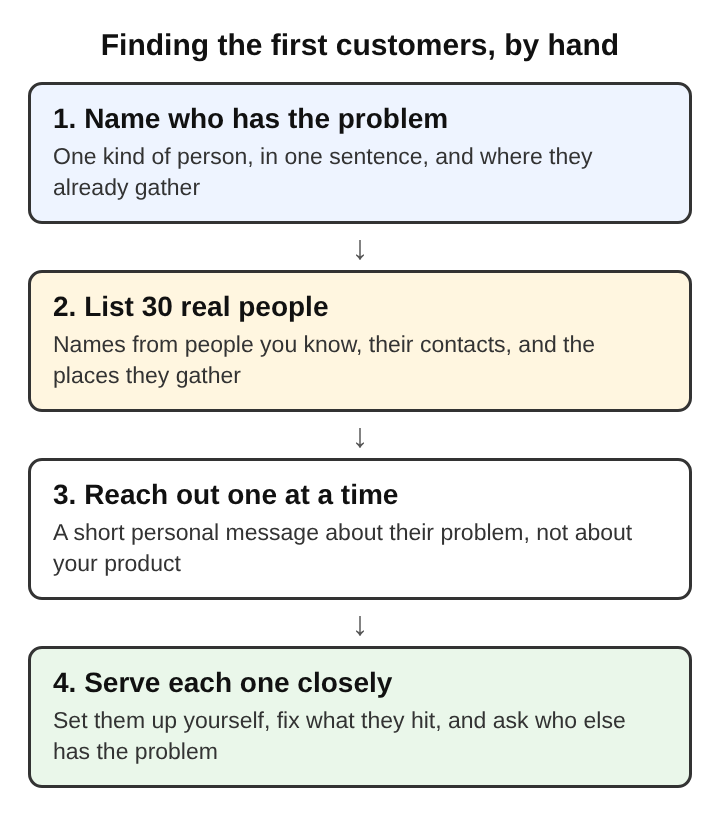
Start with a list of 30 to 50 named people who fit your one-sentence description. Names, not segments. Places to build that list include:
- Your own contacts and their contacts, asked directly for introductions.
- Online groups and forums where people in that role ask each other for help.
- Industry directories, trade associations and local business groups.
- Small events and meetups where the role gathers in person.
- Public posts where someone complains about the exact problem you solve.
The message should be short and about their problem, not your product. In the clinic example it might read: "You run billing at a four-person clinic. Office managers in that spot often say appeal letters eat their evenings. Is that true for you? A tool for it is in the works, and 15 minutes of your time would help shape it." Then follow up. Many replies come on the second or third message, not the first.
On the call, ask about the last time the problem happened, what they did, and how long it took. If they want to try your product, set it up with them right then, while you are still talking. Keep a plain spreadsheet: name, date contacted, reply, what they said, next step. After 20 conversations, that sheet will tell you more than any market report.
For a business that sells to other businesses, Graham goes further: pick a single user and act as if you were a consultant building something just for them. In the clinic example, that means sitting with one office manager while they write a real appeal and shaping the tool around how they work. Other clinics of the same size and kind tend to want the same thing.
Where AI helps with outreach and where it does not
Language models help most with the parts of outreach that are reading and writing. They help least with the parts that are trust.
Useful jobs for AI at this stage:
- Research before a message. Paste a clinic's public website and ask for three specific details about how they handle billing. Then check each one yourself.
- Drafting variants. Ask for five versions of your opening line for different roles, and pick the one that sounds most like you.
- Finding patterns in notes. After 15 calls, paste your notes with names removed and ask which complaints repeat and which words people use most.
- Practicing objections. Ask the model to play a skeptical office manager so you hear the hard questions before a real call.
An AI agent can chain some of these steps, such as searching for clinics in a region and drafting a summary of each. The rule stays the same: the AI drafts, you check every fact, and you send each message yourself. A message with an invented detail about someone's business ends that conversation. Hundreds of unread drafts sent at once get ignored and hurt your name in a small market.
If your product is itself an AI tool, check its output before the first demo. An early customer judges the whole product on one bad answer. A simple eval for an AI product catches the worst failures before a customer does. None of this needs a technical background, and many AI businesses start with little code.
Turning first customers into repeat customers and referrals
A first sale is the start of the work. Stay close to each early customer for the first few weeks. Check in after their first use, fix what breaks quickly, and tell them when you have fixed it. Graham's essay gives the extreme case: for as long as it could, Wufoo sent each new user a hand-written thank you note.
Watch whether they come back without a reminder. A customer who uses the product again on their own is a much stronger signal than one who said kind things on a call. Write down the exact words they use when they describe the benefit, because those words make better outreach messages than anything you write from scratch.
When a customer has clearly gotten value, ask one question: "Who else do you know who deals with this?" Ask for one introduction, not a list. People in the same role tend to know each other, and an introduction from a peer gets a warmer reply than a cold message. Over a few months, a small group of satisfied first customers can supply much of your next list of names.
Frequently asked questions
How many first customers does a new business need?
There is no fixed number. You need enough to see a pattern in why people use the product and why they stay, which for many new businesses is a handful to a few dozen regular users.
Can AI write outreach messages to first customers?
AI can draft them well, especially when you give it real research about each person. You still need to check every fact, make each message specific, and send it yourself.
Where do first customers for an AI startup usually come from?
Most come from the founder's own contacts, introductions from those contacts, and direct messages to a narrow group of people who share a clear problem. Online communities where that group asks for help are another common source.
What is a lighthouse customer?
It is another name for an early adopter: one of the first customers of a product, who takes it on while it is still rough because the problem matters more to them than the flaws.
What first customers teach a new business
The first customers of a new business are worth more for what they teach than for what they pay. They show which problem is real, which words describe it, and which kind of person feels it most. Each one reached by hand sharpens the one-sentence description, and each satisfied one points to the next person who shares the problem. That loop, repeated a few dozen times, is how a product with no audience gets its first steady users.
AI Entrepreneur
Building a business in the age of AI, from a first project to a company. Visit aientrepreneur.vlvd.net