People who ask what is an AI agent and what can it do for a business usually want two things: a definition that holds up, and a clear sense of which jobs inside a company an agent can carry. An AI agent is software built around a language model that works toward a goal in steps. It reads a situation, picks an action, uses a tool, checks the result and decides what to do next. For a small company, that can mean answering support email, updating records or following up with leads. The history behind these systems and the practical work of building a company on top of them are the subject of AI Entrepreneur, a set of short lessons on becoming an entrepreneur in the age of AI.
What Is an AI Agent and What Can It Do for a Business? A Working Definition
The word "agent" is older than chatbots. AI textbooks define an intelligent agent as anything that perceives its environment and acts on it to reach a goal. A thermostat fits that definition in a very small way. A modern AI agent fits it in a much larger way.
A business AI agent today has three parts:
- A model that reads text and decides what to do. This is usually a large language model.
- Tools the model is allowed to call, such as a search function, an email inbox, a spreadsheet, a calendar or a store database.
- A loop that feeds each tool result back to the model so it can choose the next step, until the goal is met or a person steps in.
Researchers described this pattern in the ReAct paper, where a language model alternates between reasoning about a task and taking actions, then uses what it observes to adjust its plan.
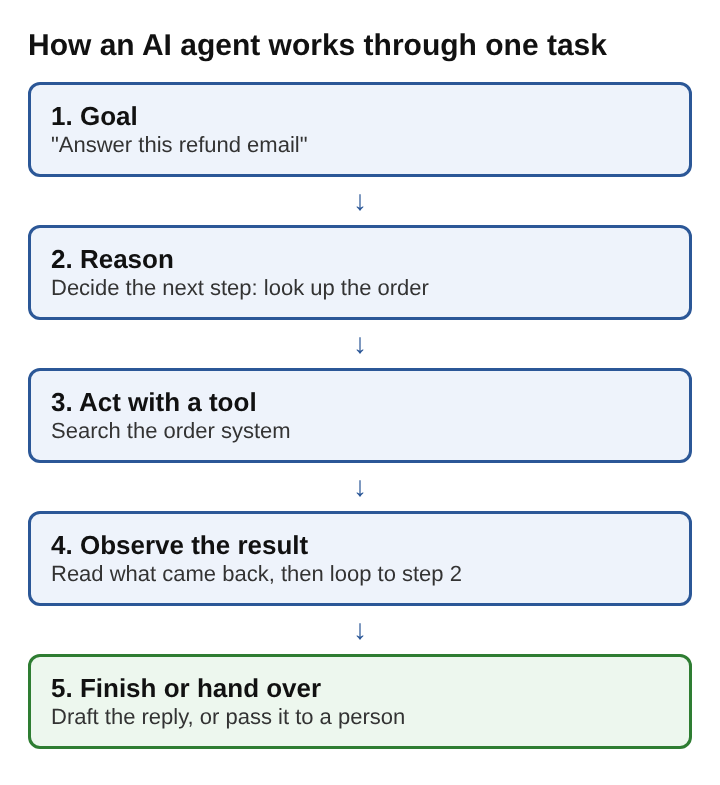
Here is a concrete case. You run an online shop that sells ceramic mugs. A customer writes: "My order arrived cracked." An agent reads the email and finds the order number. It looks up the order in your store system, checks the delivery date against your return window, writes an apology and prepares a replacement order. Then it either sends everything to you for approval or, if your rules allow it, sends the reply and places the order itself. No one wrote a fixed path for that email. The agent chose each step from the tools it had.
How an AI Agent Differs From a Chatbot or an Automation Script
A chatbot talks. You ask a question and it answers in the conversation. Unless it is connected to tools, it cannot look up your order or change anything in your systems.
An automation script acts, but only along a path someone wrote in advance. "When a form is submitted, add a row to the sheet and send email template B." It is fast and predictable. It also breaks when the input does not match what the author expected, such as a customer who puts the order number in the subject line instead of the form field.
An agent sits between the two. It reads messy input with the flexibility of a language model, and it can act through tools. The cost of that flexibility is predictability. A script does the same thing every time. An agent may take a different route on two similar emails. That is why most businesses give agents narrow jobs, clear rules and a person who checks the work.
Tool use itself was a research question before it became a product feature. The Toolformer paper showed that a language model could learn when to call outside tools, such as a calculator or a search engine, and how to use the results in its answer.
From Expert Systems to AI Agents: The History That Led Here
The idea of a machine that reasons about a task goes back to Alan Turing, who asked in 1950 whether machines could think. His argument still frames much of the debate, and a fuller account of it is at what Alan Turing said about thinking machines.
The first wave of business AI came in the 1970s and 1980s with expert systems. Engineers interviewed human experts and wrote their knowledge down as thousands of if-then rules. One well-known example, XCON, configured computer orders at Digital Equipment Corporation. Expert systems worked inside a narrow area, but they were costly to maintain. Every new case needed a new rule, and they failed badly on inputs no one had planned for.
When those limits became clear in the late 1980s, money for the field dried up. That collapse is part of the AI winter story, and the two funding collapses known as the AI winters show how quickly support can leave a field when results fall short of promises.
Today's agents solve the problem that sank expert systems. Instead of hand-written rules, they rely on language models trained on huge amounts of text, built on the transformer design introduced in "Attention Is All You Need" in 2017. A model trained that way can read an email it has never seen and still work out what the sender wants. Add tools and a loop, and you have the current AI agent.
What an AI Agent Can Do for a Business: Sales, Support and Operations
The useful jobs share a pattern: they repeat often, they involve reading and writing, and the steps can be checked.
Sales
- Research a list of leads and write a short note on each company before a call.
- Draft first-contact emails that refer to something specific about the prospect.
- Update your customer records after a meeting, using your notes or a transcript.
Support
- Sort incoming messages by type and urgency.
- Answer common questions using your help pages and order data.
- Prepare refunds or replacements within limits you set, and pass anything outside those limits to a person.
Operations
- Match invoices to orders and flag the ones that do not line up.
- Pull numbers from several systems into a weekly report.
- Watch stock levels and draft reorder requests.
One caution for founders: any competitor can rent the same models. An agent on its own rarely protects a company. What can protect it is the data, the customer relationships and the process you build around the agent. The five kinds of business moat are a useful way to sort out which of those you actually have.
Where AI Agents Fall Short Inside a Business
Agents make mistakes, and the mistakes look confident. Language models can produce false statements that read as fact, a problem known as AI hallucination). In a chat, a wrong answer is one bad reply. In an agent, a wrong step can feed into the next one, so a small error early in a task can turn into a wrong refund or a wrong record later.
Agents also read untrusted text. A customer email or a web page can contain instructions written to steer the model, an attack called prompt injection. An agent that can send money or delete records should never act on text from outside the company without limits and checks.
Practical limits worth setting from day one:
- Give read access first. Add write access one tool at a time.
- Put spending and refund caps in the tool itself, not only in the instructions.
- Keep a log of every action the agent takes, so you can trace a bad result back to its cause.
- Require human approval for anything that is hard to undo.
Starting and Growing a Business With AI Agents Through AI Entrepreneur
Building a company around agents takes three kinds of knowledge: where the technology came from, how it works now, and how to turn it into something customers want. The lessons cover the history that led here, how modern AI works, and how to build, launch and grow a business with it. There are 12 courses in three parts: "How we got here", "Your first business" and "Growing a company". Lesson 1 is "Thinking Machines: Turing to the AI Winters".
Each lesson takes about nine minutes of reading, diagrams and short activities, followed by questions, and some cards set out where people disagree, which matters for agents, since how far they can be trusted is still argued.
Frequently asked questions
Does an AI agent need code to run in a business?
Many agent tools can be set up with written instructions and connected apps, with no programming. Code becomes useful when you need custom tools, strict limits or links to systems that have no ready connector. The question of whether coding is needed to build an AI startup goes into this further.
Can an AI agent replace staff in a small business?
An agent can take over specific repeated tasks, such as sorting email or drafting replies. It still needs a person to set its rules, check its work and handle the cases it gets wrong, so it changes what staff do more often than it removes the need for them.
How does an AI agent handle customer data safely?
Safety depends on how you set it up, not on the agent itself. Give it access only to the data its task needs, keep logs of what it reads and does, and check what the model provider does with the data you send.
What is an AI agent able to do for a business on its own?
Within a narrow job, an agent can read inputs, use tools and finish multi-step tasks without a person at each step. It works best on tasks where the result can be checked and where a mistake is cheap to undo.
What an AI Agent Means for a Business Owner in 2026
For a business owner, an AI agent is best seen as a new kind of worker for narrow, repeated tasks. It reads well, writes fast and follows a goal through several steps. It also makes confident errors and can be steered by text it should not trust.
The owners who get value from agents tend to start small. They pick one task that happens dozens of times a week, such as order questions or invoice matching. They write down the exact steps a person takes today. They give the agent read access, watch its drafts for a few weeks, and only then let it act on its own within firm limits. They keep the logs and look at the failures.
The technology has changed a great deal since expert systems, but the lesson from that era still applies. A system that works well inside a narrow area can fail on the case no one planned for. An agent with clear boundaries, a person checking its work and a record of every action is one a business can rely on.