A moat in business is an advantage that keeps competitors from taking your customers for a long time, even when they copy what you sell. It is not the product itself, and it is not being first. It is the reason a customer would stay with you after a rival shows up with something that looks the same. For a founder building with AI, this question comes up early, because a feature built on a public model can often be rebuilt by someone else. AI Entrepreneur, a set of short lessons on starting and growing a business with AI at aientrepreneur.vlvd.net, gives one of its courses, "Distribution and Moats", to exactly this question.
What a moat in business means
The word describes a company's competitive advantage: something about the business that protects it from competitors. Investors use it to ask whether a company's profits will last. Founders can use it to ask a sharper question: if a rival with more money copied the product tomorrow, what would still make customers stay?
A moat is different from a lead. A lead is being ahead today: a better feature, a faster release, a nicer design. A moat is what keeps the lead from shrinking. Many young companies have a lead and no moat, and the gap closes as soon as someone else notices the market.
A moat is also different from a secret. Most strong moats are in plain view. Everyone can see why a large marketplace is hard to compete with. Seeing it does not help a rival cross it.
Where the word comes from
The term is often attributed to Warren Buffett, the investor who runs Berkshire Hathaway. As of 2012 he had used the word "moat" in the company's shareholder letters more than 20 times since 1986, and the 2016 letter is the most recent one to contain it. The idea spread from investing into startup writing, where it now stands for any edge that grows harder to copy over time.
The origin matters for one reason. An investor asks about a moat because they want to know whether earnings will still be there in ten years. That framing pushes the question past this quarter's features and toward what compounds: what gets stronger the longer the company runs.
Five kinds of economic moat
The same economic moat page lists five common kinds. Each one protects a business in a different way.
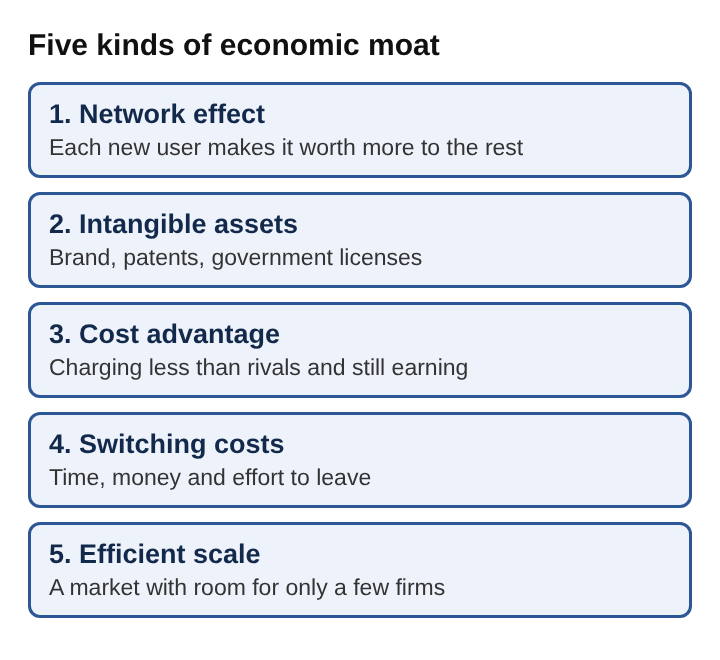
- Network effect. The value of the service grows as existing and new customers use it. Amazon is the example usually given.
- Intangible assets. A brand people know (Nike or Apple), patents, and government licenses. A rival can make a similar shoe; it cannot make the name.
- Cost advantage. A company that can keep what it charges low can hold its market share and discourage competition. Walmart is the usual example.
- Switching costs. Customers and suppliers are less likely to change providers when the move costs money, causes delays or takes extra effort.
- Efficient scale. Some markets have room for only a few firms, or are natural monopolies. Utility companies are the classic case.
Most lasting companies have more than one. A marketplace often has a network effect and a brand. A business software company often has switching costs and a brand. One moat on its own can be crossed; two or three that reinforce each other are much harder.
Switching costs, up close
Of the five, switching costs are the one a small company can build first, so they are worth a closer look. The page on switching barriers defines them as the costs a customer feels when changing brand, supplier or product. Most are about money, but some are about time, effort or feelings.
It sorts them into three groups:
- Procedural barriers: the time and effort of changing. Searching for and comparing a new provider, setting the new one up, and learning its routine all count here.
- Financial barriers: money that would be lost. Sunk costs already spent on the relationship, and benefits that end on leaving, such as credit terms from a current supplier.
- Relational barriers: the discomfort of ending a working relationship and the bonds that go with it.
The useful point for a founder is that switching costs are not only about lock-in. A customer who has set up a product, trained their staff on it and stored years of records in it has real work to lose by leaving. That cost comes from value the product created, not from a trap.
Which moats an AI product can build
A product built on a model that anyone can call has a weak starting position. The model is not the moat, because a rival can call the same one. A clever prompt is not the moat either, since prompts are easy to copy. What is left are the moats that come from running the business, not from the code.
Switching costs grow as a customer puts their own work into the product: their settings, their templates, their history, the way it fits their team's routine. Each month of use makes leaving cost more time and effort.
A brand grows as a product becomes the name people think of for one narrow job. In a crowded field, being known for one thing by one group of customers is an intangible asset a newcomer has to spend years matching.
A network effect is rarer but possible when users share something: a community, a library of shared templates, or work that passes between companies. It is worth checking for, but not worth forcing.
Cost advantage and efficient scale usually belong to large firms. A small company rarely starts with either.
A worked example: a quoting tool for plumbers
Take an invented case. A founder builds a tool that drafts written job quotes for small plumbing firms from a few notes and photos. It uses a public model. Within months, two rivals launch tools that do the same thing. Which moats could the founder build?
- Network effect. Plumbing firms do not share quotes with each other, so the tool gets little extra value from each new user. Weak.
- Intangible assets. No patents, no license. A brand is possible: the tool plumbers in one region name when asked. Slow, but real.
- Cost advantage. The rivals use the same model at the same cost. None.
- Switching costs. Strong if designed for. Each firm's past quotes, its parts list, its labor rates and its customer records live in the tool. After a year, a rival would have to win all of that back. This is a procedural and financial barrier that grows with use.
- Efficient scale. The market is large and open. None.
The founder's answer: build the product so that each firm's records and settings make it better for that firm, and become the known name in one region first. Two moats, both earned by use, neither copied by a rival in a few weeks.
Frequently asked questions
Is a moat the same as a competitive advantage?
A moat is a competitive advantage that lasts. A better feature is an advantage; it becomes a moat only if rivals cannot easily copy it or win customers away from it.
Can a new startup have a moat?
Rarely on the first day. Most moats grow with time and use, such as switching costs from stored records or a brand known in one niche, so a startup plans for one and builds it as customers arrive.
Are switching costs bad for customers?
Not always. Many come from value the customer already got, such as setup work and records kept in the product. They turn harmful when a company makes leaving hard on purpose instead of by being useful.
Which kind of moat is strongest?
No one kind wins everywhere. A network effect can be very strong in a marketplace, and switching costs can be very strong in business software. Companies that last usually have two or more that support each other.
What makes a moat in business last
A moat lasts when it grows with each customer and each month, and when copying the product does not copy it. Network effects grow with users. Switching costs grow with the work customers put in. A brand grows with every job done well for the same group of people. Cost advantage and efficient scale tend to arrive later, with size. The question to keep asking is simple: if a rival matched every feature tomorrow, what would still be yours? Whatever survives that question is the moat, and whatever does not is only a lead.