Founders reach the same question sooner or later: what is product-market fit and how do you know a product has it? The short answer is that product-market fit is the point where a specific group of people wants what you made strongly enough to keep using it, tell others about it, and miss it if it disappeared. The longer answer is in the numbers you can collect and the behavior you can watch. Both are more concrete than the phrase suggests.
What is product-market fit and how do you know a new business has it
Product-market fit has two halves. The market is a group of people with a shared, pressing problem. The product is something that solves that problem well enough that they choose it over doing nothing. Fit means the two match: the people you built for use the product, return to it, and pull it forward without you pushing.
Before fit, you do most of the work. You send messages, run calls, explain the product, and watch people try it once and drift away. After fit, demand starts to do some of the work for you. Users come back on their own schedule, bring colleagues, and complain loudly when something breaks.
Here is a worked example. Say you build a small AI tool that drafts polite payment reminders for freelance designers. In month one, you find 30 designers through forums and direct messages. Most try it once. A handful use it every week, and two of them ask whether their studio partners can have accounts. That handful is your first real signal. The question is whether the handful grows into a stable share of everyone who tries the product.
If you have not yet checked whether the problem is real, start earlier, with validating a business idea before building it. AI Entrepreneur teaches becoming an entrepreneur in the age of AI in short lessons: the history that led here, how modern AI works, and how to build, launch and grow a business with it.
Where the idea of product-market fit came from
The term is credited to investor Andy Rachleff, who said the thinking behind it came from Sequoia Capital founder Don Valentine, and it was spread widely by Marc Andreessen in the mid-2000s, according to the Wikipedia entry on product-market fit. Andreessen defined it as being in a good market with a product that can satisfy that market, and he called getting there the only thing that matters for a startup.
Paul Graham added a practical point about the early stage. In Do Things that Don't Scale, he writes that the most common unscalable thing founders have to do at the start is to recruit users manually, because nearly all startups have to. That manual work is how you learn what the market wants before the product can pull anyone in by itself. It is also where you first see whether fit is forming.
Signs of product-market fit in retention and usage data
Retention is the clearest signal you can measure. Group users by the week or month they started, then track what share is still active over time. That share almost always falls at first. What matters is whether it stops falling.
Back to the reminder tool. Say 100 designers start in March. By April, 40 are still active. By May, 32. By June, 30. By July, still 30. The curve has flattened. A stable group of people found enough value to stay, and that group is the market you fit. If the curve keeps sliding toward zero, the product has not found that group yet. The opposite of retention is the churn rate, the share of users who leave in a given period, and the two numbers tell the same story from different sides.
Other usage signals to watch:
- Frequency. Users return at the rhythm the problem demands. A weekly problem should produce weekly use.
- Depth. Users move past the first feature into the rest of the product.
- Referrals. New users arrive because an existing user told them, not because of your outreach.
- Growth rate. Paul Graham writes in Startup = Growth that a good weekly growth rate during Y Combinator is 5 to 7 percent. Growth at that pace, held over many weeks without heavy spending, is hard to get without fit.
The very disappointed survey as a product-market fit signal
Numbers tell you what users do. A short survey tells you how much they care. Sean Ellis popularized one question for this after looking at many startups: how would you feel if you could no longer use the product? Each user picks an answer such as very disappointed, somewhat disappointed or not disappointed.
The benchmark, known as the 40 percent rule, is that if at least 40 percent of surveyed users say they would be "very disappointed," the product and its market fit. Under that level, a meaningful part of the user base could walk away without much loss.
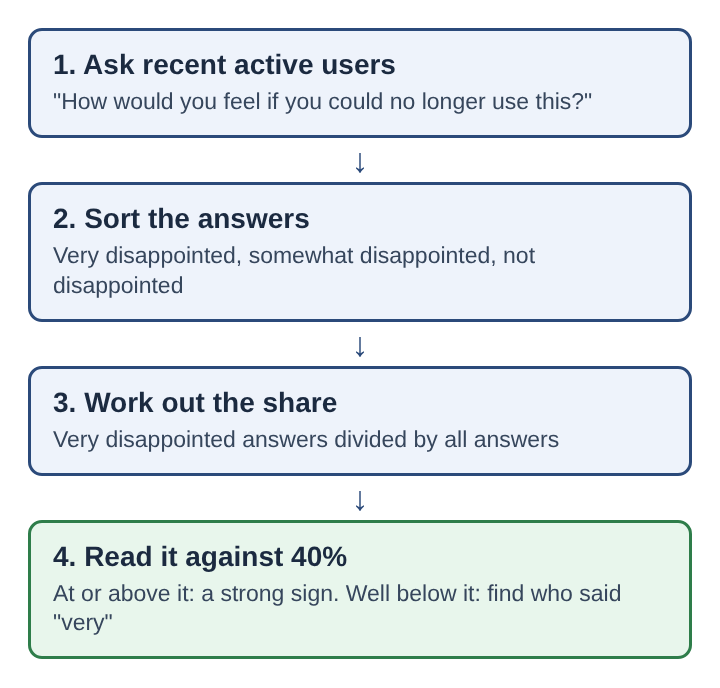
To run it well:
- Send it only to people who used the product recently and more than once. One-time visitors skew the result.
- Ask a follow-up: "What is the main benefit you get from it?"
- Read the answers from the "very disappointed" group closely. Their words describe the core value. Use those words in your messaging and build more of what they named.
- Ask who they think would benefit most. That points to your sharpest segment.
For the reminder tool, suppose 18 of 40 active designers say "very disappointed," and almost all of them mention the same thing: they stopped having awkward conversations about late invoices. That is 45 percent, and it is a clear message about what to keep.
Signs a product has not reached product-market fit
The absence of fit is often easier to see than its presence. Watch for these patterns:
- Every new user comes from your outreach or ads, and growth stops the week you stop.
- People create an account, try the product once, and do not return.
- Feedback is polite but vague: "interesting," "nice idea," "I might use this later."
- Feature requests point in many different directions because no single group shares a problem.
- You spend long stretches explaining what the product is for.
None of these mean the business is finished. They mean the match between product and people is not there yet. The usual fixes are narrowing the audience, sharpening the problem, or changing the product until a small group cares deeply. Talking to more people directly helps here, and finding your first customers for a new business covers that work in detail.
How the history of AI changed the path to product-market fit
AI has a long record of promises that ran ahead of results. The field went through several hype cycles followed by disappointment, and the AI winters were periods of reduced funding and interest in AI research. In product terms, the market wanted the outcomes, but the technology could not yet deliver them reliably. You can read more about the two funding collapses and about what Turing said about thinking machines.
Today the gap has narrowed. A founder can build a working AI prototype quickly, so the first demo arrives much sooner. That shifts the hard part. Showing that something works once is easy. Showing that it works reliably enough for people to depend on it every week is the real fit question for an AI product. Output that is right most of the time but wrong at random moments can drive retention down even when the first impression is strong.
This is why measuring output quality matters so much for AI businesses. An eval for an AI product is a structured way to check whether the system does its job across many real cases. AI Entrepreneur covers this ground in its third part, "Growing a company," which deals with agents, evals, moats and the economics of growing an AI company; course 11 in that part is "Evals: Shipping AI That Works." Its first lesson, "Thinking Machines: Turing to the AI Winters," starts with the history.
Frequently asked questions
How long does it take to reach product-market fit?
There is no fixed timeline. Some products find a committed group of users within months, while others take years of narrowing the audience and reworking the product. The useful question is whether retention and the "very disappointed" share are moving in the right direction each month.
Can a business lose product-market fit after finding it?
Yes. As markets, customers and competitors shift, fit has to be reassessed and pursued again, which is why it is called a process rather than a one-time achievement. A retention curve that starts sliding again after a long flat period is the usual warning.
Is product-market fit different for an AI product?
The definition is the same, but reliability plays a bigger role. Users judge an AI product on how often its output is correct and useful, so fit depends on consistent quality across many real cases, not just a strong first demo.
What comes after product-market fit?
Growth and defense. Once people want the product, the work shifts to reaching more of them efficiently and building advantages that are hard to copy, which is what a moat in business describes.
Product-market fit as an ongoing measure in an AI business
Product-market fit is not a single moment you pass and leave behind. It is a condition you keep measuring. For an AI business, the inputs move faster than usual: models change, costs shift, and what users expect from AI output rises month by month. A product that fit last year can fall behind if its quality stays flat while expectations climb.
Keep three habits. Track retention by starting group, and watch whether the curve stays flat. Run the "very disappointed" survey every few months, and read the reasons people give. Check your AI output against real cases each time the model or prompt changes. Together, those three measures tell you whether the people you built for still want what you made, which is the whole of what product-market fit means.
AI Entrepreneur
Building a business in the age of AI, from a first project to a company. Visit aientrepreneur.vlvd.net