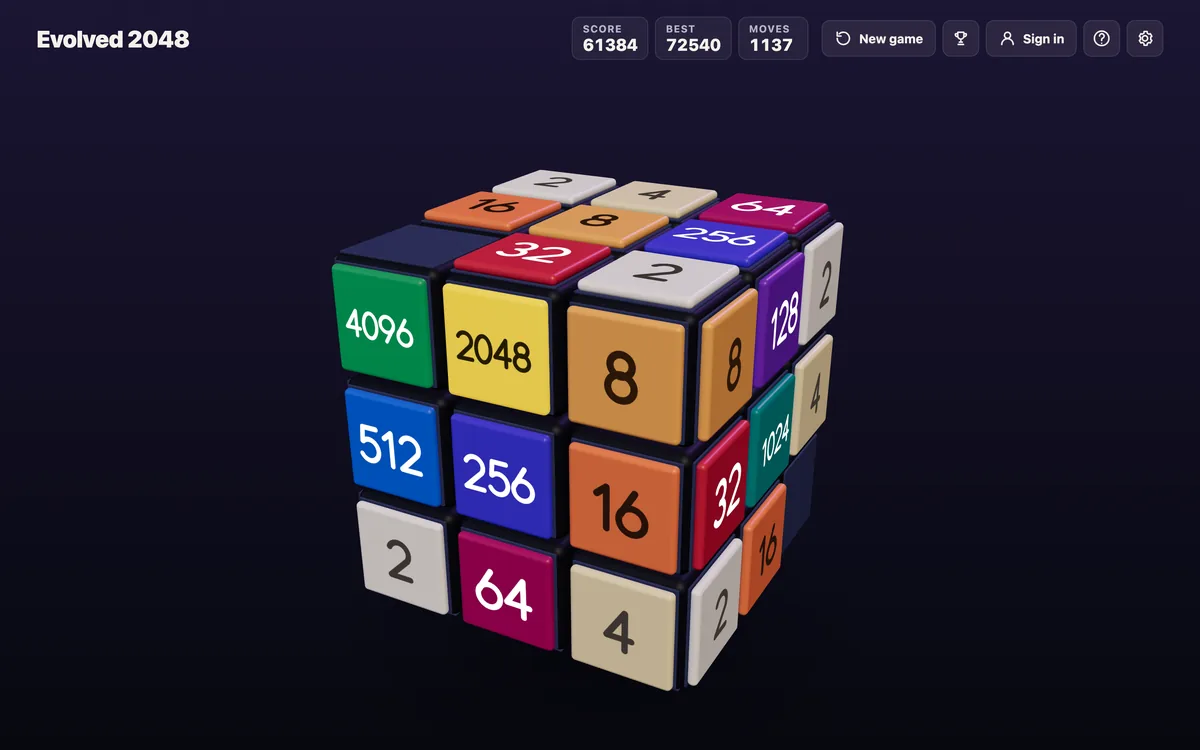
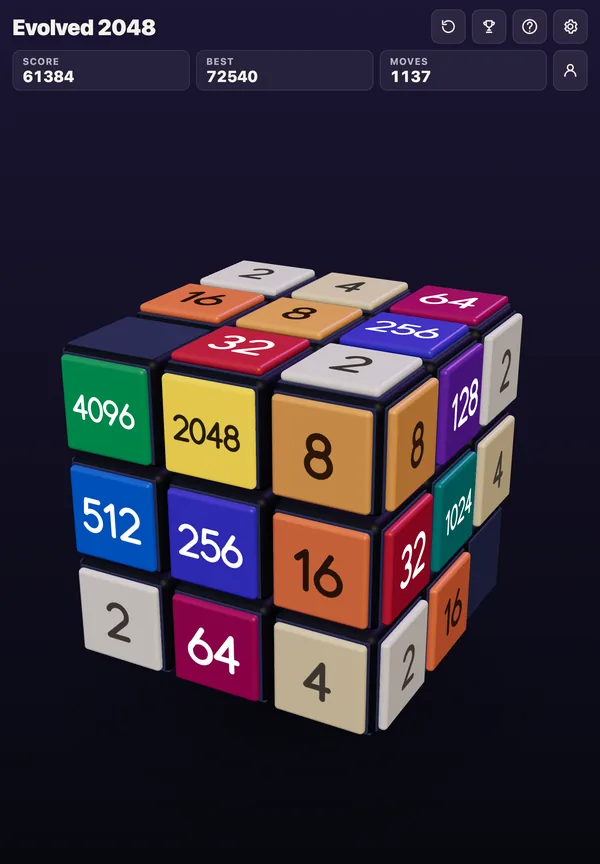
Every 2048 move ends with a tile you did not choose, dropped in a square you did not pick. So it is fair to ask: is 2048 a game of luck or skill? The short answer is that it is a game of skill with chance built into every turn. The game decides where the new tile lands and whether it is a 2 or a 4. You decide everything else, including how many squares the game has to choose from. The same split holds in a 2048 puzzle played on a Rubik's cube, where you get extra moves that add no tile at all.
Seeing exactly where the line falls helps in two ways. It tells you which bad games were bad luck and which were bad choices. And it shows you where practice pays off, because practice only improves the part that is yours.
Is 2048 a game of luck or skill by the usual definition?
A game of skill is one whose outcome is decided mainly by mental or physical skill rather than chance. That definition does not require zero chance. A game of skill can contain random elements, as long as skill plays the greater role. Backgammon is the usual case: dice decide what you can move, but strategy gives a steady advantage over many games.
A game of chance is the opposite. Its outcome is strongly shaped by a randomizing device, which in a digital game is a random number generator. Roulette is the pure case. No strategy changes where the ball falls, so no player does better than another over time.
So the useful question is not whether 2048 has randomness. It plainly does. The question is whether your decisions change how games turn out, game after game. They do, and by a wide margin.
The two things chance decides on every move
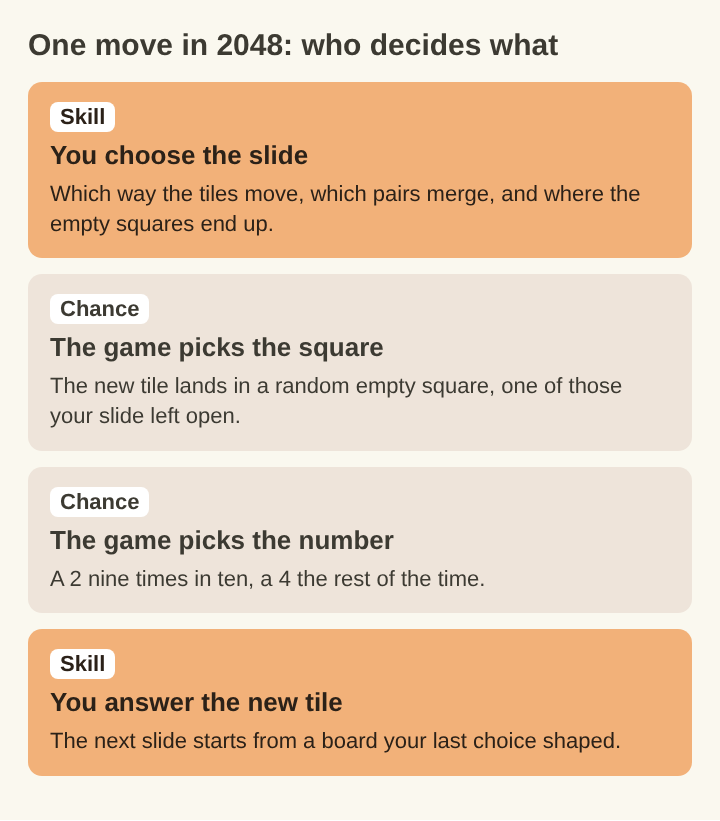
Classic 2048) is played on a 4 by 4 grid. After each move, a new tile appears in a random empty square. That tile is a 2 nine times in ten and a 4 the rest of the time. Those are the only two random events in the game.
- The square. The game picks one of the empty squares at random.
- The number. The game picks 2 or 4, weighted heavily toward 2.
Nothing else is random. Tiles slide the same way every time. Equal tiles merge by fixed rules. If you saw the same board twice and made the same slide, the tiles would end up in the same places, and only the new tile could differ.
The part of every move that belongs to you
Your part is the slide, and it carries more weight than it first appears. The slide decides which pairs merge, which tiles stay against the wall, and which squares are left empty. That last point matters most. The game picks the new tile's square at random, but only from the empty squares you left. You choose the set the game draws from.
That is why the familiar 2048 strategies work. Keeping the largest tile in a corner with its row filled means three of the four directions leave that tile where it is. Keeping small tiles from being cut off by large ones means a new 2 usually lands somewhere it can merge soon. Neither strategy removes chance. Both shrink the number of ways chance can hurt you.
A worked example: two slides, the same random tile
Take an invented board with the biggest tile, a 256, in the bottom left corner. The bottom row reads 256, 128, 64, 8. Above it sit a few small tiles, including two 2s side by side in the second row from the top, and five squares are empty, one of them just above the 256.
You are weighing two slides.
- Slide left. The bottom row stays put because it is full and has no equal neighbours. Two 2s higher up merge into a 4. You end with six empty squares, all in the upper rows, away from the corner.
- Slide up. Nothing merges. The 256 leaves its corner and moves up the left column. The bottom left square is now empty.
Now let chance do the same thing to both boards: a new 2 appears. After the left slide, every empty square is in the upper rows. Wherever the 2 lands, the bottom row and the corner are untouched. After the up slide, one of the empty squares is the old corner. If the 2 lands there, the 256 is shut out of its corner with a small tile underneath it, and fixing that costs several moves.
The random event was identical. The outcome was not, because the slide decided which squares the random tile could reach. A player who picks the left slide has made the bad result impossible on this turn. A player who picks the up slide has left it to a coin the game flips. That difference, repeated over hundreds of moves, is the skill in 2048.
What computer play shows about the balance
If 2048 were mostly luck, nobody could reach huge tiles reliably. Programs do. According to the 2048 page on Wikipedia), a program combining expectiminimax search with prebuilt tables played 1200 simulated games in 2025 and reached a 16384 tile with 99.9% probability and a 32768 tile with 86.1% probability. Chance was present in every one of those games. Strong decisions still produced nearly the same result almost every time.
The search method itself says something about the game. Expectiminimax treats the random tile as an average over every square and both numbers, weighted by how likely each is. It cannot predict the tile. It picks the move whose average over all the tiles is best. That is the same split as before: the program accepts that it cannot control the draw and puts all its effort into the choice. The way computers play 2048 is a clear picture of skill working on top of chance.
Humans do not search that deep, but the lesson carries over. A bad tile in a bad square is luck. A board where one bad tile can ruin the game is usually the result of earlier choices.
When a cube gives the player more of the decisions
On the cube version, the board has six faces of nine squares, 54 squares in all, and 2048 is a first milestone rather than the end. You slide the front face, as in classic 2048. You can also twist a row on the right face or a column on the top face, which turns that layer a quarter and carries its tiles to the next face. And you can turn the whole cube to look at another side.
The chance part stays the same in shape. Every slide or twist adds a 2 or a 4, on the front face when it has room, and a twist needs one empty square for it. What changes is the size of your part. Turning the cube costs nothing, because only a slide or a twist adds a new tile. So you can inspect the far faces before you commit, and no random tile comes with that look. The game's own tip says a needed tile is often on a side face, and a twist can bring it round next to its match on the front.
More options per turn means more ways to answer a bad tile, which tilts the game further toward skill. It also means more ways to make a careless twist, so the extra room rewards planning rather than speed.
Frequently asked questions
Is 2048 pure luck?
No. Only the new tile's square and its value are random. How tiles slide and merge is fixed, and your slide decides which squares the new tile can land in.
Can you win every game of 2048?
Not with certainty, because a bad run of new tiles can still trap a board. Strong programs reach the 2048 tile and far beyond almost every game, which shows how much good choices reduce that risk.
Why do some 2048 games go badly even with a good strategy?
A 4 or a 2 can land in the one square that hurts most, and sometimes every safe move is gone. Good play makes those moments rarer and easier to recover from, not impossible.
Does practice make you better at 2048?
Yes. Practice trains you to see which slide keeps the corner safe and leaves the empty squares where a new tile can merge, and that is the part of the game chance cannot touch.
Luck and skill in 2048, one move at a time
Every move in 2048 has the same shape: you choose, then chance chooses from what you left. The game will always pick the square and the number, and no strategy changes that. What strategy changes is the list of squares on offer and how much damage the worst one can do. Over a few moves that looks like luck. Over hundreds of moves it is mostly the sum of your choices, which is why the same habits keep producing the same large tiles, and why a lost board is worth reading back to find the slide that opened the wrong square.
Evolved 2048
The 2048 puzzle on a Rubik's cube, and past 2048. Visit evolved2048.vlvd.net