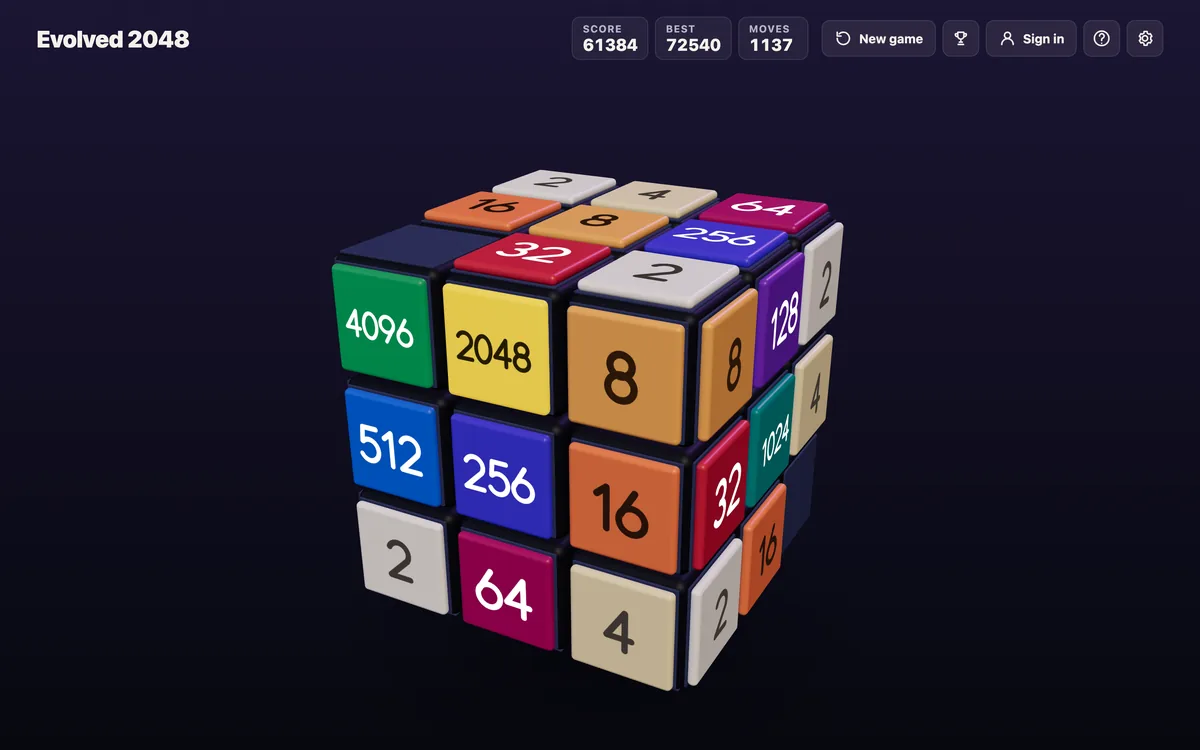
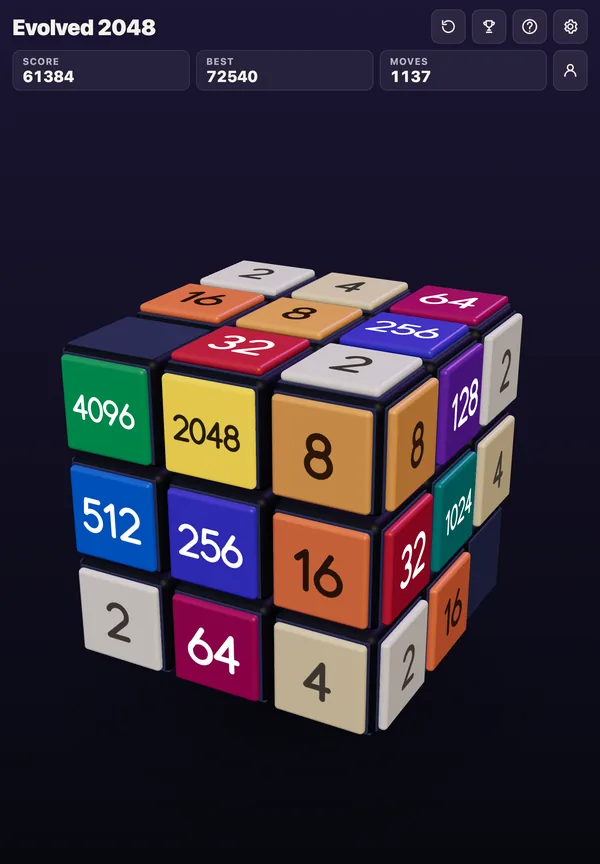
Every move in 2048 ends the same way: a new tile drops into an empty square, and it is almost always a 2. Now and then a 4 shows up instead. If you have wondered why 2048 tiles appear as 2 or 4, and why the 4 feels so rare, the short answer is that the game picks between the two at random with a fixed split. The same rule drives a 2048 puzzle played on a Rubik's cube, where every slide or twist adds a 2 or a 4 to the front face.
Knowing the split turns a vague feeling about luck into numbers you can plan with. It tells you how fast the board fills, what a single move is worth, and when a surprise 4 is worth worrying about.
Why 2048 tiles appear as 2 or 4 in the classic game
Classic 2048 is played on a 4 by 4 grid. The 2048 page on Wikipedia) sets out the rule plainly: the game begins with two tiles already on the grid, each a 2 or a 4, and after each turn another such tile appears in a random empty space. Tiles with a value of 2 appear 90% of the time, and tiles with a value of 4 appear 10% of the time.
So there are two separate random choices on every move:
- Where. The new tile lands in one of the empty squares, chosen at random.
- What. The new tile is a 2 nine times in ten and a 4 one time in ten.
Neither choice looks at your plans. The game is not aiming its tiles at the gap you were saving, and it is not handing you a 4 as a reward. It rolls the same way every turn.
Why a game would use two starting values
A game that only ever dropped 2s would be perfectly predictable in one respect: you would always know the value of the next tile. That makes planning easy, but it also makes every game feel the same. Adding a small chance of a 4 keeps a little doubt in each move without making the board chaotic.
The split matters too. If 4s came half the time, the board would fill with values that do not match, and rows would jam quickly. At one in ten, a 4 is common enough that you meet several in every game and rare enough that most of your merges still start from a pair of 2s. Every tile on the board is still a power of two, so a 4 is never a stranger: it is simply a pair of 2s that arrived already merged.
What one new tile is worth on average
Because the value of the new tile is random, it helps to ask what it is worth on average. The expected value page on Wikipedia gives the method: for something that takes a few values, the expected value is the weighted average of those values, with their chances as the weights, and you can read it as the long-run average.
For a new 2048 tile that is 0.9 times 2 plus 0.1 times 4, which is 1.8 plus 0.4, or 2.2. Over a long game, each move that adds a tile adds about 2.2 to the total of all the numbers on the board.
That total is worth watching. A merge never changes it: two 8s become one 16, and the sum stays 16. Only new tiles raise it. So the sum of every tile on the board is, in effect, a count of how many tiles the game has dropped, multiplied by about 2.2.
A worked example: how many moves a 2048 tile holds
Follow the numbers to see what the split means for a whole game.
- Start with the target. A 2048 tile is made only of merged new tiles, so it holds 2048 worth of them.
- Divide by the average. Each new tile is worth about 2.2, and 2048 divided by 2.2 is about 931.
- Read the result. Building a single 2048 tile takes, on average, about 931 moves that add a tile, and that is before counting any other tiles still on the board.
- Compare the extremes. If every new tile were a 2, the count would be exactly 1024. If every new tile were a 4, it would be 512. The real game sits between, much nearer the all 2s figure.
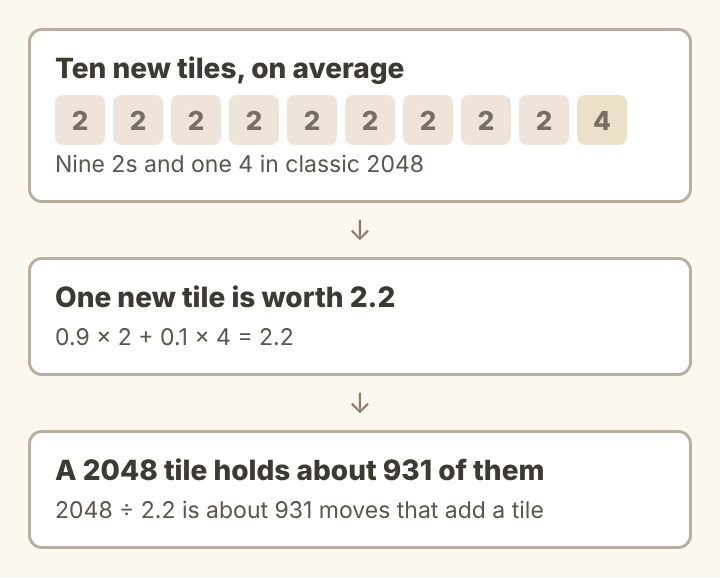
The example also shows why every 4 is a small gift to your total. It brings the value of two 2s in a single move and takes up one square instead of two. Over a game, the 4s save you dozens of moves you would otherwise have spent merging pairs of 2s.
When a surprise 4 hurts a plan
The same 4 that helps your total can wreck a row. Suppose your bottom row reads 64, 32, 16 and one empty square, and you are waiting for a 2 to land in the row above so you can feed it down. A 4 that drops into the gap in the bottom row instead sits next to the 16, too small to merge with it, and blocks the end of a row you were keeping in order.
A few habits keep that damage small:
- Leave fewer gaps in your main row. An empty square in your ordered row is where a stray tile does the most harm.
- Keep a small tile near the end of the row. If the row ends in a 2 or a 4, a new 2 or 4 often has something to merge with.
- Plan for the one in ten. Before a slide, ask what happens if the new tile is a 4 rather than a 2, the same habit as planning moves ahead. If the answer is a jammed row, look for a safer move.
Most of the time the new tile will be a 2, so you do not need to fear every move. You only need to avoid moves where a 4 in the wrong square would leave you with no way out.
How the rule plays on a cube
On a cube, the 2 or 4 rule carries over with a few changes worth knowing. The puzzle has six faces of nine squares, 54 squares in all. You slide the front face, twist a row of the right face or a column of the top face to carry tiles to the next face, or turn the whole cube to look at another side.
- Two moves add a tile. Every slide or twist adds a 2 or a 4, on the front face when it has room.
- A twist needs space. A twist needs one empty square for its new tile, so a full front face limits what you can do.
- A turn adds nothing. Turning the whole cube costs nothing: only a slide or a twist adds a new tile, so you can check the far sides without feeding the board.
Because new tiles land on the front, the front face fills fastest. In the main mode the game ends only when all 54 squares are full and no face has two equal tiles side by side, so the other faces give you room the flat board never had. The arithmetic of each new tile is the same; there are simply more places to put the results.
Frequently asked questions
How often does a 4 appear in 2048?
In classic 2048, a new tile is a 4 about 10% of the time and a 2 about 90% of the time. Over ten moves you should expect about one 4, though a run of several 2s or two 4s in a row is normal chance.
Can you control whether the next tile is a 2 or a 4?
No. The value is chosen at random each time a tile appears, and your move only decides which squares are empty. What you can control is how much damage a 4 would do, by keeping your ordered row free of gaps.
Is a 4 better than a 2?
A 4 adds twice as much to the board's total in one square, so it saves you a merge. It is worse only when it lands where a 2 would have matched and a 4 matches nothing.
Why are 2048 tiles always powers of two?
Every new tile is a 2 or a 4, and two equal tiles merge into their sum. Doubling a power of two gives another power of two, so every tile you can ever build is one.
What the 2 or 4 split means for every move
The new tile is the only random part of a 2048 move, and its rule is small: a 2 nine times in ten, a 4 one time in ten, in a random empty square. From that rule come the 2.2 average, the roughly 931 tiles inside a 2048 tile, and the habit of asking what a 4 would do before you slide. Once the split is in your head, the next tile stops feeling like luck and becomes one more thing you plan around.
Evolved 2048
The 2048 puzzle on a Rubik's cube, and past 2048. Visit evolved2048.vlvd.net