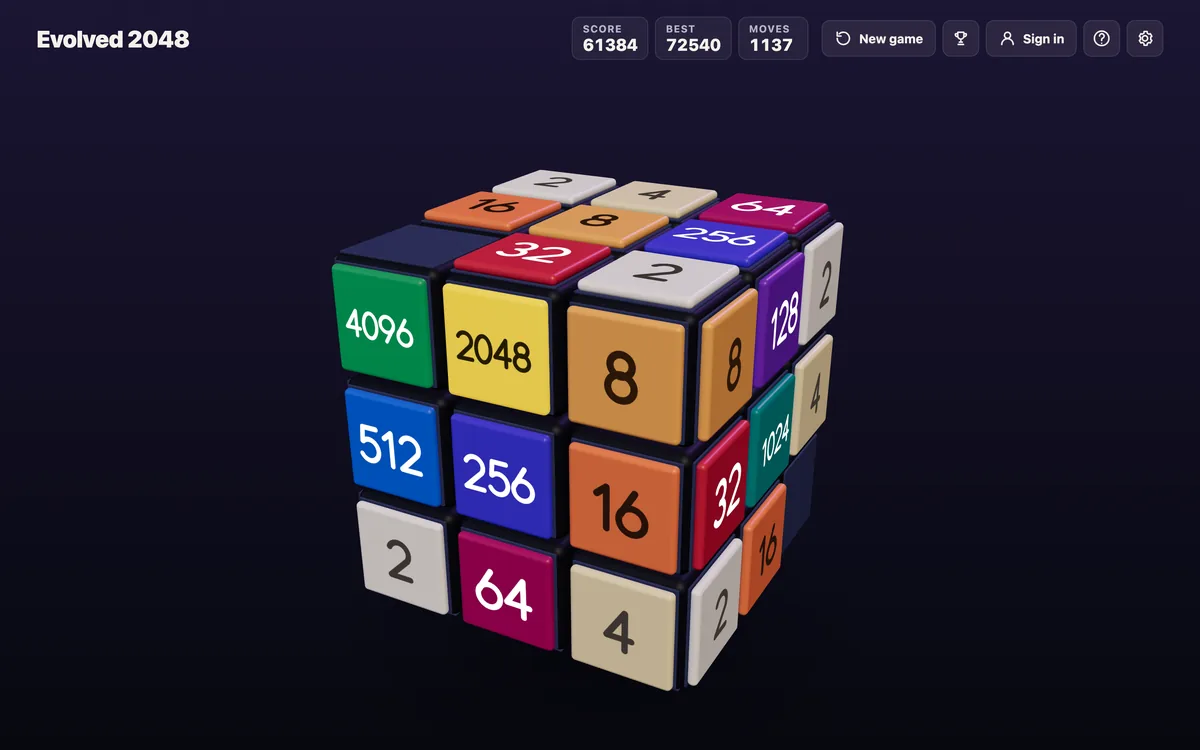
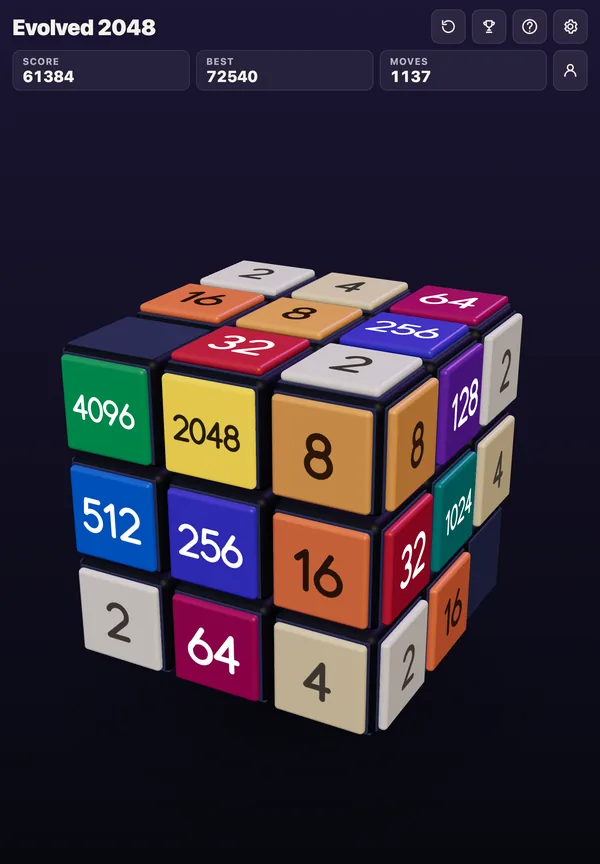
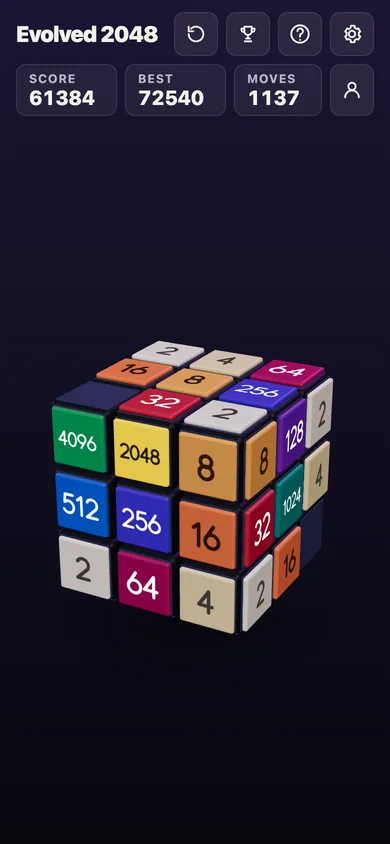
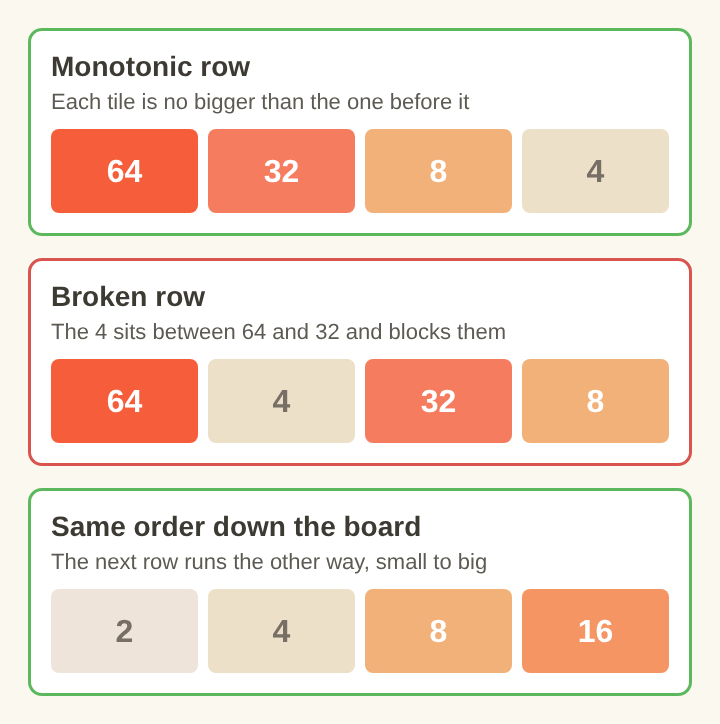
Monotonicity in 2048 is the habit of keeping the tiles in each row and column in order: they only get smaller as you move away from your biggest tile, never jumping back up. A row of 64, 32, 8, 4 has it. A row of 64, 4, 32, 8 does not, because the 4 sits between two tiles it can never merge with.
The idea is the quiet rule behind the corner and snake strategies, and it is easy to check at a glance once you know what to look for. It holds on the classic 4 by 4 board and on Evolved 2048, which puts the puzzle on a Rubik's cube: you slide the front face and twist rows to bring tiles in from the other sides.
Where the word comes from
Monotonic is a word from mathematics. The Wikipedia page on monotonic functions defines a monotonic function as one that is entirely non-decreasing or entirely non-increasing. A non-decreasing function does not have to rise at every step; it simply must never fall.
Carry that over to a row of tiles. Read the row from the end that holds the biggest tile. If each tile is the same size as the one before it or smaller, the row is monotonic. Two equal tiles side by side do not break it, and an empty square at the small end does not either. What breaks it is a tile that is bigger than the one before it, a step back up.
The same check works on a column, read from the top or the bottom. A whole board is in good shape when most of its rows and columns pass, and when they all lean towards the same corner.
Why an ordered row merges in chains
The rules of 2048 make order valuable. The 2048 page on Wikipedia) sets them out: tiles slide as far as they can until another tile or the edge stops them, two equal tiles that collide merge into their total, and a merged tile cannot merge again in the same move. After every turn a new tile appears in a random empty square, a 2 nine times in ten and a 4 the rest of the time.
In an ordered row, each tile's next partner is the tile beside it. When the small end grows to match its neighbour, the two merge, and the result is now the size of the next tile along. Merges then run up the row towards the big tile, one after another, across several turns. Nothing has to be moved out of the way first.
The same page states the general rule players use: no small tile should be separated from other small tiles by a large tile. That is monotonicity seen from the other side. A row in order never traps a small tile behind a big one.
How a row loses its order
Tiles in 2048 never pass each other. A slide moves every tile in the same direction until something stops it, so the order of tiles along a row stays the same unless two of them merge. Once a small tile lands between two big ones, no slide along that row can lift it out.
Three things usually cause the trouble:
- A forced slide away from the corner. When the big tile leaves its corner, a new 2 or 4 can drop into the gap it left, and the row now starts with a small tile.
- A new tile in an open square mid-row. If the row has a hole near its big end, the next random tile may fill it and sit between two large tiles.
- A slide that empties a row. A move that clears space can let tiles from the row below drift in out of order.
Each case is easier to prevent than to fix, which is why it pays to look at the order of a row before each slide rather than after.
A worked example: reading and repairing one row
Take an invented top row with the biggest tile in the left corner: 128, 64, 4, 16. Read it from the left and compare each pair.
- 128 then 64. Smaller, so the order holds.
- 64 then 4. Smaller, so it still holds.
- 4 then 16. Bigger. This is the one break in the row.
A row with one break is still in decent shape, but the 16 cannot reach the 64 while the 4 sits in front of it, and the 4 cannot reach anything to its left. The repair is to grow the 4, not to move it.
Look at the square just below the 4. If a 4 can be brought there, an up slide merges the two into an 8 in the top row: 128, 64, 8, 16. That is still one break. A second 8 brought up below it makes 16: 128, 64, 16, 16. Now a left slide merges the two 16s into a 32, and the row reads 128, 64, 32, with an empty square at the end. Every pair is in order again, and the next 32 that forms beside it will merge straight up the chain.
Notice what the repair never did: it never slid the 128 out of its corner, and every move it used was an up slide or a left slide. Keeping the big tile in its corner with the rest of its row filled, the corner strategy the Wikipedia page describes, leaves three safe directions; the repair used two of them.
Reading a whole board for order
One row is the start. On a full board the rows usually alternate: the top row runs big to small from left to right, and the row below runs small to big, so its biggest tile ends up just under the smallest tile of the row above. That turn at the end of each row is what the snake strategy follows.
Columns matter too. Read each one from the top: the tile in the top row should be at least as big as the tile under it. When both rows and columns pass, every tile on the board has a neighbour it can grow into, and the board can absorb a run of new 2s without a jam.
Programs that play 2048 rate positions in a similar way. According to the Wikipedia page, a position evaluation function can favour empty squares, many possible merges, larger tiles at the edge, and monotonicity of tile sizes, especially for the larger tiles. A person cannot weigh all of that every turn, but a quick count of breaks in the top two rows is a usable stand-in.
Monotonicity in 2048 on a cube
On a cube the front face is still where tiles slide and merge, so its rows and columns are the ones to keep in order. The difference is that tiles can also arrive sideways. A twist drags a row on the right face, or a column on the top face, a quarter turn, and that layer carries its tiles to the next face. A tile from a side face can land next to its match on the front.
That gives two extra checks. Before a twist, read the incoming row as it will sit on the front: will it land in order beside what is already there, or drop a big tile into the middle of a small run? And since every slide or twist adds a new 2 or 4 on the front face when it has room, a twist is a full turn with the same risk as a slide. Turning the whole cube to look at the far sides costs nothing and adds no tile, so look before you twist.
Frequently asked questions
Does monotonicity mean the tiles must double each time?
No. A row of 64, 64, 16, 2 is monotonic, because no tile is bigger than the one before it. The tiles only need to stay in order, not follow a fixed ratio.
Should every row run the same way?
Usually not. Most players run the top row one way and the next row back the other way, so the small end of one row sits next to the big end of the row below.
Is a board with one break in a row lost?
No. One break is common and can often be repaired by growing the small tile from below until it matches its neighbour, as in the worked example.
Do empty squares break the order?
An empty square at the small end of a row does not. An empty square near the big end is a risk, because a new 2 or 4 can land there and become a break.
Why monotonicity is the shape of a good board
Most 2048 advice, from the corner to the snake, comes back to one picture: big tiles gathered at one edge, each row sloping down from them, and the small tiles all on the far side together. Monotonicity is the name for that slope. A board that keeps it can take almost any new tile and still have a merge waiting somewhere, because every tile sits next to the tile it is growing towards. A board that loses it starts to fill with small tiles stuck between large ones, and those are the squares that end games.
Evolved 2048
The 2048 puzzle on a Rubik's cube, and past 2048. Visit evolved2048.vlvd.net