To plan moves ahead in 2048 is to stop asking "which slide merges something right now?" and start asking "what will the board look like after the next tile appears?" Most lost games are not lost on the move that fills the last square. They are lost three or four moves earlier, on a slide that looked fine and left a hole where a 2 could fall in the worst place.
The habit is small and you can learn it in a single game. It works on the classic 4 by 4 board and on Evolved 2048, which puts the puzzle on a Rubik's cube: you slide the front face and twist rows to bring tiles in from the other sides.
Why one move is never enough
A slide in 2048 has two halves. First the tiles move: each one slides as far as it can until it hits another tile or the edge, and two equal tiles that collide merge into their total. Then the game adds a new tile, a 2 or a 4, in a random empty square. The 2048 page on Wikipedia) gives the odds: a 2 appears 90% of the time and a 4 appears 10% of the time.
The first half you control completely. The second half you do not control at all. A player who looks only at the first half sees merges. A player who plans ahead also sees the empty squares that the slide leaves, because each of them is a place the next tile might land.
That is the whole shift. You are not trying to predict the random tile. You are trying to choose a move where no landing spot is a disaster.
Start with the moves you will never make
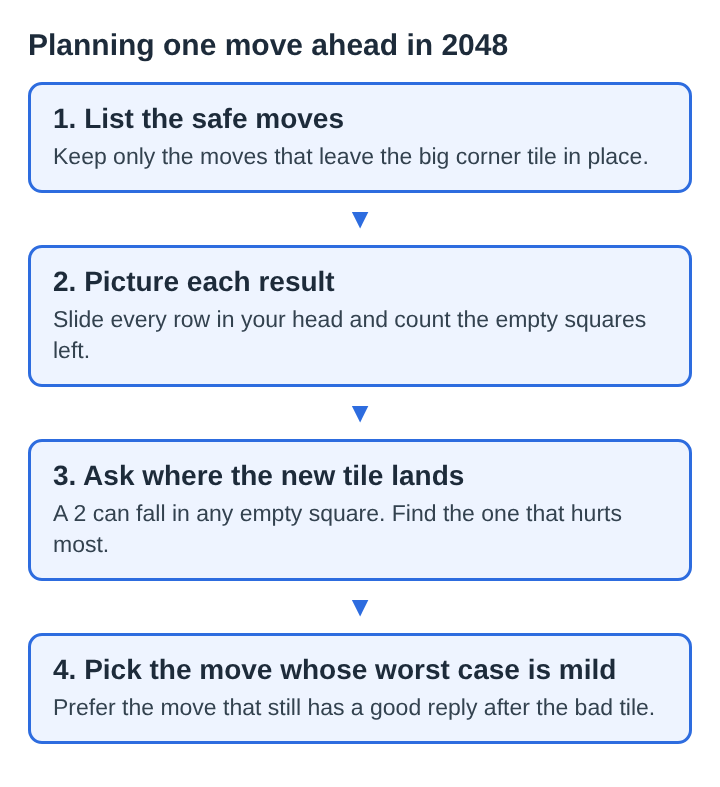
Planning gets easier when there are fewer moves to plan. The common corner strategy, described on the same Wikipedia page, keeps the largest tile in one corner with other large tiles filling the row beside it. While that row stays full, you can move in three directions and the big tile stays put.
So before you think about anything else, cross out the fourth direction. If your biggest tile sits in the bottom left corner with a full bottom row, the move to cross out is up. Now you are choosing between two or three slides, not four, and each one is easy to picture.
Sometimes only the forbidden move is left. That is a warning sign, and the plan for the next few moves is to make sure it does not happen again: keep the edge row full and avoid leaving a single gap in it.
Read each safe move as a picture
For each move still on the list, slide the tiles in your head, row by row or column by column. Do not try to see the whole board at once. Take one row, slide it, note any merge, then take the next.
When you have the picture, look at three things:
- Empty squares. How many are left, and where are they? More empty squares means more room to recover.
- Merges waiting. Are there equal tiles now side by side, ready for the next slide?
- Small tiles cut off. Wikipedia's page puts it as a rule: no small tile should be separated from other small tiles by a large tile. A 2 stuck behind a 64 is hard to free.
This is already one move ahead. Most of the gain comes from doing just this, every move, without hurrying.
Ask where the worst tile could land
Now add the random half. Look at each empty square the move would leave and ask: if a 2 appeared here, would it hurt?
A new tile hurts most in three places. It hurts in the gap of your edge row, because the next slide can drag the big tile out to fill it. It hurts behind a large tile, where it is cut off from the other small tiles. And it hurts in the last empty square of a crowded area, where it takes the only room you had to merge.
You do not need to check every square with equal care. Find the one square that would hurt most, and judge the move by it. A move that leaves four empty squares, all harmless, beats a move that leaves five but one of them is the gap in your edge row.
Programs that play 2048 well formalise this idea. A method called expectiminimax builds a tree of moves in which some points are the player's choices and others are chance events; at each chance point it takes a weighted average of the outcomes, weighted by how likely each one is. A person cannot compute that tree, but asking "what is the worst likely tile?" is a quick human version of the same question.
A worked example of planning two moves
Here is an invented position on a classic 4 by 4 board, written row by row from the top. A dot is an empty square.
- Top row:
. . . . - Second row:
2 . . . - Third row:
4 8 2 . - Bottom row:
128 64 32 16
The biggest tile, the 128, sits in the bottom left corner and the bottom row is full. So up is crossed out. That leaves left, right and down.
Left. Nothing changes: every tile is already as far left as it can go.
Down. Nothing changes here either. The 2 in the second row rests on the 4, the 8 rests on the 64, the third row's 2 rests on the 32, and no two equal tiles meet.
Right. The bottom row is full and has no equal neighbours, so it stays. The 2 in the second row slides to the far right, and the third row becomes . 4 8 2. This is the only move that changes the board besides the crossed-out up, so the planning is not about which move to make. It is about what to watch for next.
After right, eight squares are empty: the whole top row, the first three squares of the second row, and the square above the 128. Ask where the worst tile could fall. If a 2 lands above the 128, the third row becomes 2 4 8 2. Now the smallest tile holds the square that the row's largest tile should own, the row rises and then falls, and no slide left can put it back in order. That is the case to fear, and it is one square out of eight. In the other seven cases, the next slide left puts the third row back as 4 8 2 ., with its big tiles towards the corner.
There is also a gift in the picture. After right, the second row's 2 sits directly above the third row's 2 in the far right column, so a slide down would merge them into a 4. The plan for the next move is set before the new tile even appears: if the square above the 128 stays empty, slide left; if it fills, take the down merge first and work that stray 2 back towards the small end of the board.
The lesson of the example is not the answer. It is the order of the questions: cross out, picture, find the worst square, then decide.
Plan moves ahead in 2048 on a cube
On a cube the same habit has more to look at. The puzzle has six faces of nine squares, 54 squares in all. Every slide or twist adds a 2 or a 4 on the front face when it has room, and a twist needs one empty square for it. Turning the whole cube costs nothing and adds no tile.
That last rule is the planner's gift. Before a slide or a twist, you can turn the cube to see the far sides, then turn it back, without changing the position at all. The project's own tip is that a tile you need is often on a side face, so twisting its row or column round can land it next to its match on the front.
The questions stay the same. Which twists and slides keep your best tiles in place? What does the front face look like after each one? Where could the new tile land on the front? A twist that brings a match in but leaves the front face's only empty square in a bad spot can cost more than it gains.
Frequently asked questions
How many moves ahead should you plan in 2048?
One move plus the new tile is enough for most games. Going further multiplies the cases fast, because each move has several empty squares where a tile can land.
Can you predict where the new tile will appear?
No. It appears in a random empty square, and it is a 2 nine times in ten and a 4 the rest of the time. You can only choose moves where every landing spot is survivable.
Is planning ahead the same as the corner strategy?
No. The corner strategy says where your biggest tile should live. Planning ahead is how you pick each move so that it stays there.
Does planning ahead make the game slower?
At first, yes. After a few games the questions become a quick glance, and you slow down only when the board gets crowded.
Lookahead as a habit, not a calculation
Lookahead in 2048 is less about seeing deep and more about seeing the right thing. One slide, one random tile, one worst square: that is a short chain, and it holds most of what decides a game. The random tile is not an enemy to outguess. It is a fixed amount of uncertainty that arrives every move, and a good move is simply one that leaves room for it. Players who learn to see the empty squares as landing spots, rather than as space, find that crowded boards stop arriving by surprise.