Walk through an old castle gate, look up, and you may see a square opening cut into the stone ceiling. People who ask what were murder holes in a castle are usually asking about those openings. They were gaps in the roof of a gate passage that let defenders strike at attackers directly beneath them, from a room the attackers could not reach. The same problem of holding one entrance against many enemies sits at the heart of Two Towers, a castle defense game where you hold a city gate stage after stage. The history makes the most sense once you see how a gate passage was built.
What were murder holes in a castle, exactly
A murder hole, also called a meurtrière, is a hole in the ceiling of a gateway or passageway in a fortification. Defenders stood in the room above. Through the hole they could shoot, throw or pour things down on anyone in the passage beneath.
The key point is the angle. Attackers at a gate face forward. They watch the door, the walls on each side and the towers ahead, and they raise their shields toward whatever they can see. A hole in the ceiling strikes from directly overhead, where a raised shield does little and where there is nobody to strike back at.
A murder hole is also simple. It is an opening left in the floor of an upper room, with no moving parts. What made it dangerous was not the hole itself but where it sat and what the defenders had piled up beside it.
Where murder holes sat in the gatehouse
The entrance was the weakest part of any castle. A wall can be thick and solid, but a gate has to open. Builders answered this with the gatehouse, a building around the entrance that was often the most heavily defended part of the whole fortification, because the gate was the easiest point for an enemy to attack. A strong medieval gatehouse could hold one or more portcullises, arrow loops and murder holes where stones were dropped on attackers.
Murder holes belong to the inside of the entrance. Attackers met them after they had already reached or broken the outer gate, not while they were still outside the walls. Their job was to make the last stretch of the way in the most painful one.
Their placement was not always neat. In tower houses, which are small castles, the most common spot is over the lobby, the tower house's version of a gatehouse. Yet most murder holes give only a narrow view of the space beneath, and some sit in odd places. At Audley's Castle in County Down, the hole is over the door to an inner room, not the main threshold. That has led to the suggestion that some holes also served plainer uses, such as passing word between floors.
What defenders dropped through murder holes
The famous picture is boiling oil pouring onto the attackers. The sources say otherwise. Oil was rarely used, because it cost too much. Defenders used whatever was cheap and close at hand:
- Rocks. Heavy, plentiful, and deadly when dropped from a height onto people packed close together.
- Hot sand. Heated over a fire and poured down, it gets into gaps in clothing and armor.
- Scalding water. Easy to heat in quantity and painful enough to break up a group.
- Quicklime. A caustic powder that burns skin and eyes.
- Arrows. Archers in the room above could shoot straight down.
Notice what the list has in common. None of it needs to be aimed with great care. A rock, a spray of sand or a bucket of water falling into a crowded passage is likely to hit someone.
How murder holes worked with the portcullis
A portcullis is a heavy latticed grille of wood, metal or both that slides down grooves cut into each side of the gateway. It could be dropped quickly, even by a single guard, which made it the barrier of choice when trouble came suddenly.
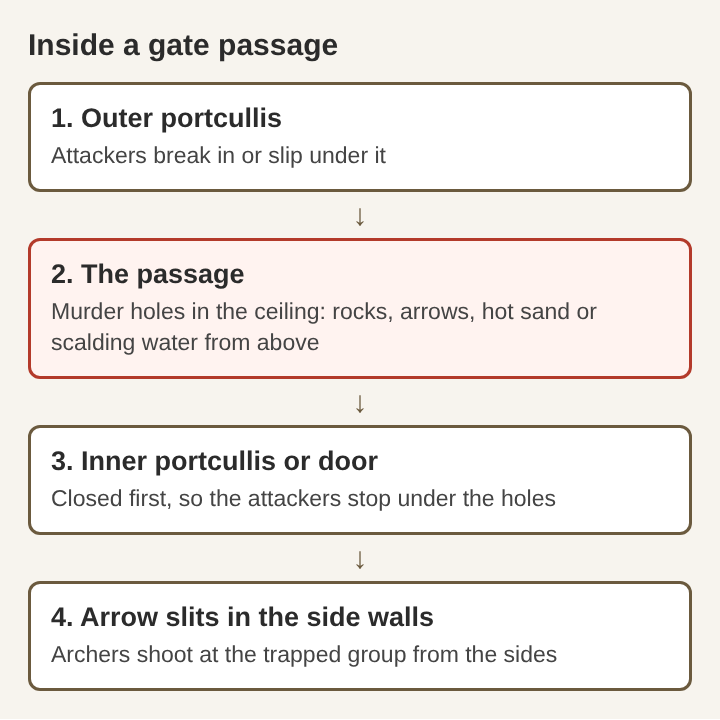
Many entrances had two portcullises, and the order in which they closed mattered. Follow it step by step:
- Attackers push through the outer gate and into the passage.
- The inner portcullis comes down first. The way forward is shut.
- The outer portcullis comes down behind them. The way back is shut too.
- Above the trapped group, defenders drop burning wood or fire-heated sand through the murder holes.
- From arrow slits in the side walls, archers and crossbowmen shoot into the same group.
Each part on its own did only a little. A closed portcullis harmed nobody. A murder hole over an empty passage did nothing. Together they turned a narrow tunnel into a place where the defenders chose the ground, the timing and the angle of every blow.
Why murder holes made the gate passage so dangerous
Three things made the passage deadly for anyone caught in it.
First, the passage was a chokepoint. However large the attacking army, only a few people fit in the tunnel at once. The defenders never faced the whole force, only the part of it that could squeeze in.
Second, attackers in the passage had to stop. Breaking a barrier takes time. Whether they used axes, fire or a battering ram, they had to stay in one place while they worked, and a target that stands still is much easier to hit.
Third, the attackers were packed close together. Sand and water spread over everyone underneath. Damage that covers an area works best on enemies who stand close, and the passage made sure they did.
Lessons from murder holes for holding a gate in tower defense
Tower defense games pose the problem a castle builder faced: enemies are coming to one entrance, and you have limited means to stop them. In this game you pick a pair of towers, add two more with gold, and hold the city gate against knights, monks, kings and rams as the stages go on, in a browser on a computer or a phone. The gatehouse offers a few lessons that carry over to tower defense strategy in general.
Cover the place where enemies stop
Murder holes sat over the passage where attackers met the barriers and bunched up. In a tower defense game, the ground right before the gate is where enemies arrive last and gather. Towers that reach that ground keep working on every enemy that gets close. Reading a map this way is the core of where to place towers in a tower defense game.
Pair a hold with damage
A portcullis held people still, and the murder holes did the harm. Tower defense rewards the same pairing: anything that slows enemies makes the rest of your damage count for more. A slow tower does the holding, and splash damage pays off most against a group held close together.
Spend where the enemy has to pass
Castle builders put their strongest work at the entrance, the one place every attacker had to reach. When you add towers with gold, ask the same question: where will this tower act on the most enemies for the longest time? A tower set where enemies pass quickly gives back less than one set where they slow down and crowd together.
Frequently asked questions
Were murder holes really used for boiling oil?
Rarely. Oil was too expensive to pour away, so defenders more often dropped rocks, hot sand, scalding water and quicklime, or shot arrows.
What is the difference between murder holes and machicolations?
The difference is where they sit. Murder holes are in the ceiling of an entrance passage inside the walls. Machicolations are openings in a parapet that juts out from the top of an outer wall, so defenders can strike attackers at the wall's base.
Did English castles have machicolations as well as murder holes?
Some did, but machicolations were more common in French castles. In England they were usually kept to the gateway, as at Conwy Castle.
Were murder holes only for attacking?
Not always. Because many give only a narrow view of the space beneath and some sit over inner doors, it has been suggested that some were also used to pass word between floors.
Murder holes and the logic of gate defense
Murder holes show how castle builders thought. They accepted that the gate was a weak point and planned around it. Instead of trying to make the entrance impossible to reach, they made reaching it costly. They narrowed the way in, added barriers that forced attackers to stop, and placed a striking point over the place where attackers would stand still.
That logic is short to state. Control where the enemy goes. Make the enemy stop. Strike where the enemy stops, from a place the enemy cannot reach. Strong walls mattered, but much of a castle's strength came from how its parts worked together at the one place an attacker had to pass, and an opening in a ceiling is the plainest sign of that thinking.
Two Towers
Defend the castle gate, stage after stage. Visit twotowers.vlvd.net