What Is a Birman Cat?
What is a Birman cat? It is a pedigree breed with a pointed coat, deep blue eyes and a white glove on every paw. The body is pale, white to cream. The face, ears, legs and tail are darker. The coat is medium-long and silky. The even white feet are the breed's trademark, so the paws are the first place to look.
A Birman is a cat you might meet behind a window, in a garden or on a doorstep. Cat Go is a walking game built around meetings like that: you photograph a real cat, lure it with food and catch it, and every catch keeps its breed and where you found it. Its Catdex of 34 breeds files the Birman under Rare, next to the Russian Blue, the Himalayan and the Burmese.
Where the Birman Breed Comes From
The Birman is also called the Sacred Cat of Burma, and its name comes from Birmanie, the French word for Burma. According to the Wikipedia entry on the Birman, there is no clear record of where the breed began. It is most often said to have started as the companion of temple priests in northern Burma, and there are many competing stories of how the first cats reached France.
The record gets firmer in France. The breed was first recognised there in 1925. During the Second World War it almost died out: by the end of the war only two Birmans were alive in Europe, a pair named Orloff and Xenia de Kaabaa. Breeders rebuilt the line from their offspring, crossing in Persian and Siamese cats, and pure Birman litters were being born again by the early 1950s. Britain recognised the restored breed in 1965, and the Cat Fanciers' Association in the United States followed within two years.
That narrow start left a mark. A 2008 genetic study cited on the same page found the Birman has one of the lowest levels of genetic diversity of all the breeds it looked at.
Birman Cat Appearance: Points, Gloves and Eyes
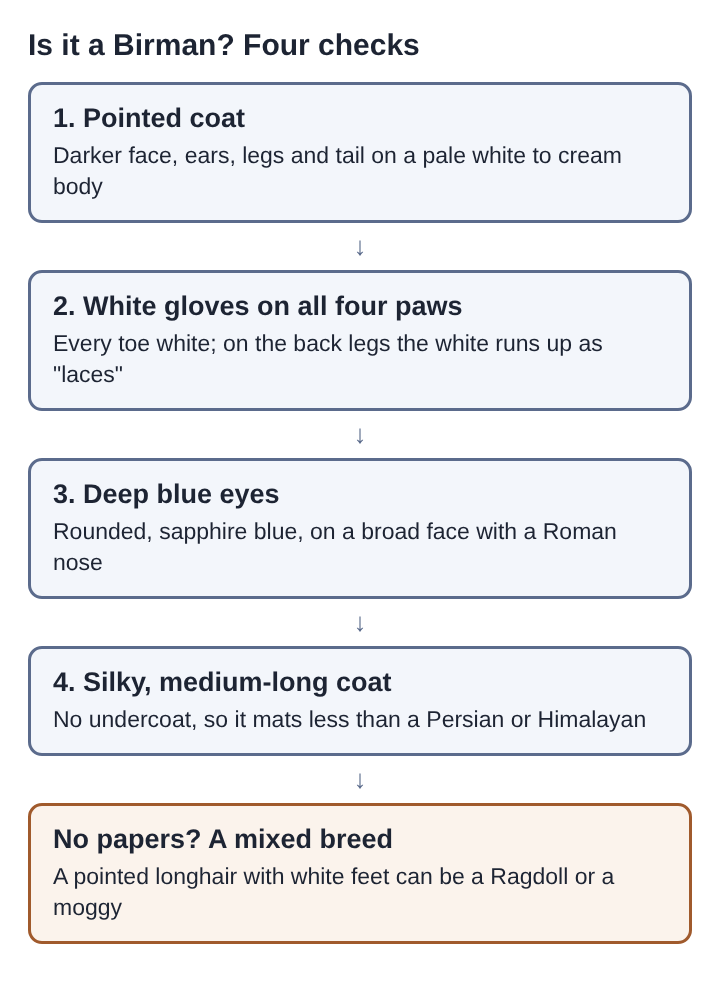
Four features together make a Birman. Check every one before you settle on the name.
The points
The dark face, ears, legs and tail are a colourpoint coat. The Wikipedia page on the Siamese cat explains that this coat comes from a temperature-sensitive type of albinism, which is why the cooler ends of the body carry the colour. On a Birman the body is white to cream, with a much paler wash of the point colour. Kittens show only faint points at first, and the markings fill in over the first months.
The gloves and laces
The white feet are what set the breed apart. On a well-marked Birman, the white covers every toe, and on the front feet it stops at the joint where the toes meet the foot. On the back feet the white runs further up the rear of the leg, ending in an inverted V half to three quarters of the way up the hock. Breeders call these the laces. Breeders count white anywhere else on the points as a serious fault.
The eyes
The eyes are round and a deep sapphire blue. The Siamese and the Ragdoll have blue eyes too, so the colour alone proves little.
The head and build
The body is medium-sized and rectangular. The face is broad, with a distinct Roman nose, and the ears are about as wide at the base as they are tall.
Birman Colours and Coat
The first Birmans were seal point, a dark brown. Blue point arrived in 1959 through blue Persian lines, and English breeders later added chocolate, red and tabby points. Today the recognised point colours are seal, chocolate and red, with their paler versions blue, lilac and cream. Tabby and tortoiseshell points in seal, chocolate, blue or lilac are allowed too. Whatever the colour, the body stays light and the feet stay white.
The fur is medium-long with a silky feel. Unlike a Persian or a Himalayan, a Birman has no undercoat, so its coat is much less prone to matting.
Telling a Birman From a Ragdoll, a Siamese or a Mixed Breed Cat
Three kinds of cat are most often taken for a Birman. Each one fails a different check.
Birman or Ragdoll
This is the hardest pair, and for good reason: Birmans were used in developing the Ragdoll. A mitted Ragdoll has white paws too. The Wikipedia page on the Ragdoll says mitted Ragdolls are often confused with Birmans, and that the easiest ways to tell them apart are size, since the Ragdoll is larger, and the chin. A mitted Ragdoll has a white chin and a white stripe down its belly. A Birman's white stays on its feet.
Birman or Siamese
This one is easier. A Siamese has almond-shaped eyes, a triangular wedge of a head, large wide-set ears and a long, slender body. Its feet carry the point colour, with no white at all. A solid, round-faced, silky cat with white feet is not a Siamese.
Birman or pointed mixed breed cat
Here is a worked example. A pale, fluffy cat with a dark face sits on a garden wall. It has blue eyes and some white on its paws. Is it a Birman? Run the four checks:
- Points: dark face, ears, legs and tail on a pale body. Passed.
- Gloves: the white reaches the ankle on one front foot and covers only two toes on the other, and there is a white splash on the chest. Failed.
- Eyes: blue. Passed, but so would a Siamese.
- Coat and build: long and full, with a narrow face. Unclear.
One clear failure on the feet and a white chest point away from a Birman. Most cats you meet have no pedigree at all, as the piece on what a mixed breed cat is called sets out, and a pointed longhair with patchy white feet is most likely one of them. If the white had been even on all four feet and nowhere else, on a medium, round-faced cat with a silky coat, Birman would be a fair guess. Only papers settle it.
Birman Health, Lifespan and Naming Traditions
A study of veterinary records in the United Kingdom, cited in the Birman entry, found a life expectancy of 14.39 years for Birmans, against 11.74 years for cats overall, though it rested on a sample of only 38 Birmans. The same page lists risks that come up more often in the breed, including kidney disease and a reflex form of epilepsy set off by sounds.
The breed also keeps an unusual habit. Many Birman breeders follow a French tradition of giving every kitten born in one year a name that starts with the same letter. Kittens born in 2016 had names beginning with N, and those born in 2017 with O.
Spotting a Birman Cat in a Neighbourhood
In the game, you catch a cat by taking its photo. While the photo is checked, the game says it is checking for a cat and reading its coat, and when there is no cat it says "No catch this time". It does not name the breed for you. It asks "Which breed is it?" and you pick from a list, with the reminder: "Most cats you meet are mixed breed. Rarer breeds are warier." When nothing fits, "Mixed breed is always a safe pick."
That is where the four checks earn their keep: look at the feet before you choose. Four even white gloves and no other white point to Birman. A white chin and belly stripe point to Ragdoll. Dark feet rule out both.
A wary cat takes patience in the game, too. You toss treats from the map's treat stops, kibble and tuna, and the game says tuna works much better on wary cats and startled cats leave quickly.
A real cat on a real street needs the same calm. Never feed, pick up or chase a cat that is not yours. Stand still at a distance and let it decide whether to come closer. The Wikipedia page on cat communication notes that a cat's ears are erect when it is alert, slightly relaxed when it is calm and flattened against the head when it feels threatened, and a scared cat may puff up the fur on its tail and back. Flat ears or a puffed tail mean it is time to take the photo from where you stand and move on.
Frequently asked questions
Is a Birman the same as a Burmese cat?
No. Both names point to Burma, but they are separate breeds, and the Catdex lists the Birman and the Burmese as two different entries.
Do Birman cats mat easily?
Less than most longhaired cats. A Birman has no undercoat, so its silky coat is much less prone to matting than a Persian's or a Himalayan's.
Can a mixed breed cat have white paws and points?
Yes. A mixed breed cat can carry both the colourpoint coat and white markings. On such a cat the white is usually uneven, or shows on the chest or face as well.
Where does the name Birman come from?
From Birmanie, the French word for Burma. The breed was first recognised in France, in 1925.
What Makes a Birman a Birman
A Birman is the sum of its checks: a pale body with dark points, deep blue eyes, a silky coat with no undercoat, and white gloves that cover every toe and stop where they should. Any one of those turns up on plenty of ordinary cats. All four together, with the white in no other place, are what the breed was rebuilt around after it came down to two cats at the end of the Second World War. The feet carry most of the answer, which is why a careful look always starts there.
Cat Go
Walk anywhere, find a real cat, and catch it. Visit catgo.vlvd.net