People who ask what is a Ragdoll cat are usually looking at a big, soft cat with blue eyes and a darker face, and wondering whether it is a breed or just a pretty long haired cat. The Ragdoll is a recognised breed with a short history, a pointed coat, eyes that are always blue, and a large body that keeps growing for years. Those four things are enough to tell one apart from the cats it is most often confused with.
What is a Ragdoll cat: a large pointed breed with blue eyes
The Wikipedia entry on the Ragdoll describes a breed with a distinct colorpoint coat and blue eyes, a large and weighty body, and a semi-long, silky coat. It was developed in Riverside, California, in the 1960s by a breeder named Ann Baker. The name comes from behaviour, not looks: these cats tend to go limp and relaxed when picked up.
The question also comes up in a walking game where you photograph real cats you meet and keep each one with its breed and the place you found it, because there you name the breed yourself. A Ragdoll is one of the easier breeds to pin down once you know where to look, since it combines several features that rarely turn up together by chance.
The breed began with ordinary cats. In 1963 a non-pedigreed white domestic longhaired cat named Josephine had several litters, and every Ragdoll today descends from matings of one of her sons, a seal point male with white feet called Daddy Warbucks, to two of her daughters. That is why the breed has a fixed look so quickly: the gene pool started small.
Ragdoll size and build: one of the largest breeds
The Ragdoll is one of the largest domesticated cat breeds. Grown females weigh about 8 to 15 lb (3.6 to 6.8 kg), and males are larger, at 12 to 20 lb (5.4 to 9.1 kg) or more. The body is sturdy with a bulky frame, the legs are in proportion, and the head is broad with a flat top and a wide space between the ears.
They also mature slowly. It can take up to four years for a Ragdoll to reach its full size. That matters when you meet one: a young Ragdoll can look leaner than you expect, and its size alone is never proof. Plenty of mixed breed cats are big, and the Maine Coon is large too, with a very different coat and face. Treat size as a first clue, then check the coat and the eyes.
The Ragdoll coat: silky, low on undercoat and always pointed
The coat looks plush, but it is made mostly of long guard hairs without a dense undercoat. According to the Cat Fanciers' Association, as quoted on the Ragdoll page, that means reduced shedding and matting, with more shedding in spring.
The key feature is that the coat is always pointed: the face, ears, legs and tail are darker than the body. In many species this pattern comes from pigment being made only in the cooler areas of the body, a mechanism called acromelanism, as the Wikipedia page on points in coat colour explains. The cooler extremities darken while the warm body stays pale. For the genetics in more depth, see what a colorpoint cat is.
Ragdolls come in six point colours: seal, chocolate and red, and their dilute forms, blue, lilac and cream. On top of any colour a cat can be lynx, which adds tabby markings to the points, or tortoiseshell, which mottles them.
Ragdoll patterns: colorpoint, mitted and bicolor
Every Ragdoll has one of three patterns on top of its point colour, as the Ragdoll page lists them. Learning them is the fastest way to tell a Ragdoll from a lookalike.
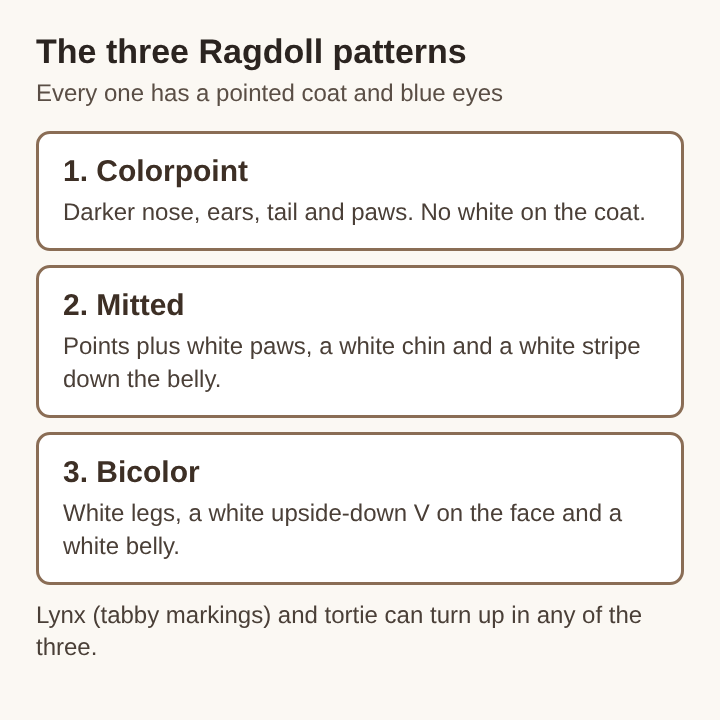
- Colorpoint: one colour darkening at the nose, ears, tail and paws, with no white.
- Mitted: the same points with white paws and a white belly. A mitted Ragdoll must have a white chin and a white stripe that runs from the chin down the belly, and may also have a white blaze on the face.
- Bicolor: white legs, a white inverted V on the face and a white belly, sometimes with white patches on the back.
Here is a worked example. You see a pale, fluffy, heavy cat with a seal brown face, blue eyes, white front paws and a clean white chin, and when it rolls over there is a white stripe down its belly. That set of clues fits a mitted Ragdoll. A second cat has the same dark face, blue eyes and white paws, but its chin is dark and it is noticeably smaller. That cat needs a different answer, and the next section gives it.
How to tell a Ragdoll from a Birman, a Himalayan or a mixed breed cat
Three kinds of cat get mistaken for Ragdolls most often. Each has a clear tell.
Birman
The Birman is also long haired and colour pointed, with a silky coat and deep blue eyes. Its trademark is a pure white glove on each paw, and on the hind legs the white runs further up the back of the leg in a point called the laces. The Ragdoll page says mitted Ragdolls are often confused with Birmans, and that the easiest checks are size, since the Ragdoll is larger, and chin colour: a mitted Ragdoll has a white chin, a Birman a coloured one. The smaller cat with the dark chin from the worked example fits a Birman.
Himalayan
The Himalayan is a long haired cat similar in type to the Persian, with blue eyes and point colouring that came from crossing the Persian with the Siamese. In Europe it is often called the Colourpoint Persian. So the points and eyes match, but the head and build are the Persian's, not the broad, flat-topped head and bulky frame of a Ragdoll.
A fluffy mixed breed cat
Most cats you meet belong to no breed at all. A mixed breed long haired cat can be large and soft, but it is usually not pointed, and its eyes can be any colour. If a cat lacks either the points or the blue eyes, it is almost certainly not a Ragdoll, however much it looks the part.
The Siamese shares the points and blue eyes but has a short, fine coat and a slender body, so it is rarely mixed up with a Ragdoll up close.
Ragdoll temperament and meeting one outdoors
Breed descriptions call the Ragdoll affectionate, relaxed and gentle, and the Ragdoll page says the breed is known for following people from room to room and for taking handling well. The floppy hold that gave it its name is a tendency, not a rule. Opinions vary on whether it is genetic or an instinctive reaction from being carried as kittens, and a Ragdoll that does not know you has no reason to relax for you.
So a soft looking cat on a garden wall is still a cat to watch from a distance, not one to pick up. The Wikipedia page on cat behaviour notes that much of a cat's body language is in its tail, ears, head position and back posture, and that ears pinned to the side or back show a frightened cat. If you see those signs, give the cat more room.
Naming a Ragdoll in Cat Go
In the game you catch a cat by taking its photo. It checks the photo for a cat and reads its coat, then asks "Which breed is it?" and you choose from a list. The game does not name the breed for you, so your own eye does that work: points, blue eyes, pattern and build. It also says most cats you meet are mixed breed and that rarer breeds are warier.
Its Catdex of 34 breeds puts the Ragdoll in the uncommon group, while the Birman and the Himalayan sit in the rare group. So the mitted cat with the white chin and belly stripe goes down as a Ragdoll, and the smaller one with the dark chin as a Birman. When the clues do not line up, the game's own advice holds: "Mixed breed is always a safe pick."
Frequently asked questions
Are Ragdoll kittens born white?
Yes. Ragdoll kittens are born white, show good colour at 8 to 10 weeks, and reach full colour and coat at 3 to 4 years.
Do Ragdoll cats shed a lot?
They shed less than many long haired cats, because the coat is mostly guard hair without a dense undercoat. Shedding tends to increase in spring.
Can a Ragdoll cat have green or gold eyes?
Not a pedigree Ragdoll. The breed is defined by blue eyes, so a pointed, fluffy cat with green or gold eyes is most likely a mix.
What is the difference between a mitted Ragdoll and a Birman?
Both are pointed with white paws and blue eyes. The mitted Ragdoll is larger and has a white chin and a white belly stripe, while the Birman has a coloured chin.
Where the shared Ragdoll description came from
The Ragdoll's early years were unusual. Ann Baker did not work with the traditional cat breeding associations. She trademarked the name Ragdoll, set up her own registry, the International Ragdoll Cat Association, around 1971, and enforced strict rules on anyone who wanted to breed or sell cats under that name.
In 1975 a group led by Denny and Laura Dayton broke away from that registry to win mainstream recognition. Starting from one breeding pair of its cats, they developed the written description of the Ragdoll that major registries such as the Cat Fanciers' Association and FIFe accept today. The three patterns, the six colours and the blue eyes all come from that shared description, which is why a Ragdoll in one country and a Ragdoll in another are judged by the same features.
Cat Go
Walk anywhere, find a real cat, and catch it. Visit catgo.vlvd.net