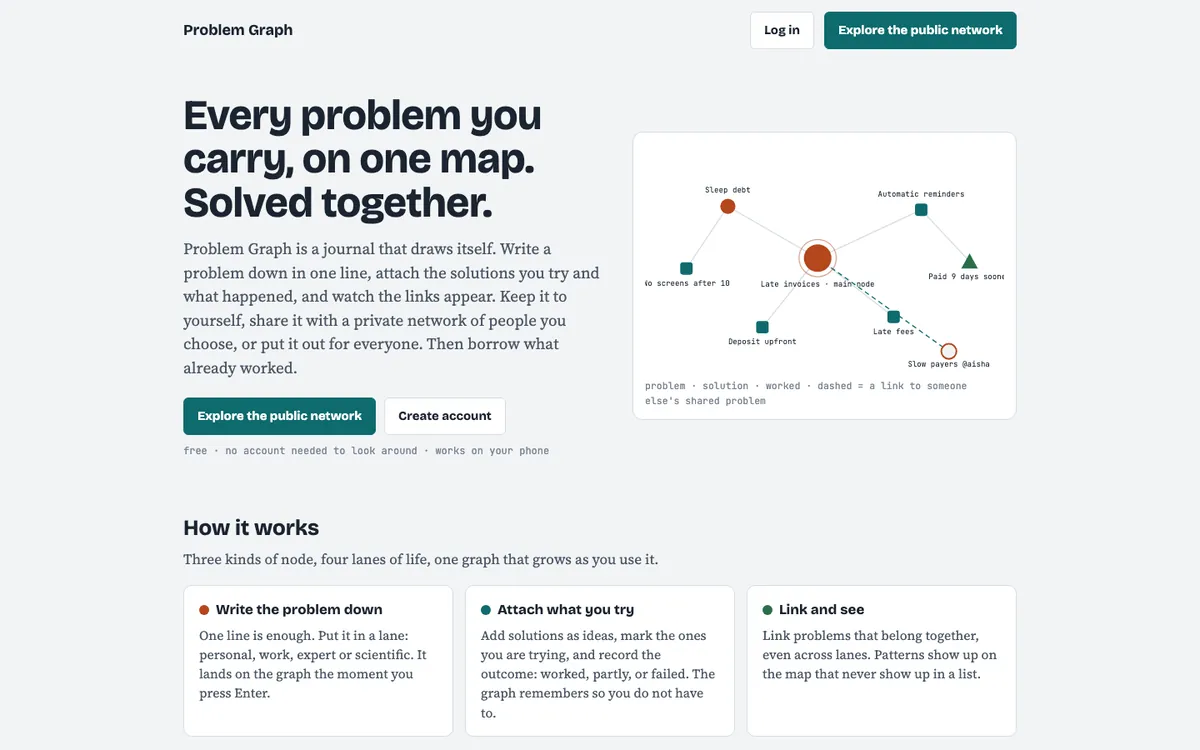
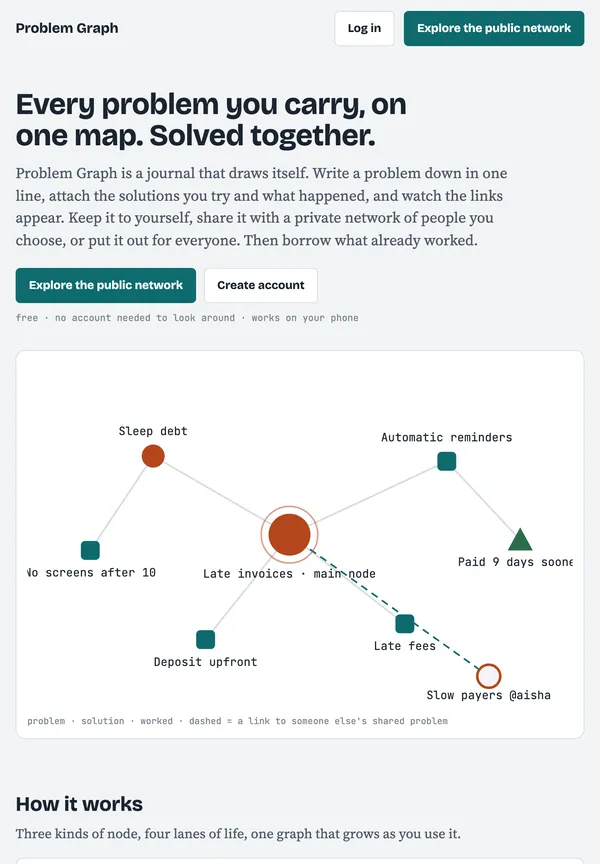
Knowing how to brainstorm solutions to a personal problem matters most when you feel stuck. The hard part is rarely a lack of ideas. More often, the same two or three options circle in your head, you have half-tried each one, and nothing new turns up. A written method helps: put the problem down, list what you already tried, produce a long list of options without judging them, look at what other people did, then pick one and record what happens. Problem Graph is built around that habit. It is a journal where each problem is written in one line, each solution tried on it is attached with its outcome, and related problems are linked on a graph that can stay private, go to people you choose, or go public.
Why Brainstorming Solutions to a Personal Problem Often Stalls
Personal problems are close to you, so your thinking about them gets worn into grooves. Psychology has a name for one version of this, the Einstellung effect: a set way of solving a problem that holds on even when better methods exist, so earlier experience gets in the way of a new problem. You keep returning to "try harder" or "set a reminder" because those came first.
A second reason is that you judge each idea the moment it appears. You think of an option, see a flaw, drop it, and start over. After ten minutes you have nothing on paper and a sense that the problem has no answer. The problem usually has several answers. The process killed them early.
A third reason is memory. You may have tried something six months ago, seen it partly work, and forgotten the details. Without a record, each new attempt starts from zero.
Write the Personal Problem Down Before Brainstorming Solutions
Brainstorming works better on a specific problem than on a vague one. "Money stress" gives you nothing to work on. "Weeknight dinners end up as takeout four nights out of five, which costs more than the food budget allows" gives you a lot.
Keep it to one line. Say what happens, how often, and why it matters to you. Leave the cause out for now, since guessing the cause too early narrows the ideas you will allow yourself. There is more on wording in how to write a problem statement for a personal problem.
In Problem Graph, each problem goes into one of four lanes: personal, work, expert or scientific. The takeout problem belongs in personal. Sorting matters because a personal problem has limits that a work problem does not: your own time, your own household, your own energy at 7 pm.
List What Has Already Been Tried and What Happened
Before you generate anything new, write down every attempt you can remember. For each one, note the result in plain terms: worked, partly worked, or failed.
For the dinner problem, the list might read:
- Meal planning on Sunday: partly. Plans were made, but nothing was cooked ahead, so Wednesday fell apart.
- Deleting the delivery app: failed. It was back on the phone within a week.
- Stocking frozen meals: partly. Used on two nights, then forgotten in the freezer.
This list does two things. It stops you from brainstorming the same ideas again as if they were new. It also shows where the real difficulty sits. Here, plans get made but the cooking does not happen midweek. That points the next brainstorm at a sharper question: what would make a meal ready on Wednesday without effort that evening?
Keep the failures. A failed attempt tells you something specific about your situation. The journal follows the same rule: a solution marked failed stays on the map as a failed solution instead of being deleted. There is more on keeping these records in how to track what you tried to solve a problem.
How to Brainstorm Solutions to a Personal Problem Without Judging
The word brainstorming was made popular by the advertising executive Alex Osborn in his 1953 book Applied Imagination. His four rules are short: go for quantity, hold back criticism, welcome wild ideas, and combine and improve ideas already listed. The skill being used is divergent thinking, producing many possible answers to one question, as opposed to finding the single correct one.
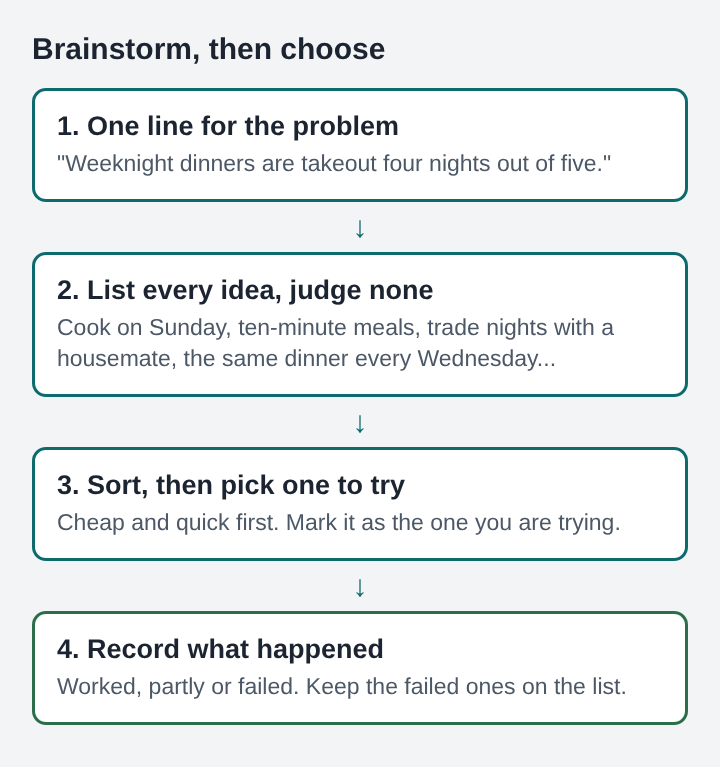
Set a timer for fifteen minutes and write without crossing anything out. If the ideas dry up, change one part of the problem at a time:
- Change the time. Cook on Sunday for three nights. Cook in the morning. Eat the main meal at lunch.
- Change the effort. Pick five meals that take under ten minutes and rotate them. Use pre-chopped vegetables.
- Change who does it. Trade cooking nights with a housemate. Split a meal kit with a neighbor.
- Change the trigger. Put Wednesday's dinner in the fridge with a note on it. Set the oven timer before leaving for work.
- Change the money side. Set a weekly takeout allowance and stop fighting it. Order from cheaper places only.
- Go to the extreme. Eat the same dinner every Wednesday for a month.
Some of these look silly. Write them anyway. The extreme ones often hold a useful piece. "Same dinner every Wednesday" sounds dull, but it removes the decision, and the decision may be the part that fails at 7 pm.
Borrow Solutions Other People Tried for the Same Problem
Your own head is a small sample. Other people have had nearly the same problem and tried things you have not thought of. Friends, family and forums are all sources. The useful question to ask them is narrow: "What did you try for this, and what happened?" Asking only for advice gets you opinions. Asking for results gets you evidence.
The journal shows similar problems other people shared and which of their solutions worked. You can borrow one into your own graph, and it keeps a link back to where it came from. An AI also proposes new solutions, grounded in what worked for others on similar problems.
Treat any borrowed idea as a record of what happened for someone else, not a promise of what will happen for you. Their kitchen, schedule and budget differ from yours. Still, a solution that worked for several people with the same problem deserves a place on your list ahead of one nobody has tried.
Narrow the Brainstormed Solutions to One to Try First
Now you judge. Go through the list and ask four questions about each idea:
- How much does it cost in money and time?
- Does it address the weak point the earlier attempts showed? Here, that is midweek cooking.
- How soon will you know if it works? A week is better than a month.
- Can you undo it easily if it fails?
Combine ideas where you can. "Cook on Sunday" and "same dinner every Wednesday" merge into one plan: make a double batch of one fixed dish on Sunday and eat it Monday and Wednesday.
Pick one. Trying three changes at once leaves you unable to tell which one helped. Before you start, write what success looks like in numbers: "takeout two nights a week or fewer, for three weeks." Deciding this in advance protects you from confirmation bias, the habit of noticing evidence that fits what you hoped for. There is a fuller look at this in what confirmation bias is in problem solving.
Record the Result So the Next Brainstorm Starts Further Ahead
When you begin, mark the solution as being tried. When the period ends, give it an outcome: worked, partly, or failed. Add a sentence on why. "Partly: Monday worked, Wednesday's portion got eaten Tuesday" is far more useful later than "partly."
Check the numbers you set before you started, not your general feeling. If takeout dropped to two nights, it worked. If it dropped to three, it partly worked, and you know which night broke. For ways to make that call fairly, read how to know if a solution really worked.
This record changes your next brainstorm. You will not start from a blank page. You will start from a list of attempts with their results, a clearer sense of where the problem breaks, and ideas already waiting to be tried. Over several rounds, the problem gets smaller because each round builds on the last.
Frequently asked questions
How many solutions should a brainstorm for a personal problem produce?
Aim for at least fifteen to twenty before you judge any of them. The first handful are usually the familiar ones you have already considered, and the more useful ideas tend to show up after those run out.
Is it better to brainstorm a personal problem alone or with others?
Both help, in order. Looking across 22 studies, Michael Diehl and Wolfgang Stroebe found that groups brainstorming together usually produce fewer ideas than people working separately, and the nominal group technique has people write ideas down silently and alone before any discussion, so write your own list first, then ask others what they tried.
Where can solutions other people tried for a personal problem be found?
Look for places where people share a problem together with the solutions they tried and the outcome of each, since results tell you more than opinions. Friends and family can help too, if you ask what they tried and what happened rather than what they think you should do.
What makes brainstorming solutions to a personal problem effective?
A specific one-line problem, a list of what was already tried with results, a long list of new ideas made before any judging, and a clear measure of success chosen before you try one. Recording the outcome afterward is what lets the next round start further ahead.
Problem Graph
Every problem you carry, on one map. Solved together. Visit problemgraph.vlvd.net