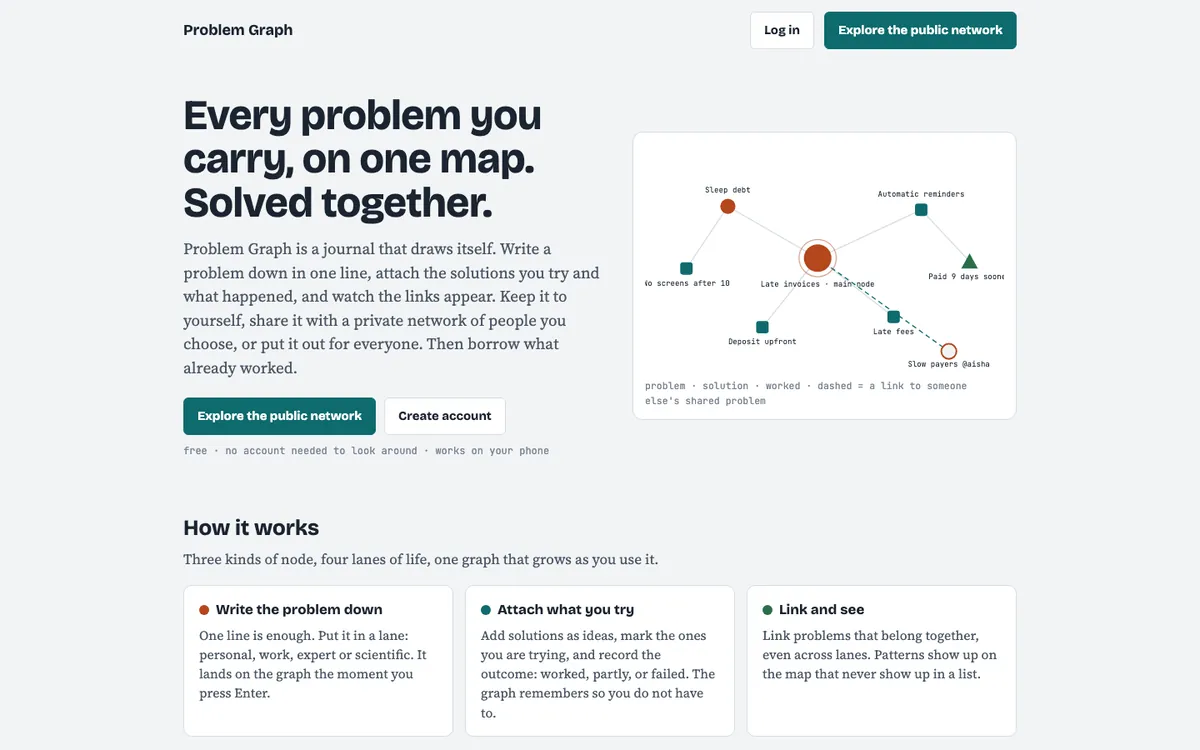
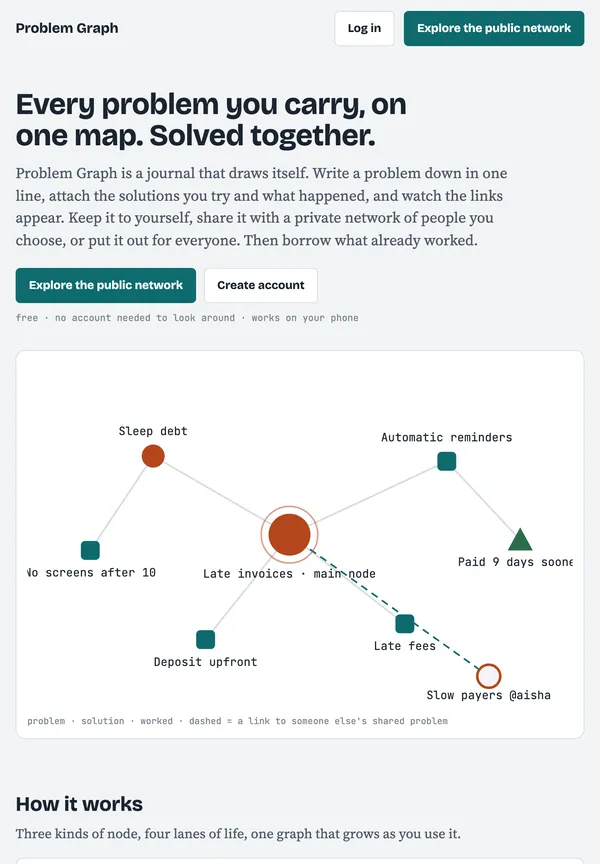
Learning how to write a problem statement for a personal problem starts with knowing what one is: a short description of what is going wrong in your life, how often it happens, and what it costs you, written without a fix tucked inside it. Most personal problems stay vague because they live only in your head, where they change shape every time you think about them. Putting the problem into one clear line gives you something fixed to work against. It also gives you something to attach your attempts to, and some people keep that record in a journal that draws problems and the solutions tried on them as a graph, which can stay private or be shared.
What a Problem Statement for a Personal Problem Contains
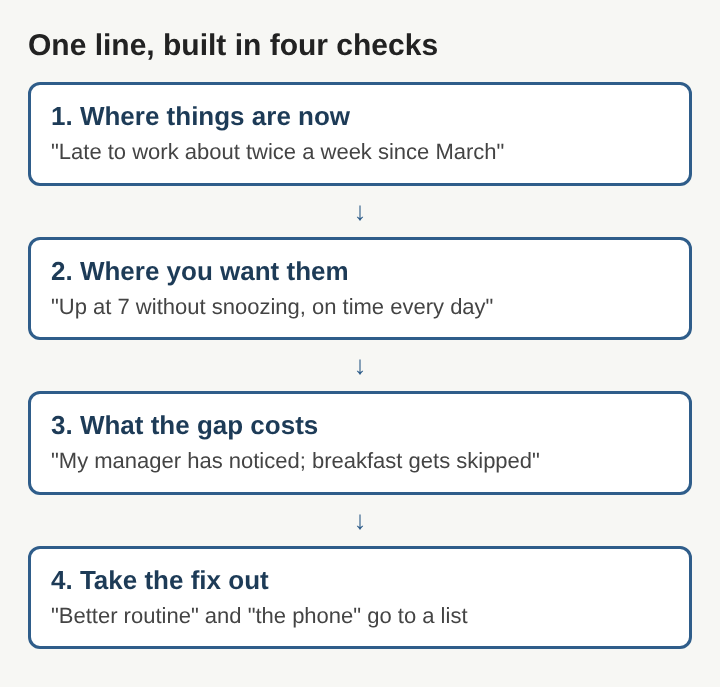
In business, a problem statement identifies the gap between the current problem and the goal, and it does not define the solution. A template often used in business analysis lists the ideal state, the reality, the consequences and a proposal. A personal version covers the same ground with fewer formalities, and it moves the proposal out of the line. It usually holds four parts:
- What happens. An observable event or pattern, not a feeling about yourself.
- When and how often. Since when, on which days, in which situations.
- What it costs. Lost sleep, money, time, a relationship under strain.
- What better would look like. One plain sentence about the state you want, so you know when the problem is gone.
What it leaves out matters just as much. A good statement has no solution in it and no guessed cause stated as fact. Those belong in the attempts you record later.
Why Writing a Personal Problem Down Changes How It Gets Solved
A problem you only think about gets restated a little differently each time. On a bad day it is huge. On a good day it seems to have gone away. When it is written down, you can compare today against the same words you wrote last month.
Research on problem solving splits problems into well-defined ones, with a specific end goal and a clearly expected solution, and ill-defined ones, without either. Most personal problems start out ill-defined. Writing the statement moves yours toward the well-defined side, which allows more planning before the first attempt.
Writing it down also separates the problem from your first idea for solving it. Once those are two separate things on paper, a failed idea no longer feels like proof the problem cannot be solved.
How to Write a Problem Statement for a Personal Problem, Step by Step
Take a common situation. You feel exhausted all the time and keep telling yourself you need to "get your life together." Here is how to turn that into a usable statement.
- Write the raw version first. Put down whatever comes out: "Always tired, no energy, need to fix my routine." Do not edit yet.
- Find the observable part. Ask what someone watching you would actually see. In this case: you hit snooze three or four times and arrive at work late about twice a week.
- Add time and frequency. When did it start? Say it began around March, and it happens on most weekdays.
- Add the cost. Your manager has mentioned the lateness, and you skip breakfast to make up time.
- Remove solutions and guesses. "Need a better routine" is a solution. "Because of the phone" is a guessed cause. Move both to a separate list of things to try.
- State what better looks like. Up at 7 without snoozing, at work on time every day.
- Cut it to one line, then add a short note. The headline might read: "Weekday mornings since March: can't get up at 7, late to work about twice a week." The note holds the cost and the target.
The headline is what you will see every time you come back. The note is where the detail lives.
Examples of Personal Problem Statements Before and After Rewriting
Before: "Need to be more disciplined about guitar." After: "Weeknight evenings go to the phone; the planned hour of guitar practice happens about once a week instead of four times."
Before: "Money is a mess." After: "By the 20th of each month the checking account is close to empty, though income has not changed in a year."
Before: "Should find a new job." After: "Since the spring reorganization, Sunday evenings bring enough dread about Monday that plans with friends get cancelled."
Each rewrite removes a judgment or a solution and replaces it with something you could count. "Find a new job" might be the right move, but it is one possible answer; the rewrite leaves room for others, such as a talk with a manager.
Common Mistakes in a Personal Problem Statement, Such as Hiding a Solution Inside It
The most frequent mistake is writing the fix as the problem. "Need to cut sugar" or "need to move out" are plans, not problems. Programmers have a name for a related trap, the XY problem: someone asks for help with their attempted solution instead of the underlying problem, and the help they get is aimed at the wrong thing. The same thing happens when you work alone. If the statement says "need to cut sugar," every failed week of cutting sugar feels like failure on the whole problem, when the real issue might be afternoon energy crashes with several possible causes.
Other common mistakes:
- Character labels. "Lazy," "bad with money," "too sensitive." These describe you, not the situation, and they give you nothing to change.
- Several problems in one line. "Tired, broke and lonely" is three problems. Write three statements, then note how they connect.
- A guessed cause written as fact. "Late because of the phone" closes off other explanations before you have checked any of them.
Recording Attempts and Results Against the Statement
In a problem journal drawn as a graph, the problem goes down in one line, which is exactly the headline you wrote in step 7. Each problem sits in one of four lanes: personal, work, expert or scientific. The late mornings would go in personal.
Each possible solution goes in as an idea, gets marked when you start trying it, and then receives an outcome: worked, partly or failed. A failed solution stays on the map as a failed solution instead of disappearing. The list of things that did not help is what stops you from trying the same thing again in six months; keeping it well is covered in how to track what you tried to solve a problem.
Sharing is private by default, so only you see the entry. You can also share a main node with a private network of people who have an invite code, or make it public. A shared node carries its solutions, their outcomes and the requirements they need. The tool also shows similar problems other people shared and which of their solutions worked. You can borrow one into your own graph with a link back to where it came from, and an AI proposes new solutions grounded in what worked for others on similar problems. What the graph gives you is a record of someone else's outcome, not a promise about yours, so a borrowed solution still needs its own outcome marked on your problem.
Frequently asked questions
How long should a personal problem statement be?
One line for the headline, ideally under twenty words. A short note of two or three sentences can hold the cost and what better would look like.
Should a personal problem statement include the cause?
Only if the cause is already known for certain, which is rare. Keep suspected causes as a separate list and check them one at a time, for example with the five whys method or a fuller root cause analysis on a personal problem.
Is a problem statement the same as a personal goal?
No. A goal describes where you want to end up, while a problem statement describes the current gap and what it costs. The "what better looks like" sentence links the two, but the statement starts from what is happening now.
When should a personal problem statement be rewritten?
Rewrite it when an attempt shows the problem is different from what was written, or when part of it is solved and a smaller piece remains. Keep the old version with its date so the change in understanding stays visible.
Keeping a Personal Problem Statement Accurate as Attempts Pile Up
A statement written on day one reflects what you knew on day one. After a few attempts, you know more. Say you tried going to bed an hour earlier and the outcome was partly: you snooze less but still arrive late on Mondays. That result changes the problem. It is no longer "can't get up on weekdays." It is closer to "Monday mornings after late Sunday nights."
When that happens, write the new statement and keep the old one beside it with the date. The old version shows which ideas were aimed at which understanding of the problem, which makes it easier to read your results honestly. A solution that failed against the first statement might never have been tried against the second.
Check the statement against the numbers you wrote into it. If it said "late about twice a week," count the late days for two weeks after each attempt. That count is the plainest way to tell whether a solution really worked, instead of trusting how the week felt.
Keep the failures in the record too. A statement that sits next to three failed attempts and one partial one, each with its reason, is far more useful than a clean line with nothing under it. Those attempts narrow the problem down, and a record of failed solutions often shows the shape of the problem more clearly than the first statement did.
Problem Graph
Every problem you carry, on one map. Solved together. Visit problemgraph.vlvd.net