Most people can name a few things they care about. Fewer can say how those things showed up on a Tuesday. Learning how to write about your values in a journal means closing that gap: you name what matters to you, then you go back to real days and look at where it appeared, where it went missing, and what got in the way. One way to get regular material for this is a site that asks five questions a day about your own life. EnrichAI asks those questions at an hour you pick, then writes a plain readout of what you said and sets it beside your week and month. You can also do all of this in a paper notebook with nothing more than a few honest questions.
How to write about your values in a journal, in two parts
A value is something you choose to act for, even when nobody is watching. Honesty, care for family, craft, fairness, curiosity, and autonomy are common ones. Philosophers and psychologists have argued for a long time about what values are and where they come from. The overview of values in ethics) gives a sense of how wide that question is.
In a journal, you do not need to settle any of that. Writing about values on the page has two parts. First, you put a value into your own words, specific enough that you could spot it in action. Second, you write about actual events and check them against those words. The first part without the second turns into a list of nice ideas. The second part without the first turns into a diary of events with no thread running through it.
Why journaling about values helps with everyday decisions
Most decisions are small and fast. Do you answer the message now or later? Do you say the awkward thing in the meeting or let it pass? When you have already written down what you care about, you have words ready to check a choice against. That does not make the choice for you. It makes the trade-off visible.
Some therapy approaches build on this. Acceptance and commitment therapy pairs acceptance of what a person feels with commitment to their core values. Separately, researchers studying self-affirmation often use a values essay: people rank a list of values, then write for about five minutes on the one they ranked first and why it matters to them. You do not need a study to use the basic move: write about what matters, then write about what you did.
There is also a less comfortable reason. When your actions and your values pull apart, people tend to explain the gap away. Psychologists call the tension behind this cognitive dissonance. Writing the gap down in plain words makes it harder to quietly smooth it over.
How to name your core values on the page
Start with evidence, not a list of virtues. Abstract words such as "integrity" are easy to write and hard to use. Try these steps instead:
- Recall three moments you were proud of. They can be small. Write two or three sentences on each: what you did and why it mattered.
- Recall one moment that bothered you afterward. Write what you did and what you wish you had done.
- Look for the common thread. If two proud moments involved telling someone a hard truth and the bad moment involved staying quiet, honesty is probably near the top.
- Write the value as a sentence, not a single word. "Honesty" becomes "Saying what is true when it would be easier to stay quiet." That sentence is something you can check a day against.
If you want a vocabulary to work from, the theory of basic human values sorts values into broad groups such as security, achievement, benevolence, and self-direction. A list like that can remind you of values you hold but had not named. Keep the final wording your own.
Three to five values is usually enough to start. More than that and the list stops guiding anything.
Journal prompts for writing about your values
Good prompts ask about a specific time and place, and they cannot be answered yes or no. "Do you value honesty?" gets a quick yes and nothing else. These open more room:
- When did a value you named cost you something this week, even something small?
- What did you spend the most time on today, and which value did it serve?
- Who did you make time for recently, and what made that time matter to you?
- What is something you used to care about that now gets less of your attention? What replaced it?
- Where did you act against one of your values, and what were you protecting instead?
- What would someone watching your week guess you care about most?
The last one is useful because it skips what you intend and looks only at what you did. If a prompt feels too heavy on a given day, it helps to shrink it to one concrete moment; there are more ways to handle that in what to do when a reflection question feels too hard.
How to compare daily choices with your stated values
Here is a worked example. Say one of your written values is "Being present with my kids, not half-present." On Thursday evening you write:
Dinner, then homework help. Checked work email twice during homework. Read one chapter at bedtime, phone in the other room.
Now compare. Bedtime matched the value. Homework did not, twice. The useful next question is not "Why am I failing?" but "What pulled me to the email?" Maybe a deadline was real. Maybe it was habit. Write the honest answer, then one small, specific change: "Phone stays in the kitchen during homework on weeknights."
A simple way to structure this in any entry:
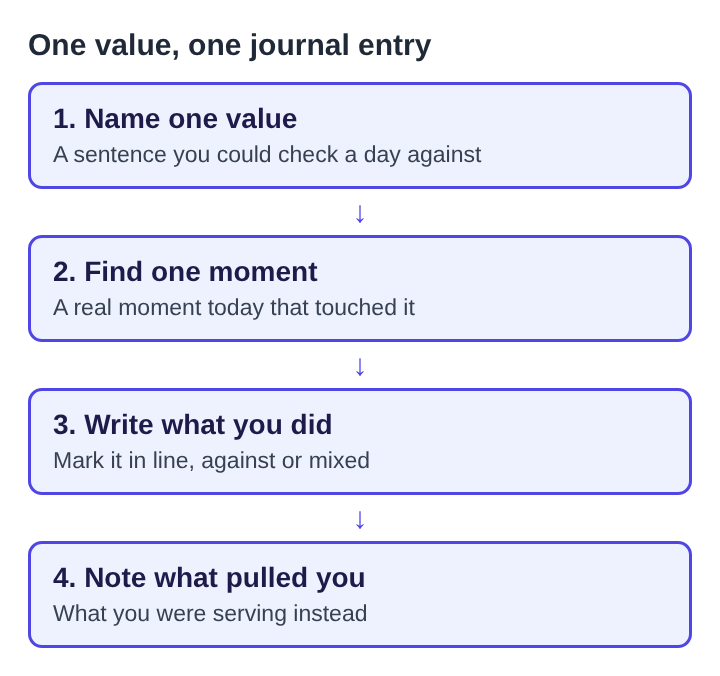
- Pick one value for the entry.
- Write two or three concrete things you did today that touched it.
- Mark each as in line, against, or mixed.
- For anything against or mixed, write what you were serving instead.
That fourth step matters. Often the competing pull is another value, not a flaw. Once a week, read the entries together. Patterns show up across days that no single entry reveals; how to notice patterns in your own journal entries covers that reading in more detail, and how to reflect on your week in ten minutes gives a short routine for it.
Using EnrichAI questions to write about your values
The hardest part of a values journal is often coming up with a fresh question every day. A daily question site can handle that part. At the time you choose, it asks five questions drawn from what you value, what you are dealing with, and what you are curious about, ordered from the easiest to step into toward the deepest. Each question says what it draws on, such as a value you named, your stage of life, the season, or a thread from yesterday. None can be answered yes or no.
One question shown on its home page reads: "When did honesty cost you something small this week?" That is close to the comparison of daily choices with a stated value, already narrowed to one value and one week. You can type or speak your answers, and each one saves as you go.
After the fifth answer, the site writes the day's readout, which it calls the enrichment. It catalogs your words, says plainly what you left unanswered, and sets the day beside your week and month. The next day's questions follow what was left open. For values work, the "left unanswered" part is the useful one: the value you keep skipping is often the one that most needs writing about.
There are also things it will not do. It will not tell you how you feel, flatter you, grade your answers, give advice you did not ask for, or invent progress your answers do not show. The site is private, with no ads or trackers, and you can download everything you wrote or delete your account and all of it.
Frequently asked questions
How many values should one journal entry cover?
One is usually enough. Focusing on a single value lets you look closely at a few real moments instead of skimming several values in general terms.
How often should values be revisited in a journal?
Short daily entries that touch one value work well, with a weekly read-through to compare days. Rewriting the value list itself every few months is often enough.
What if two values seem to conflict in a journal entry?
Write both down and describe the specific situation where they clashed. Philosophers discuss this as value pluralism, the view that real values can compete without one cancelling the other, so a conflict on the page does not mean one value is fake.
Can values change over years of journaling?
Yes. Older entries make the change visible, and writing about what shifted and why is one of the more useful entries a long journal can hold.
Keeping a values journal over time
A values journal gets more useful the longer it runs, because the comparison grows. After a month you can see which values show up in your days and which only show up in your list. After a year you can see which ones changed. Keep the value sentences on the first page and date every revision instead of erasing the old wording. When a sentence no longer fits, write what replaced it and what happened that made the old one stop fitting.
Keep entries short enough that you will actually write them. A few lines that name one value and one real moment do more than a long entry you skip. For a closer look at how this kind of writing differs from simply recording events, the difference between journaling and reflecting lays out that line in more detail. The whole practice comes down to one repeated move: say what you care about, look at what you did, and write down the distance between them in plain words.