Most people use the two words as if they mean the same thing. They overlap, but they are different acts. If you have ever filled a notebook and then found you learned little from it, you have already met the gap between them. So, what is the difference between journaling and reflecting? Journaling records what happened. Reflecting asks what it shows. One puts experience on the page. The other turns that experience over and looks at it. A practice that does both gets more out of each entry than a practice that does only one.
Some tools are built around that pairing. EnrichAI asks five questions a day about your own life, at an hour you pick, and then gives back a plain account of what you said, set beside your week and month. The way it is put together makes the line between the two acts easy to see.
What Journaling Means: Putting Experience on the Page
Journaling is the habit of writing about your days. The form is old. A diary is a dated record of events and thoughts, kept by one person, usually in order. A journal can hold lists, scraps of conversation, worries, plans and notes on the weather. Its main job is capture.
Capture has real value. A line written on Tuesday can keep details that might be gone by Friday: the exact words a friend used, the time you woke, the meal you skipped. Without that record, later thinking has little to work with.
But capture is description. A sentence such as "Long day, the meeting ran over, got takeout, tired" is journaling. It is true and it is useful. It does not yet ask anything.
What Reflecting Means: Asking What an Experience Shows
Reflecting means turning your attention back on an experience to find out what it means for you. Philosophers call the wider capacity introspection: the way a person comes to know their own thoughts and feelings. Educators use a narrower term, reflective practice, for the habit of looking back on what you did in order to learn from it. Donald Schön, in his 1983 book The Reflective Practitioner, drew a line between reflection in the middle of an action and reflection on an action after it is over.
Reflection can happen in your head, in a talk with a friend, or on paper. What makes it reflection is the question behind it. Why did that bother you? What did you choose there? What does this share with last month?
Take the same tired evening. Reflecting on it might produce this: the meeting ran over because nobody wanted to end it, and you stayed quiet because you did not want to be the one to call time. That is a different kind of sentence. It names a choice and a reason.
What Is the Difference Between Journaling and Reflecting
The core difference is direction. Journaling moves from experience to page. Reflecting moves from the page, or from memory, to what the material shows about you.
- Journaling answers "what happened?" It records events, moods and details.
- Reflecting answers "what does it mean?" It looks for causes, choices, values and repeats.
- Journaling can be complete in one sitting. A day is written down and done.
- Reflecting often needs distance. It gets richer when you set today beside last week or last month.
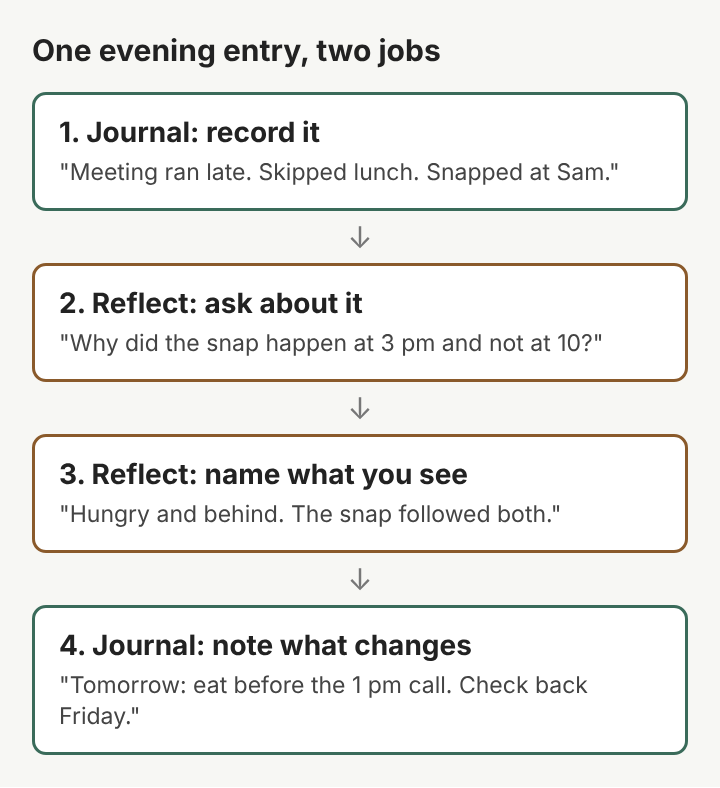
Neither one is enough alone. Reflection without a record can drift toward what you already believe, since memory keeps some things and drops others. A record without reflection tends to pile up unread. The two work well in sequence: write it down, then ask about it. A short weekly look back is one way to build in that distance, and reflecting on your week in ten minutes is a realistic amount of time to give it.
When Journaling Happens Without Reflection
Many journals stay at the level of capture for years. A few signs point to it:
- Entries repeat the same complaint with no new angle.
- You rarely read old pages.
- Entries stop where the day stopped, with no question at the end.
- The prompt "how was your day?" gets a one-word answer: fine, busy, tired.
The last sign matters most. A yes-or-no question, or one with an easy one-word answer, closes thought quickly. "Was today good?" gets "yes." Nothing else follows.
Journaling without reflection is not wasted. It is raw material. To use it, you need a way back in. Reading entries in a batch is one route, and noticing patterns in your own journal entries is a skill you can practice. Another route is to change the questions you write to.
How Reflection Questions Turn a Journal Entry Into Insight
A good reflection question does three things. It cannot be answered yes or no. It starts somewhere concrete. And it leaves room to go deeper.
Here is a worked example. Suppose your entry reads: "Spent the afternoon fixing the shelf. Took longer than planned." Three questions, moving from easy to deep, change what that entry can give you:
- Concrete: "What did you notice while you worked?" You might write that the drill was your father's, and you had not used it in years.
- Skill and change: "What do you do now that you once had to learn?" You might write that you no longer read the instructions twice, and that this took practice.
- Value: "What made you keep going when it took longer than planned?" You might find that finishing things yourself matters to you more than you usually say.
The facts are the same. The questions draw out a link to a person, a sense of growth, and a value. That is the move from journaling to reflecting.
Order matters. Starting with the hardest question often stalls the whole session. Start small and concrete, then go further. There are practical ways around a reflection question that feels too hard, and a short set of daily self-reflection questions gives the habit a fixed shape so you are not inventing prompts each night.
Using EnrichAI to Pair Journaling With Reflecting
The site takes both halves and puts them in a fixed order. At the time you choose, Claude asks five questions drawn from what you value, what you are dealing with and what you are curious about. They run from the easiest to step into to the deepest. Each one says what it draws on: your place and the season, your stage of life, a value you named, yesterday's thread or a curiosity. None of them can be answered yes or no.
Its home page gives three examples: "What did you notice on the way out this morning?", "What do you do now that you once had to learn?" and "When did honesty cost you something small this week?" The first sits close to plain journaling. The last asks you to reflect on a choice and a value.
You type or speak each answer, and each one saves as you go. That part is the journal: a record in your own words.
After the fifth answer, the day's readout is written by Claude, the AI language model) that also asks the questions. The site calls this readout the enrichment. It catalogs your words, says plainly what you left unanswered, and sets the day beside your week and your month. The next day's questions follow what was left open. That is where reflection gets the distance a single entry lacks.
The site also sets limits on itself. It will not tell you how you feel, flatter you, grade your answers, give advice you did not ask for, or invent progress your answers do not show. That leaves the meaning-making with you. The readout is a plain record, not a judgment. Accounts are by invitation, and answers stay in its own database, sent to Claude only to write the questions, readouts and progress. There are no ads or trackers, and you can download everything you wrote or delete your account and all of it.
Frequently asked questions
Can reflecting happen without writing anything down?
Yes. Reflection is a way of thinking, and it can happen on a walk or in a conversation. Writing helps because it gives what you noticed a record you can return to and compare with later days.
Is a gratitude list journaling or reflecting?
On its own, a gratitude list is mostly journaling, because it records things. It becomes reflecting when you ask why an item mattered or what it says about what you value.
How long should a reflective journal entry be?
There is no fixed length. A few sentences that answer one open question can hold more reflection than pages of description, so the depth of the question matters more than the word count.
Does a guided question practice replace a paper journal?
It does not have to. Guided questions handle the asking, while a paper journal can hold sketches, lists and loose notes that do not fit a question. Plenty of people keep both.
Journaling and Reflecting as One Practice
Journaling and reflecting are two steps in one habit. The first keeps the day. The second asks what the day meant. Each alone leaves something out: a record nobody reads, or thoughts with nothing solid under them.
A simple order works. Write down what happened in plain terms. Then answer one open question about it, starting with something concrete. Once a week, read the entries together and ask what repeats. Over time the record gives your questions real material, and the questions give the record a use.
The difference between journaling and reflecting is not a choice between them. It is the step from noting what you did to noticing what it shows. The practice is to take that step often, one open question at a time.