Most people who want to know how to start journaling already own a notebook or have an app on their phone. What stops them is the first page. It is blank, and it seems to expect something worth saying. The fix is smaller than it looks: a short, fixed time, a plain format, and a question to answer instead of a page to fill. With those three in place, writing becomes a few minutes of noticing your own life rather than a task you keep putting off.
Why people start journaling and what it offers
People begin for different reasons: to remember their days, to work through a decision, or to see where their attention goes. Writing to yourself has a long history, and the word itself says how often to do it: "journal" comes from the Latin diurnus, "of the day", the same root as diary. The Roman emperor Marcus Aurelius wrote reminders and questions addressed to himself, and they survive as the Meditations.
Researchers have also studied structured writing about your own experience. The psychologist James Pennebaker developed a method of writing about difficult events in short sessions. In its first study, published in 1986, people wrote for 15 minutes a day on 4 days in a row, and his work is a large part of what is now called writing therapy. If that approach interests you, the article on what expressive writing is and how it works covers it in more detail.
The most dependable thing a journal gives you is a record. You can read back what you said last Tuesday and see it plainly. Some people get that record from a notebook. Others use a service that asks five questions a day about your own life and then writes back a plain summary of the answers. Either way, the value builds as entries pile up.
Choosing a format to start journaling: paper or app
Paper is slower, and that slowness suits some people. You cannot scroll away from it, and handwriting makes you choose words with more care. But paper is hard to search, and a notebook left at home stays empty.
An app is on your phone, and your phone is with you. You can search old entries, and some apps let you speak your answers instead of typing them.
Pick the format you will actually have in reach at the time you plan to write. If a few weeks show you guessed wrong, switch.
Setting a small time and place for a new journaling habit
A vague goal such as "journal more" rarely survives a busy week. A specific plan does better. Psychologists call this an implementation intention: a plan written in the form "when this happens, do that." The psychologist Peter Gollwitzer introduced the idea in 1999, and his studies link these if-then plans to a higher chance of reaching a goal than a general intention alone.
Applied to journaling, the plan names a cue, a place and a tiny amount:
- When the kettle starts to boil in the morning, write three sentences at the kitchen table.
- When you sit on the train home, answer one question in your notes app.
- When you get into bed, write the date and one thing you noticed that day.
Keep the amount small enough that a tired evening cannot talk you out of it. Three sentences is enough.
Writing a first journal entry: how to start journaling without a blank page
The blank page is hard because it asks you to choose a subject and a tone at the same moment. Remove one of those choices and it gets easier. A few ways to do that:
- Start with a fact. Write the date, where you are and what you just did.
- Answer a question instead of writing an entry. A question gives you a subject. All you have to supply is the answer.
- Set a short timer. Write for five minutes and stop when it ends, even mid-sentence. A clear end makes the start feel smaller.
Here is how that plays out. Say it is 10pm and you have nothing in mind. You write: "Thursday. Kitchen. Just finished the dishes." Then you add one question: what took more time today than expected? The answer, a long phone call with a sister about her move, takes four sentences. You stop. That is a complete first entry. It is short, it is true, and it gives tomorrow's version of you something to read.
Starting questions that make journaling easier to begin
Good starting questions are concrete and cannot be answered with yes or no. "Was today good?" ends after one word. "What part of today would you repeat?" asks for a scene. A few that work well in the first weeks:
- What did you notice on the way out this morning?
- What took longer than you expected today, and why?
- Who did you talk to today, and what stayed with you afterward?
- What do you do now that you once had to learn?
Start with the easy, outward ones about places, people and events. Leave questions about values and fears until writing feels routine. A longer set appears in five daily self-reflection questions to ask yourself. If a question stalls you, that is normal, and there are practical ways around it in the piece on what to do when a reflection question feels too hard.
Starting a journal by answering questions you are asked
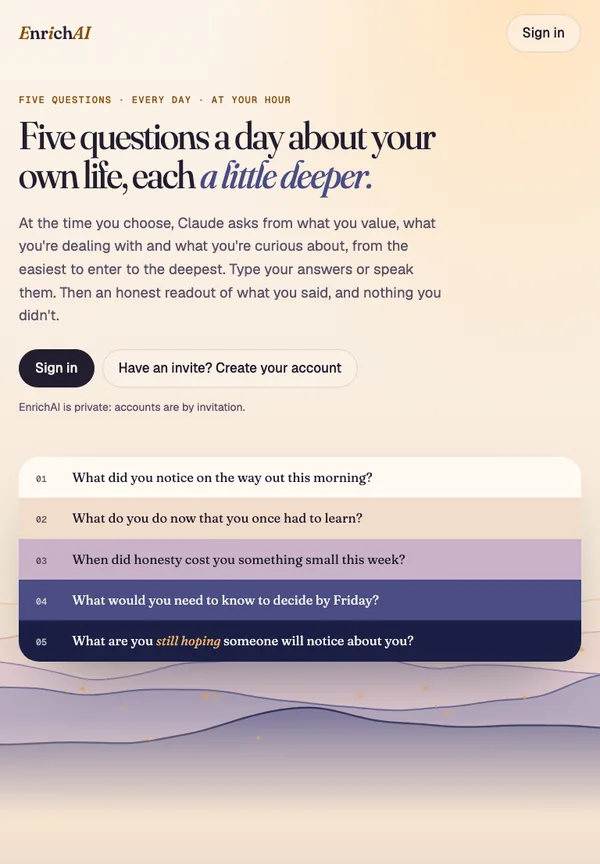
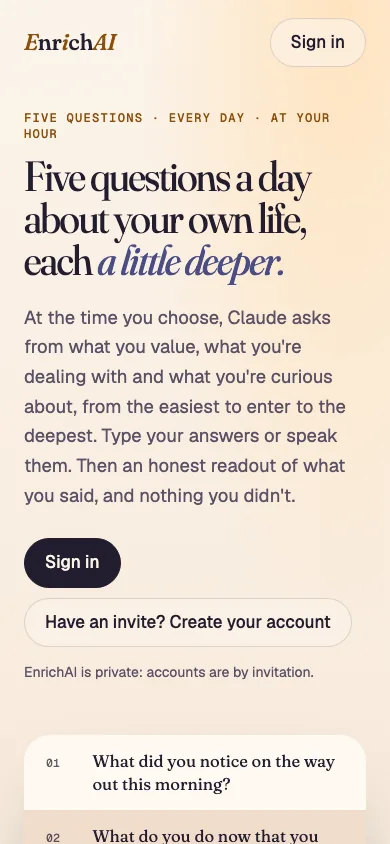
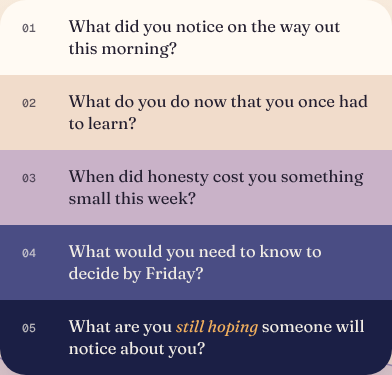
Some beginners would rather be asked than come up with their own questions. EnrichAI is built around that. At the time a person chooses, Claude, a language model, asks five questions drawn from what they value, what they are dealing with and what they are curious about. The questions go from the easiest to step into toward the deepest. Each one says what it draws on, such as the person's place and the season, their stage of life, a value they named, yesterday's thread or a curiosity. None can be answered yes or no.
Here is what that looks like for a beginner. They pick 7:30 in the morning. The first question might be one of the examples the site shows: "What did you notice on the way out this morning?" A later one goes deeper, for example: "When did honesty cost you something small this week?" They type some answers and speak others, and each saves as it goes, so a phone call halfway through loses nothing.
When the fifth answer is in, the day's readout arrives, which the site calls the enrichment. It catalogs the person's own words, says plainly which parts were left unanswered, and sets the day beside the week and the month. The next day's questions follow whatever was left open. For a beginner, that thread answers "what do I write about tomorrow?"
It also has firm limits. The model will not tell a person how they feel, flatter them, grade their answers, give advice they did not ask for, or claim progress their answers do not show. The readout is a plain record of what was said. Accounts are by invitation and private. There are no ads or trackers, nothing is sold, and a person can download everything they wrote or delete it all with their account.
Keeping a new journaling habit going past the first week
Expect the first weeks to take effort. In one study of habit formation led by Phillippa Lally, people took 66 days on average before a new daily behavior felt automatic, and the range ran from 18 to 254 days. Habit research describes the cue that starts a habit as a time of day, a place or a prior action, so a journaling plan should name one. A few things help a journal last:
- Lower the bar on hard days. One sentence keeps the habit alive. Skipping entirely makes the next day harder to start.
- Do not make up missed days. Trying to fill in three lost entries turns writing into a debt. Write today's and move on.
- Read back once a week. A short weekly look is where a journal starts to pay back the time. The guide on reflecting on your week in ten minutes gives a simple routine.
- Keep the cue fixed. Change what you write about as often as you like, but keep the time and place the same. The cue is what carries the habit.
Frequently asked questions
How long should a first journal entry be?
Three to five sentences is plenty. A short entry you finish does more for the habit than a long one you dread, and you can write more once the routine feels settled.
Is it better to journal in the morning or at night?
Neither is better in general. A morning entry can catch what you notice on the way out, and an evening entry can look back over the whole day. Choose the time you can protect most often.
What if a journaling session feels repetitive or dull?
Change the question, not the habit. Ask about a conversation, a place or a skill you have not written about yet, and keep the time and place the same.
How do you start journaling as a complete beginner?
Pick a format you will have in reach, tie writing to a daily cue such as morning coffee, and answer one concrete question in a few sentences. Read back at the end of the first week to see what the entries hold.
What a journal holds after the first month
After a month of short entries you have something no single entry offers: a run of days in your own words. Repeated names, worries and small pleasures start to show. A question you skipped twice is information too, because it marks the part of life you have not put into words yet.
Starting a journal is less about the first page than about the thirtieth. Keep the cue, keep the amount small, and let the questions change as your days do. The record grows on its own.
EnrichAI
Five questions a day about your own life, each a little deeper. Visit enrich.vlvd.net