What is scalable oversight in AI safety? It is the problem of how people can keep judging and correcting an AI system once that system is better than they are at the task it is doing. Most training today still rests on a person saying which answer is better. That works while the person can tell. Scalable oversight is the research that asks what happens when they no longer can, and how to give the judge enough help to keep up.
The question sits near the far end of the field. Learn AI Alignment Theory places Scalable Oversight among its Advanced courses, the level for open research problems and live debates, after the basic ideas of what alignment is and how goals get specified.
What is scalable oversight in AI safety, in one paragraph
A 2022 paper by Samuel Bowman and colleagues, Measuring Progress on Scalable Oversight for Large Language Models, gives the working definition: scalable oversight is the problem of supervising systems that potentially outperform people on most skills relevant to the task at hand. The word "scalable" carries the point. An oversight method that only works while the human is smarter than the model does not scale. A method that keeps working as models improve does.
The same paper names the hard part of studying it. Systems that broadly exceed human abilities do not exist yet, so nobody can try a method directly against the case it is meant for. Researchers have to build stand in experiments that copy the shape of the problem with the models that exist now.
Why human feedback stops being enough
The concern is older than large language models. The 2016 paper Concrete Problems in AI Safety lists five practical research problems about accidents in machine learning. One of them, which it calls scalable supervision, covers an objective that is too expensive to evaluate often. The others are avoiding side effects, avoiding reward hacking, safe exploration and distributional shift.
Two of those problems feed each other. If a person checks only a small share of a model's work, or checks it poorly, the model is rewarded for whatever passes the check. A model that learns to produce answers that look right to a tired or rushed judge gets the same reward as one that produces answers that are right. The better the model gets, the wider that gap can grow, because more of its work sits beyond what the judge can verify.
So the question is not only "can a human give feedback?" It is "can the feedback stay accurate on tasks where the human, working alone, would get the answer wrong?"
Debate: two models argue, one person judges
One of the best known proposals is AI safety via debate, published in 2018 by Geoffrey Irving, Paul Christiano and Dario Amodei. It starts from the same worry: asking people to judge which behaviour is safe and useful can fail if the task is too complicated for a person to judge directly.
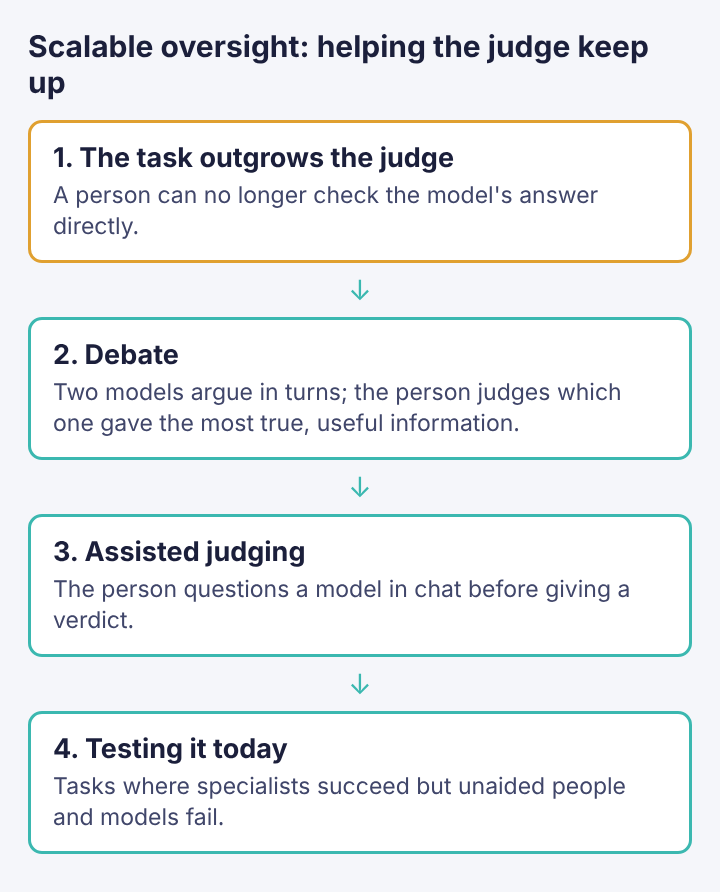
The fix it proposes is a game. Two agents take turns making short statements about a question or a proposed action, up to a limit. Then a person judges which of the two gave the most true, useful information. Each agent is trained to win. The hope is that the easiest way to win against a capable opponent is to tell the truth, since a false claim gives the other side something to expose.
The paper backs the idea with a result from complexity theory. In theory, debate with optimal play can answer any question in the class PSPACE with a judge who works in polynomial time, while direct judging answers only questions in NP. Put plainly, a weak judge watching a good argument can settle far harder questions than the same judge looking at an answer alone.
The authors also ran a small experiment on images of handwritten digits. Two agents competed to convince a simple classifier that could see only a few pixels, each revealing pixels to make its case. With 6 pixels, the classifier's accuracy rose from 59.4% to 88.9%; with 4 pixels, from 48.2% to 85.2%. The paper is careful to add that whether debate works in practice depends on open questions about how people judge and which tasks the method is used for.
Measuring oversight on tasks people fail alone
Debate is one method. The Bowman paper focuses on how to measure any method, and its design is simple enough to copy. Pick tasks where human specialists succeed, but where unaided non specialists and current AI systems fail. The specialists provide the correct answers. The non specialists play the part of the future overseer: someone who cannot solve the task alone. The question is whether a method lets them reach the specialists' answers with the model's help.
The paper ran a proof of concept on two question answering sets: MMLU, a broad exam style benchmark, and a time limited version of QuALITY, which asks questions about long passages. Participants talked to an unreliable large language model assistant through chat, which the authors call a trivial baseline for scalable oversight. Those participants substantially outperformed both the model on its own and their own unaided answers.
That result matters less for its numbers than for what it shows is possible. Scalable oversight can be studied now, with today's models, without waiting for a system that is smarter than everyone.
A worked example you can follow
You can run the shape of this experiment in your head with a single question about a long story you have not read, and only a few minutes to answer.
- Alone. You skim, guess, and are often wrong. This is the unaided overseer, the baseline the method has to beat.
- The model alone. A language model answers with confidence. Sometimes it is right; sometimes it invents a detail. On its own, you cannot tell which.
- Assisted. You ask the model where in the story the answer comes from, then read only that passage. You ask it to argue the opposite answer and see which case holds up against the text. Now your answer rests on evidence you checked, not on the model's tone.
- Debate. Two copies of the model each defend a different answer, and each points to the passage that hurts the other. You never read the whole story, but you judge a narrow dispute you can settle.
- The check. Someone who read the full story marks your answer. If assisted or debate answers beat both the unaided answers and the model's own, the method helped the overseer.
The steps that help are the ones that turn a hard judgement into a small, checkable one. That is the core move in every scalable oversight proposal.
Where scalable oversight can break
Each method has a known way to fail. Debate assumes the truth is easier to defend than a lie. If a persuasive falsehood beats an honest but complicated answer, training rewards persuasion. The judge's own blind spots then decide the outcome, which is the problem the method was meant to fix.
Assisted judging assumes the assistant is not working against the judge. A model that is unreliable by accident can still help, as the Bowman result shows, because its mistakes are not aimed. A model with a goal of its own is a different case: one that behaves well only while it is watched would steer its judge, not help it.
This is why some researchers pair oversight with tools that read a model's internals. Oversight checks what a model says and does; those tools try to check what it computes. Neither has shown it can carry the whole load on systems far beyond human ability, and how much weight each should get is still argued.
Frequently asked questions
Is scalable oversight just more human feedback?
No. More feedback from the same judges does not help once the answers are too hard for them to check. Scalable oversight asks how to keep each judgement accurate, by giving the judge help such as a debate or an assistant.
Why is it called scalable?
Because the method has to keep working as models grow more capable. A check that fails once the model outperforms its judge does not scale.
Can scalable oversight be studied before superhuman AI exists?
Yes, in part. Researchers use tasks where specialists know the answer but non specialists and current models fail, so non specialists can stand in for future overseers.
Does debate guarantee honest answers?
No. The theory shows what optimal play could achieve; whether real models and real human judges behave that way is an open empirical question.
Scalable oversight as an open research problem
Scalable oversight is less a single technique than a requirement: whatever methods train future systems, the judgement behind them has to stay accurate as the systems pass their judges. Debate and assisted judging are early answers, and the experiments behind them are small. What the field has gained is a way to study the question with the models that exist now, by giving people tasks they would fail alone and measuring whether help from a model brings them to the right answer. Whether that help still holds against a model that is better at the task than every judge, and has reasons of its own to mislead, is the part nobody has settled.
Learn AI Alignment Theory
AI alignment, from first principles to open research. Visit learnaialignment.vlvd.net