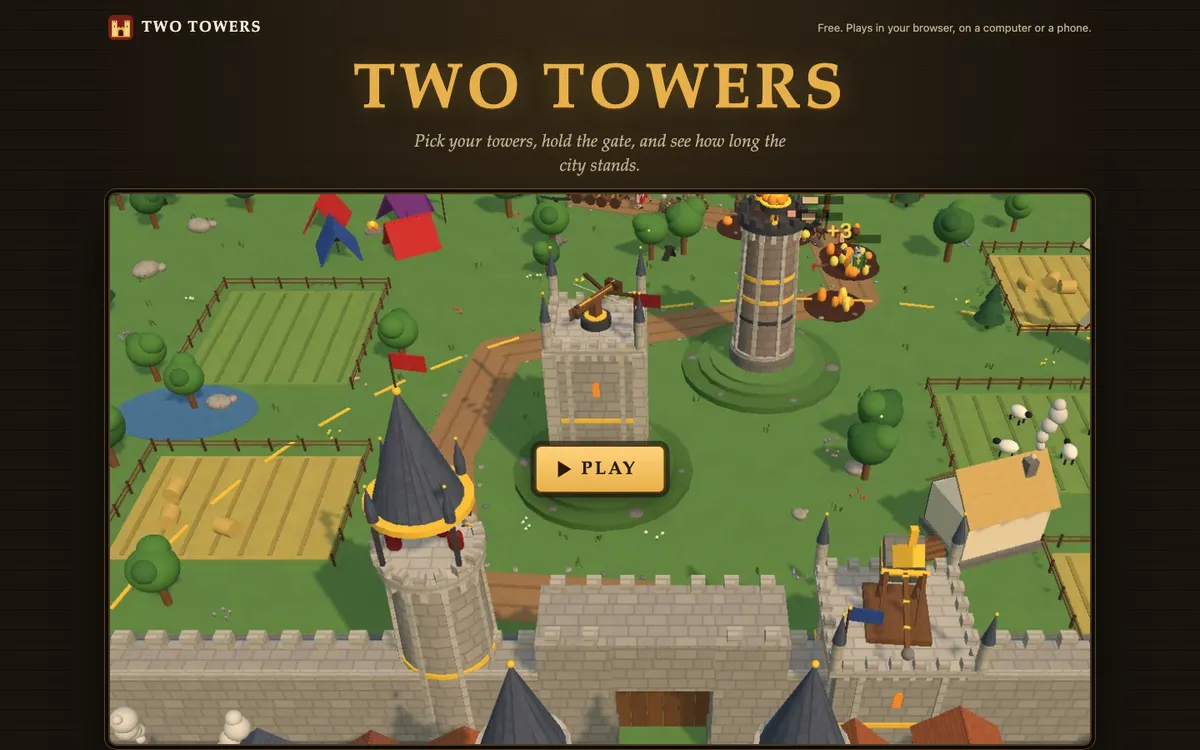
If you have asked what is a slow tower in tower defense, here is the short answer: it is a tower whose main job is to make enemies move more slowly, not to kill them. It gains time. Every other tower on the field gets more seconds to shoot at each enemy, so the whole defense deals more damage without a single extra tower doing more. The reasoning behind slowing, time spent in range, applies to any defense where enemies march on one point. Two Towers is one such game: a browser castle defense game where you pick a pair of towers, add two more with gold, and hold a city gate against knights, monks, kings and rams, stage after stage.
What is a slow tower in tower defense
In tower defense, enemies walk a path toward something you must protect, and you place towers along that path to stop them. Most towers deal damage. A slow tower does something else. It applies an effect that lowers an enemy's movement speed for a while.
In the wider language of games, a slow is a debuff: an effect placed on a character that lowers its statistics, here its speed. The same glossary files it under crowd control, techniques that hold enemies back so they can be picked off more easily. A slow rarely stops an enemy outright. It stretches the time that enemy spends in danger.
You judge a slow tower by how much damage it adds to the towers around it, not by its own number.
How slow effects work: speed reduction, duration and stacking
Three numbers decide how strong a slow is.
- Speed reduction. How much slower the enemy moves, usually as a share of its normal speed. A 40% slow leaves the enemy at 60% speed.
- Duration. How long the effect lasts after it lands. A short slow on a fast-firing tower keeps an enemy slowed all the time. A short slow on a slow-firing tower leaves gaps.
- Stacking. What happens when two slows hit the same enemy.
Stacking is where games differ most. Three rules are common:
- Strongest only. The enemy takes the biggest slow on it, and weaker ones do nothing. A second slow tower adds coverage, not strength.
- Multiplied. Each slow applies to the speed left after the last one. Two 30% slows leave the enemy at 0.7 times 0.7, which is 49% speed. That is a 51% slow, not 60%.
- Added with a cap. Slows add up until they hit a ceiling, so enemies never stop moving completely.
Many games also refresh the duration when a new hit lands, rather than adding time on top. That means a slow tower firing quickly keeps one enemy slowed but does not slow it more with each shot.
If a game does not tell you its rule, watch it. Put two slowing sources on the same stretch of path and see whether enemies crawl or just stay at the same reduced pace.
Why a slow tower makes nearby damage towers stronger
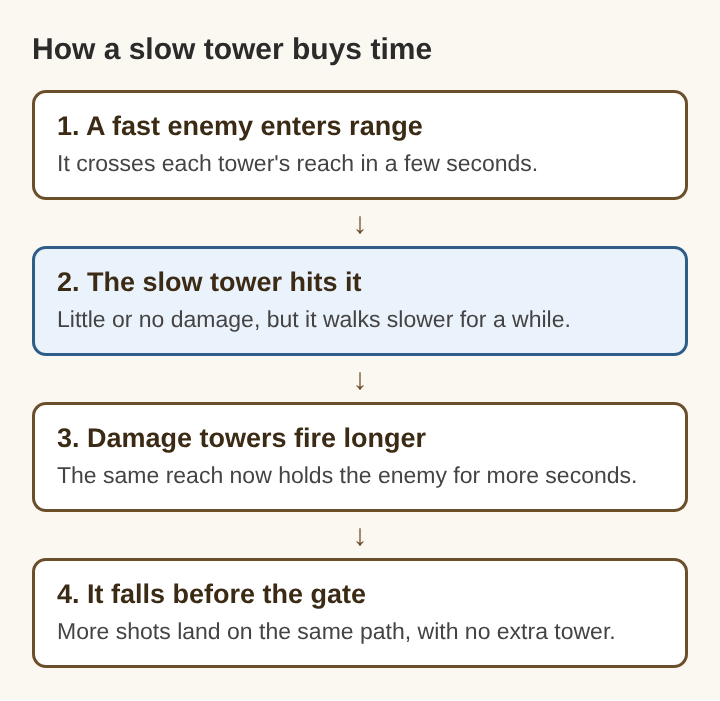
Damage in tower defense comes down to one product: how much damage a tower deals per second, a figure game glossaries call DPS, times how many seconds an enemy stays in its range. A slow tower raises the second number for every tower nearby at once.
Work through an example with made-up numbers. A damage tower covers 10 tiles of path and deals 20 damage per second. An enemy walks 2 tiles per second, so it crosses that range in 5 seconds and takes 100 damage. Now slow the enemy by 40%. It walks 1.2 tiles per second and needs about 8.3 seconds to cross the same range. It takes about 166 damage. That tower now does two thirds more work, and you did not touch it.
Put three damage towers around that slowed stretch and each one gets the same boost. This is why one slow tower can be worth more than a fourth damage tower. It multiplies what you already own.
Slowing also bunches enemies together. When the front of a group slows down and the back has not reached the slow yet, the gaps close. A group packed tight is exactly what area damage wants, which is why slow and splash damage pair so well.
Where to place a slow tower at a city gate
The general rule: put the slow where your damage is, not where your damage is not. A slow that wears off before enemies reach your damage towers wastes most of its effect.
In a game where you hold a single city gate, every enemy has to end up at the same place. That makes the approach to the gate an obvious chokepoint. A tower that slows enemies does its best work at the front edge of that chokepoint, so enemies enter the zone where your other towers overlap and stay there longer.
A few placement checks help:
- Does the slow's reach cover the same stretch of path as your damage towers? If not, move one of them.
- Does the slow land early enough that its full duration plays out inside your damage zone?
- Is there a point where the path bends or narrows? A slow on a bend keeps enemies in range of towers on both sides.
For a wider look at the placement question, the general guide on where to place towers in a tower defense game covers coverage and overlap in more depth.
Spending gold on a slow tower or another damage tower
When you have gold for one more tower, the choice is often between more damage and more time. The numbers from the earlier example give a way to decide.
Ask how many damage towers would gain from the slow. If only one damage tower covers the slowed stretch, a slow adds a share of that one tower's damage, and a second damage tower is usually the stronger choice. If two or three damage towers overlap the slowed stretch, the slow boosts all of them, and it pulls ahead.
Any game that gives you very few tower slots makes this choice sharp. Each added tower has to earn its place. A slow tower earns it when your existing towers already cover the same ground. It earns less when your towers are spread out and enemies only pass each one briefly.
Holding a castle gate with a slow tower
Holding a gate is a race. Each enemy needs a certain amount of time to walk to the gate, and your towers need a certain amount of time to bring it down. You win the race by dealing damage faster or by making the walk longer. A slow tower does the second.
Making the walk longer also helps when waves arrive in quick order. If one wave is still on the path when the next starts, your towers split their fire. A slow keeps the first wave in range so it dies before the second shows up, as long as your damage is high enough. If your damage is too low, slowing just piles both waves into the same spot. Watch for that.
Gate attackers such as rams make the race plain: a slow, heavy enemy aimed at one door. The story of how battering rams were stopped shows the same logic of time and pressure at a gate.
Common slow tower mistakes in tower defense
- Placing the slow alone. A slow far from any damage tower only delays enemies for a while, then they speed back up before reaching your defense.
- Stacking slows that do not stack. In a strongest-only game, two slow towers on the same spot give the same effect as one. Spread them out or spend the gold on damage instead.
- Ignoring enemies the slow cannot reach. Some games give certain enemies resistance to slows, or let them fly over the path. Check each enemy type against your slow.
- Letting the slow cause a pileup. Slowing enemies you cannot kill turns one wave into a crowd. Pair slows with enough damage, ideally area damage.
- Forgetting path length. In games that let you build mazes, a longer path and a slow work together, since both add time. Mazing and path length cover the other half of that equation.
Frequently asked questions
Does a slow tower deal damage on its own?
Some do a little and many deal none. Its value comes from keeping enemies inside the range of other towers for longer, which raises their total damage.
Do slow effects stack in tower defense?
It depends on the game. Common rules are strongest-only, multiplied slows, or added slows with a cap, and you can check which applies by putting two slows on one stretch of path and watching enemy speed.
Should a slow tower sit near the start of the path or near the gate?
It should sit where your damage towers overlap, usually just before the main kill zone. Near the start of the path, the slow often wears off before enemies reach anything that can hurt them.
What is a slow tower in tower defense?
It is a support tower that lowers enemy movement speed for a set time. Slowed enemies spend longer in range, so every nearby damage tower deals more damage to them.
Why a Slow Tower Is Really About Time
A slow tower never wins a fight by itself. It changes the clock. Every enemy on the path is in a race between its walk to the gate and the damage your towers can pour into it, and the slow lengthens the walk for all of them at once. That is why it belongs inside the zone where your damage overlaps, why it grows stronger as you add towers around it, and why it fails when nothing nearby can finish the job. Count the seconds an enemy spends in range, and the value of a slow tower is easy to see.
Two Towers
Defend the castle gate, stage after stage. Visit twotowers.vlvd.net