What is a colorpoint cat? It is a cat with a pale body and darker colour on its "points": the face mask, ears, legs, paws and tail. The pattern comes from a gene, not from one breed, so it shows up on a pedigree Siamese and on a mixed breed cat sitting on a garden wall. People who walk their streets looking at cats will see both. Cat Go is a walking game built around those real cats: you photograph a cat you meet, win it over with food, and keep a record of its breed and where you found it. Colorpoints are some of the easiest cats to notice on a walk, and some of the easiest to label wrongly.
What is a colorpoint cat: the pale body and dark points
A colorpoint cat has its colour held to the cooler parts of its body. The body itself is cream, ivory or near white. The mask on the face, the ears, the lower legs, the paws and the tail are much darker. The Wikipedia page on points in animal coats describes the same idea: points are areas coloured differently from the main body, and on Siamese cats they are dark extremities on a pale body. The page also notes that colored points turn up in many mammals, not only cats.
The contrast is the clue. A grey cat with slightly darker grey legs is not a colorpoint. A colorpoint has a clear shift from a light body to dark extremities, and the darkest areas are the ones furthest from the warm centre of the body: the tips of the ears, the nose, the feet and the end of the tail.
How a heat sensitive enzyme darkens the cooler parts
Coat colour depends on melanin, and making melanin depends on an enzyme called tyrosinase. The Wikipedia page on the Siamese cat describes the colourpoint pattern as a form of partial albinism, called acromelanism, caused by a mutation in that enzyme. The changed enzyme is sensitive to heat. At normal body temperature it fails to work, so the fur on the body grows in pale. In areas of skin cooler than about 33 °C it becomes active, so the fur there grows in dark.
That is why the face goes dark too, even though it sits close to the brain. The same page explains that the face is cooled by the air moving through the sinuses, so the mask forms where you might not expect cool skin.
Temperature also explains why two cats with the same genes can look different. The Siamese page notes that these cats tend to darken with age, and that adults living in warm climates generally have lighter coats than those in cool climates. A cat that lives somewhere warm can keep a pale, crisp body for years, while one in a cold place can look shaded and smoky.
The four classic point colours
The points can come in several colours. The names are traditional and do not always match the shade you see, so it helps to know what each one means. The largest US registry, the CFA, accepts only four colours for the Siamese:
- Seal point: very dark brown points, close to black.
- Blue point: slate grey points, the diluted form of seal.
- Chocolate point: warm brown points, lighter than seal.
- Lilac point: pale pinkish grey points, the diluted form of chocolate and the softest of the four.
A Siamese type cat with points in any other colour or pattern is registered by the CFA as a Colourpoint Shorthair instead. Points can also carry stripes. The Wikipedia page on the Ragdoll lists lynx as a colorpoint variant with tabby markings, so a lynx point cat has a striped mask and banded legs and tail. The guide to what tabby means in cats covers those stripes and the "M" on the forehead.
Colorpoint breeds: Siamese, Himalayan, Birman and Ragdoll
Several breeds are known for the pattern. The points work the same way in all of them, so you tell the breeds apart by body shape, coat length and white markings.
- Siamese: slim, short close coat, wedge shaped head and large ears. Its pointed pattern and blue eyes are what set it apart from the closely related Oriental Shorthair. The guide to telling a Siamese from other breeds goes through the build in detail.
- Himalayan: a longhaired breed that came from crossing Persians with Siamese to bring in the points. In Europe it is called the colourpoint Persian.
- Birman: long, silky coat, deep blue eyes and pure white "gloves" on each paw. The Wikipedia page on the Birman calls the gloves the trademark of the breed.
- Ragdoll: one of the largest domestic breeds, with a colorpoint coat and blue eyes. It comes in three main patterns: plain colorpoint, mitted (white paws and belly) and bicolour.
The Ragdoll page adds a useful warning: mitted Ragdolls are often confused with Birmans, because both are pointed cats with white feet. Breed names and groupings also vary between cat registries, as the piece on how many cat breeds there are shows.
Reading a pointed cat you meet outdoors
Most pointed cats you meet on a street are not pedigree cats. They are mixed breed cats that inherited the pattern. Points alone tell you nothing about breed. Eyes, coat, build and paws tell you more.
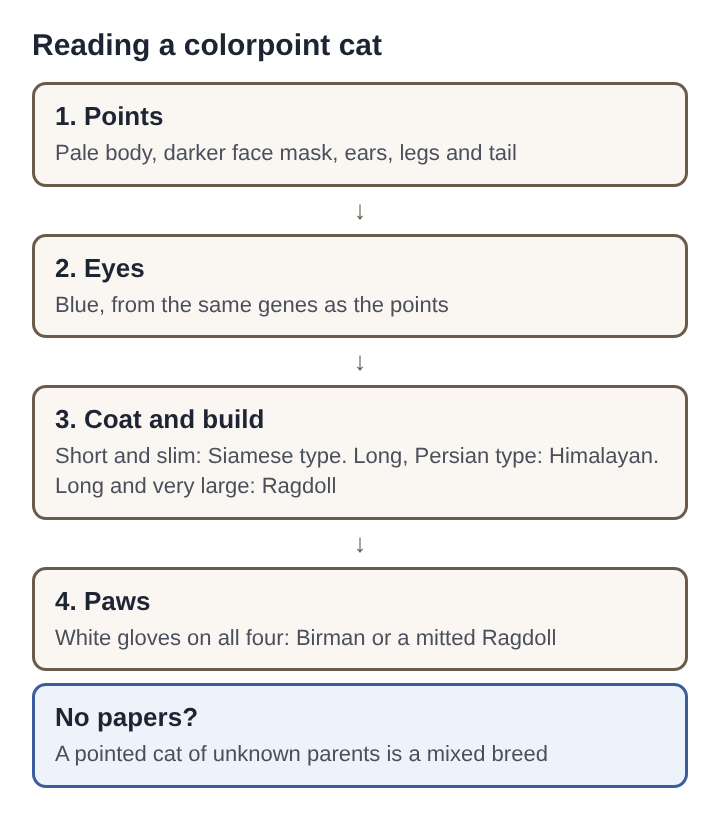
Here is a worked example. Say you see a cream cat with seal points sitting on a wall. Go through the checks in order:
- Points: pale body, dark mask, ears, legs and tail. Yes, this is a colorpoint.
- Eyes: blue. The Ragdoll page explains that the genes for point colour are also behind the blue eyes, so this fits.
- Coat and build: short coat, average build, round head, ears of normal size. That rules out the long coated Himalayan, Birman and Ragdoll, and the head and body are not the slim, wedge headed Siamese type.
- Paws: no white gloves, so nothing points towards a Birman or a mitted Ragdoll.
The answer is a pointed mixed breed cat, most likely filed as a domestic shorthair, which is a coat label rather than a breed. The articles on the domestic shorthair label and what a mixed breed cat is called cover those names. Without papers, nobody can be sure of a cat's breed from looks alone.
Spotting colorpoint cats on a walk with Cat Go
In the game, you catch a cat by taking its photo. The game checks the photo for a cat and reads its coat, and if there is no cat, it says "No catch this time". The breed is your call. After a cat is spotted, the game asks "Which breed is it?" and you pick from a list. It also says: "Most cats you meet are mixed breed. Rarer breeds are warier." When nothing fits, "Mixed breed is always a safe pick."
That advice suits pointed cats well. In the Catdex, the game's record of its 34 breeds, Domestic Shorthair and Domestic Longhair sit in the common group. Siamese and Ragdoll are uncommon. Birman and Himalayan are rare. The cat on the wall from the worked example is a mixed breed pick. A slim, wedge headed, short coated pointed cat with blue eyes could be a Siamese pick. Every catch is kept in the Catdex with its breed and where you met it.
Winning a cat over in the game uses food collected at treat stops on the map: kibble and tuna. The game says tuna works much better on wary cats, a startled cat leaves quickly, and you should stay calm with your tosses.
The real cat on the wall deserves the same calm. Stay at a distance, keep still, and let the cat decide whether to come closer. Do not chase, pick up or feed a cat that is not yours. The Wikipedia page on cat communication notes that cats slowly blink to signal relaxation and comfort, in contrast to a direct stare, so a soft gaze is kinder than a fixed one.
Frequently asked questions
Are all colorpoint cats Siamese?
No. The pattern appears in the Himalayan, Birman and Ragdoll, among others, and in many mixed breed cats. A Siamese also needs its slim build and wedge head.
Do colorpoint cats have blue eyes?
The Siamese, Birman and Ragdoll all have blue eyes. The Ragdoll page explains that the genes for point colour are also responsible for those blue eyes.
Is colorpoint a breed or a pattern?
It is a pattern. The CFA does register a breed called the Colourpoint Shorthair, but the pattern itself appears across many breeds and in mixed breed cats.
Why are colorpoint cats darker in cold places?
The enzyme that makes their colour only works in cooler skin. Siamese living in cool climates generally have darker coats than those in warm ones.
Why colorpoint kittens are born white and darken with age
Colorpoint kittens start out white. Before birth, the whole kitten is held at the same warm temperature inside its mother, so the heat sensitive enzyme stays switched off everywhere. After birth, the ears, nose, paws and tail are cooler than the body, and colour starts to appear there.
The change is slow. The Ragdoll page says Ragdoll kittens are born white, show good colour at 8 to 10 weeks, and reach full colour and coat at 3 to 4 years. Even in adulthood the change goes on, since the Siamese page notes these cats tend to darken with age. A pale, sharply marked young cat and a shaded older cat can carry exactly the same genes. Age and temperature account for the difference, not breed.
Cat Go
Walk anywhere, find a real cat, and catch it. Visit catgo.vlvd.net