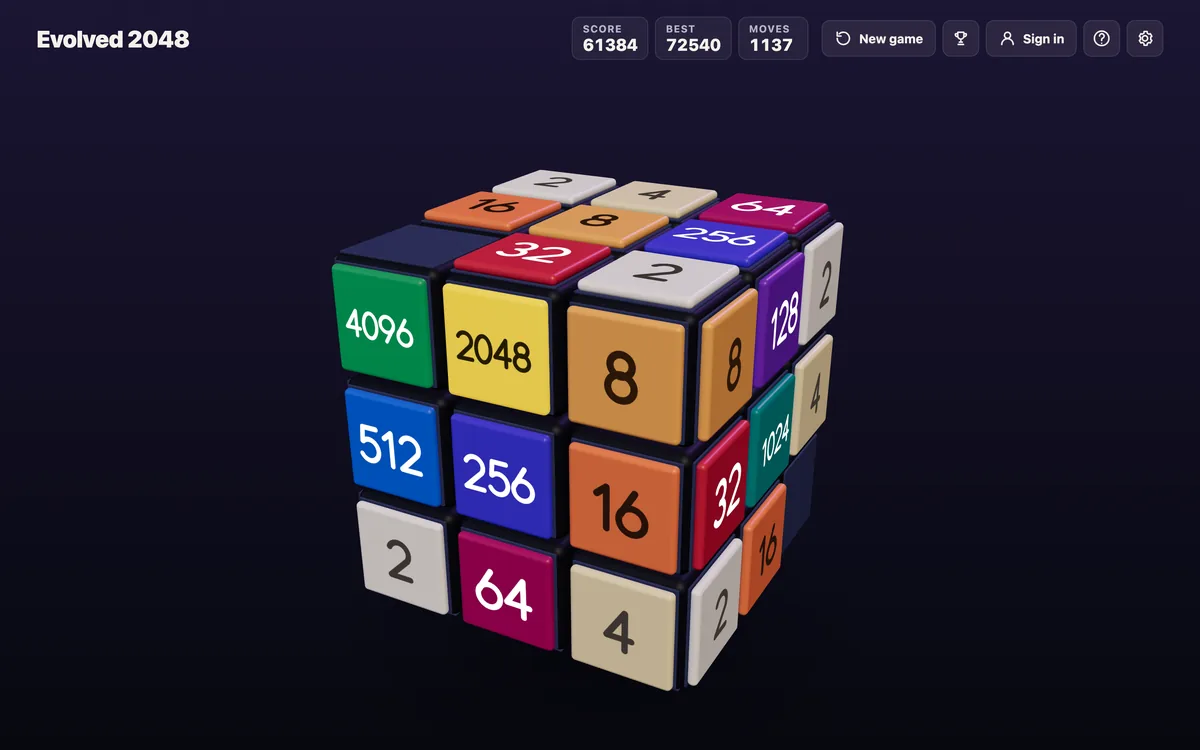
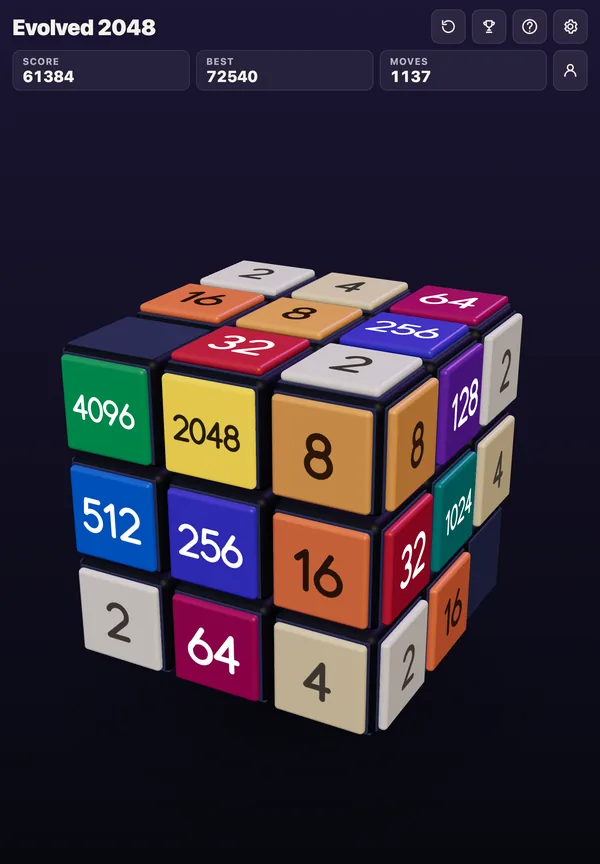
Most 2048 advice talks about tiles: keep the big one in a corner, build a row in order, merge early. The quieter part of the board is the part that decides how long you last. If you have ever wondered why empty squares matter in 2048, the answer is simple. Every move spends one, every merge buys one back, and the game ends when you run out. The same count runs a 2048 puzzle played on a Rubik's cube, where a twist needs one empty square before it can happen at all.
Once you start counting empty squares, choosing a slide stops being a guess. You can look at two moves and say which one leaves you more room, and room is what keeps a bad tile from becoming a lost game.
Why empty squares matter in 2048 more than any single tile
Classic 2048) is played on a 4 by 4 grid, so the board has 16 squares. After each turn a new tile appears in a random empty square, a 2 nine times in ten and a 4 the rest of the time. Two tiles of the same number that collide merge into one tile holding their total.
Those rules give empty squares three jobs at once.
- They are where new tiles land. The game needs an empty square for every tile it adds.
- They are what lets tiles move. A slide only does something if a tile has room to travel or a partner to merge with.
- They are the margin for bad luck. A new tile in an awkward spot is harmless while there is space to move it out of the way.
The game ends when you have no legal move left: no empty spaces and no two equal tiles side by side. A board with even one empty square still has a move. A board with none is one unlucky tile away from the end.
The count that rises and falls with every move
Here is the rule that makes empty squares easy to track. Each move adds exactly one tile. Each merge turns two tiles into one, which frees one square. So after any slide:
empty squares after = empty squares before + merges made - 1
A slide with no merge costs you one square. A slide with one merge leaves the count where it was. A slide with two or three merges gives you room back.
This also tells you the pace the game demands. To hold the number of empty squares steady, you need one merge per move on average. Fall below that for a stretch and the board fills. Rise above it and the board opens up. Every strong habit in 2048, from keeping a row in order to holding the largest tile in a corner, works partly because it sets up more merges per move.
A worked example: choose the slide that keeps more room
Say your board has 5 empty squares and two moves look reasonable.
- Slide left. Along the rows, two pairs line up: a pair of 8s in the top row and a pair of 2s in the third row. Both merge. The count becomes 5 + 2 - 1 = 6 empty squares.
- Slide up. The tiles shift, but no two equal tiles meet in any column. Nothing merges. The count becomes 5 + 0 - 1 = 4 empty squares.
The gap is 2 squares after a single move. That gap grows if you keep choosing the slide with fewer merges, because each move that merges nothing takes one more square for good.
Now look one step ahead. With 6 empty squares, the new tile has 6 places it could land, and most of them will not block your next merge. With 4, the chance that the new tile drops into the one square you needed is higher, and you have fewer slides that still do something useful.
The count is not the only thing to weigh. A slide that frees a square but pulls your largest tile out of its corner can cost more than it gains. Use the count to break ties and to spot the slide that quietly shrinks your board, then check that the shape of the board still holds.
Where the new tile lands when the board is crowded
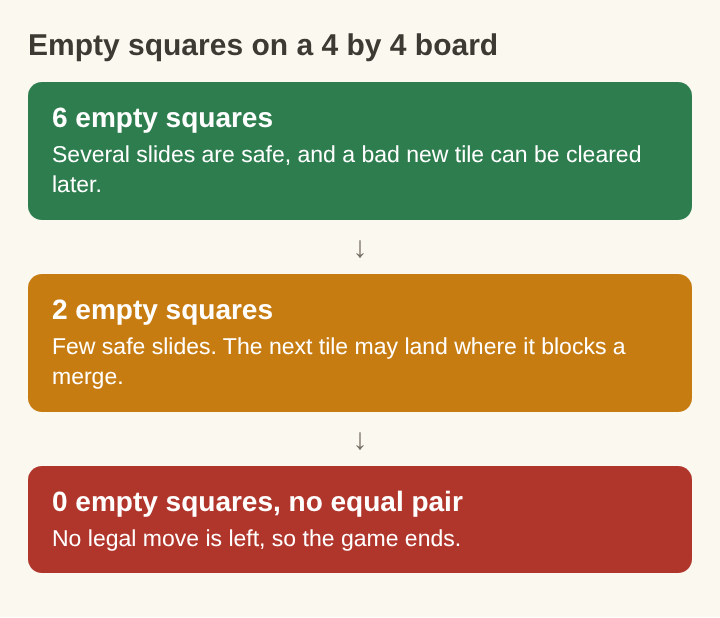
The new tile goes into a random empty square. That single fact is why a crowded board is so much harder than an open one.
With 8 empty squares, the new tile is likely to land somewhere it does no harm, and you can usually merge it away within a few moves. With 2 empty squares, there are only two places it can go. If one of them sits in the middle of the row you are building, you have about an even chance of the tile landing exactly where you did not want it.
The value of the tile matters more on a crowded board too. A 4 in a corner of an open board is a small detour. A 4 squeezed between a 2 and an 8 on a nearly full board can lock a row, because there may be no move left that brings a matching 4 next to it.
So empty squares are not only room for tiles. They are room for the random part of the game to go wrong without costing you the game.
How programs that play 2048 count empty squares
Programs that play 2048 well make this idea explicit. They search a few moves ahead and judge each board they reach with an evaluation function, a formula that estimates how good a position is. For 2048, such a function can favor empty squares, many possible merges, larger tiles at the edge, and rows that run in order.
Empty squares sit at the top of that list for a plain reason: they are easy to count and they predict trouble early. A board can look tidy and still be two moves from the end if almost every square is full. The 2048 page on Wikipedia notes that randomness and a lack of spare room are what make the biggest tiles so hard to reach, even for the strongest programs.
You can borrow the same habit without any search. Before each move, count the empty squares the move would leave. If two moves leave the same count, prefer the one that keeps your row in order. If one move leaves noticeably fewer squares, it needs a strong reason to win.
Empty squares on a cube with 54 of them
On a cube, the board is six faces of nine squares, 54 squares in all. You slide the front face, twist a row or a column so that layer carries its tiles to the next face, and turn the whole cube to see the other sides. Every slide or twist adds a 2 or a 4, on the front face when it has room.
The count works the same way, with two differences worth knowing.
- A twist needs one empty square. When no square is empty, twisting is no longer a way out, and a slide that merges is what opens room again.
- Turning the whole cube costs nothing. Only a slide or a twist adds a tile, so you can turn freely to look for a match without spending a square.
In the main mode, the game ends when all 54 squares are full and no face has two equal tiles side by side. With so many squares, the end comes slowly, but the rule of the count still holds: one tile in per slide or twist, one square back per merge. The extra room on the side faces is space you can use to park tiles you do not need yet, as long as you keep track of where they are.
Frequently asked questions
How many empty squares should you keep in 2048?
There is no fixed number, but more is safer. On a 4 by 4 board, dropping to two or three empty squares means the next new tile has few places to go, so it is a signal to look for merges before anything else.
Does every move in 2048 use up an empty square?
Every move adds one new tile, which fills one square. A merge frees one square, so a move with one merge leaves the count unchanged and a move with no merge lowers it by one.
Can you lose a 2048 game while empty squares are left?
No. The game ends only when there are no empty spaces and no two equal tiles side by side, so any empty square means a move is still possible.
Is it better to merge now or keep tiles for later?
A merge you can make now frees a square now, and a square you need later may not be there. Holding back a merge makes sense mainly when it would pull your largest tile away from its edge.
Empty squares and the long game in 2048
A long 2048 game is a steady trade. Each move takes a square and each merge gives one back, and the player who keeps that trade even or better gets to keep playing. Big tiles are the visible result, but the empty squares are what pay for them.
The habit is small: before a slide, count how many squares it leaves open, and count again after the new tile lands. When the number keeps falling, the board is telling you to stop building and start merging. When it holds steady, the plan is working, and there is room for the next tile to land wherever chance sends it.
Evolved 2048
The 2048 puzzle on a Rubik's cube, and past 2048. Visit evolved2048.vlvd.net