The paths to superintelligence are the different ways a mind far beyond the best human minds could come into being. Some run through machines, some through human brains, and one through groups. Knowing which path is fastest tells you which one people who worry about AI risk watch most closely. The strategy game Contain ASI starts from that worry: from January 2024, keep every AI lab from reaching recursive self-improvement before 2027.
What the paths to superintelligence lead to
A superintelligence is a hypothetical agent whose intelligence far surpasses that of the most gifted human minds. It does not have to be a machine. The definition is about how capable a mind is, not what it is made of.
That matters for the question of paths. If only the result counts, then a computer program, a human with an altered brain, or a well run group of people could all qualify. The philosopher Nick Bostrom laid out these routes in his 2014 book Superintelligence: Paths, Dangers, Strategies, which looks at how superintelligence could be created, what it might want, and why it would be hard to control.
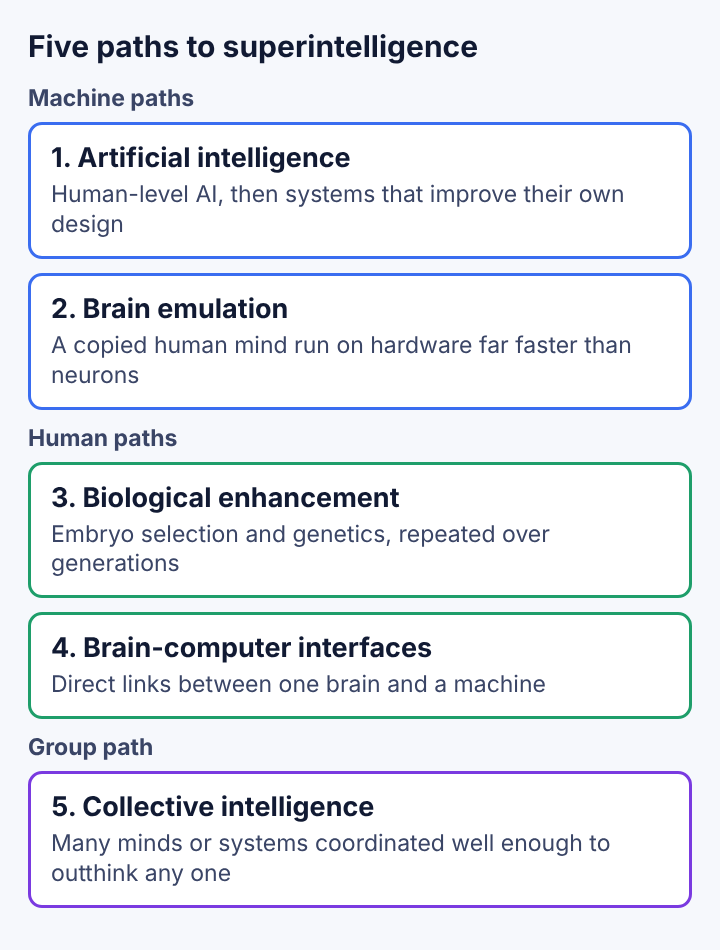
The routes sort into three groups:
- Machine paths: artificial intelligence and the emulation of a human brain.
- Human paths: biological enhancement and direct links between brain and machine.
- The group path: collective intelligence, where many minds coordinate.
The artificial intelligence path
The route most people picture is software. The philosopher David Chalmers argues that artificial general intelligence is a very likely path to artificial superintelligence, or ASI. He splits the claim into three steps. First, AI can reach equivalence with human intelligence. Second, it can be extended past that level. Third, it can be amplified until it outperforms humans across almost any task.
His case for the first step is that the human brain is a mechanical system, so it should be possible to reproduce it in other materials. Human intelligence also came about through natural selection, with no designer at all, which makes it more likely that engineers can build it on purpose.
The second and third steps lean on a loop. An AI system that can improve itself could raise its own intelligence, which makes it better at improving itself again. The Superintelligence article on Wikipedia calls this cycle recursive self-improvement and notes it might set off an intelligence explosion. The loop is set out step by step in what recursive self-improvement in AI is.
Brain emulation and the speed of hardware
A second machine path skips designing intelligence from scratch. Instead, it copies a human mind and runs the copy on a computer. The reason this route gets attention is raw speed.
Bostrom points out, in a passage quoted on the Wikipedia page, that biological neurons fire at a peak of about 200 Hz, while a modern processor runs at about 2 GHz. That is seven orders of magnitude, a factor of ten million. Signals in nerve fibres travel at no more than 120 metres per second, while electronic parts can pass signals at the speed of light.
So the simplest superintelligence might be nothing more than an ordinary human mind, emulated and run much faster than a brain can. It would not need new ideas about reasoning. It would only need more time to think than everyone around it.
A worked example: how fast each path could move
Speed is the clearest way to compare paths, so walk through it with the numbers the sources give.
- Start with an emulated mind. Suppose a copy of one researcher runs 1,000 times faster than a brain. That is far below the factor of ten million between neuron and chip speeds. A year has 8,760 hours, so one year of that researcher's thinking finishes in under 9 hours of clock time.
- Now take biological enhancement. Bostrom writes, in the Superintelligence article, that selecting one embryo out of two, once the genetics of intelligence are understood, could add up to about 4 IQ points. Selecting one out of 1,000 could add up to 24.3. Each round still needs a new generation to grow up.
- Compare the clocks. The emulated researcher gains a year of thought before lunch. The biological route gains its points once per generation, years apart, unless the lab method of deriving new sex cells from embryonic stem cells shortens each round.
- Read the result. Even a modest machine speedup moves faster than the fastest biological route. That gap is why writers on the subject spend much more time on machine paths.
The hours and the 1,000 times factor are an illustration you can redo with any speedup you choose. The 200 Hz, 2 GHz, 4 point and 24.3 point figures come from Bostrom by way of the source.
The biological enhancement path
The human paths start from the brains people already have. According to the Wikipedia summary of the field, selective breeding, nootropic drugs, epigenetic changes and genetic engineering could all raise human intelligence faster than natural change would.
Natural change is slow either way. Some writers expect human intelligence to drift up over long spans of time and others expect it to drift down, and there is no scientific consensus on which. Both happen far more slowly than culture changes.
Embryo selection is the most concrete idea. If it were repeated over many generations, Bostrom suggests in his 2014 book the gains could grow by an order of magnitude. A society of people raised this way could, in principle, reach collective superintelligence. The weak point is the one the worked example shows: every step waits for people to grow up.
Brain-computer interfaces and direct enhancement
A faster human route would change one living person instead of the next generation. Options named in the Superintelligence article include nootropic drugs, somatic gene therapy and brain-computer interfaces, which connect a brain directly to a machine.
Bostrom is doubtful about this route. He questions whether drugs and gene therapy can scale to large gains. For interfaces, he argues that designing a superintelligent cyborg link is an AI-complete problem. In plain terms, making the interface smart enough would already require solving artificial intelligence, so this path loops back to the machine one.
Collective intelligence as a path
The last route does not need any single mind to be extraordinary. Bostrom raises collective superintelligence: enough separate reasoning systems, communicating and coordinating well enough, could together act with far more capability than any one of them.
The parts could be humans. Some writers argue that civilization, or parts of it such as the Internet or the economy, already acts as a kind of global brain with abilities beyond any person in it. A prediction market is sometimes given as a working example built from people alone.
The parts could also be machines. Many AI systems working together would combine the speed of the machine paths with the reach of the group path.
Frequently asked questions
Which path to superintelligence is most likely?
Most writing on the subject focuses on artificial intelligence. Machines are not bound by the speed and size limits of biological brains, so a machine path could move far faster than any human one.
Is brain emulation the same as artificial intelligence?
No. Artificial intelligence builds a mind from new designs, while brain emulation copies an existing human mind and runs it on a computer. Both are machine paths, and both gain from hardware speed.
Could humans become superintelligent without machines?
In principle, through embryo selection repeated over generations or through better organized groups. Each generation takes decades, so these routes are slow next to a machine path.
What does AI-complete mean?
It describes a problem so hard that solving it would mean solving artificial intelligence in general. Bostrom applies it to a superintelligent brain-computer interface.
Why the speed of each path to superintelligence matters
The paths differ most in how fast they could move. Biological routes wait on births and decades, and direct enhancement may stall unless AI is solved first. Machine routes are limited only by hardware, which already runs ten million times faster than neurons, and by how well a system can improve its own design. That is why the question of which path arrives first usually turns into a question about AI labs: how quickly they move, how many copies of a system they can run, and whether anyone can slow a loop of self-improvement once it begins.
Contain ASI
January 2024. Four AI labs. One race. Visit containasi.vlvd.net