A heavy grey cat with bright copper eyes is sitting on a garden wall, and the question comes up at once: what is a Chartreux cat, and could this be one? The Chartreux is a rare breed from France with a blue grey coat, copper or orange eyes, a muscular body on short legs and a muzzle that seems to smile. Because it is rare, most grey cats on a street are something else. That difference matters in a walking game where people photograph real cats, lure them with food and keep each catch with its breed and the place it was found. Cat Go puts the Chartreux among the eight breeds of its very rare group, next to the Korat, the Turkish Van and the Singapura.
What is a Chartreux cat: an old French breed
The Wikipedia page on the Chartreux calls it a rare breed of cat from France. Its written history is long. The breed is first mentioned in 1558, in a poem by Joachim du Bellay about the death of a small cat. A grey cat of this kind sits as a pet in a portrait painted by Jean-Baptiste Perronneau in 1747, and the naturalist Buffon gave the first documented description in the 18th century.
The name invites a story. A popular legend says the cats were kept by Carthusian monks at the Grande Chartreuse monastery. In 1972 the monastery's Prior said its archives held no record of such cats, so the legend stays a legend.
The breed came close to disappearing. It was greatly reduced during the First World War, and after the Second World War wild populations were no longer seen, except perhaps on Belle-Ile-en-Mer, where the Leger sisters bred the best cats they could find. European cat fanciers kept the Chartreux from extinction. The first ones reached the United States in 1971, and the Cat Fanciers' Association gave the breed championship status in 1987. That near loss is one reason the breed is still uncommon today.
The Chartreux coat: blue grey, thick and water-resistant
The coat is the first clue. A Chartreux is blue, which in cats means a silver grey. The fur is short but slightly thick, a double coat that resists water. When it is ruffled it tends to split into small breaks instead of lying smooth.
That texture is worth a second look in a photo. A grey cat whose fur lies flat and sleek against the body is a weaker match. A grey cat whose coat looks dense and stands a little away from the skin is a stronger one. Texture alone never settles it, though, because many grey cats have thick fur in winter.
Copper eyes and a muzzle that seems to smile
Chartreux eyes are orange or copper. This is the quickest check on a grey cat, because it rules out the best known green eyed grey breed straight away.
The face has a feature people remember. The muzzle tapers, and because of the structure of the head and that tapered muzzle, a Chartreux often appears to be smiling. The smile is a shape, not a mood, so it shows whether the cat is relaxed, alert or half asleep. A grey cat with copper eyes and a round, short face is missing this clue.
A big body on short, fine-boned legs
The Chartreux is large and muscular, a build breeders call cobby. Its limbs are relatively short and fine boned, and the breed is known for very fast reflexes. The contrast between a solid body and slim legs is easiest to see when the cat walks or stands side on.
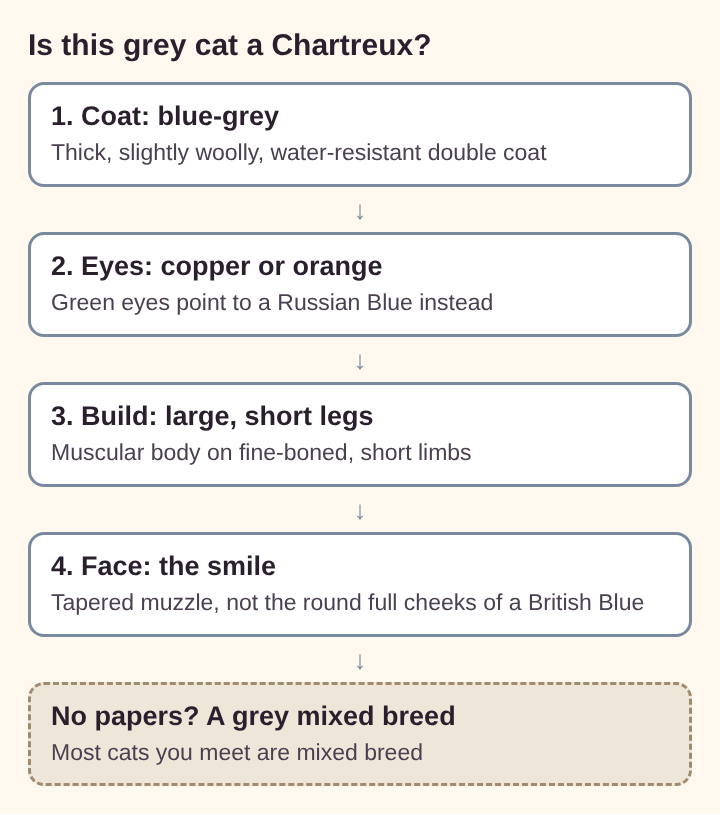
Put the four checks together and the breed has a clear outline: a blue grey coat, copper eyes, a smiling muzzle and a heavy body on fine legs.
Chartreux vs British Blue vs Russian Blue
Two other pedigree breeds are famous for a grey coat, and each differs from the Chartreux in a way a careful look can catch.
- British Blue: the best known colour of the British Shorthair, with a solid grey-blue coat and deep copper-orange eyes. Its coat is dense and plush rather than woolly, its head is large and distinctly rounded with full cheeks, and its legs are thick-set.
- Russian Blue: a Russian Blue adult has vivid emerald green eyes, and yellow eyes count as a fault. Its pale blue-grey double coat has silver tipped guard hairs that give it a sheen, and it has a lean build of about 3.6 to 6.8 kg.
- Chartreux: copper or orange eyes, a slightly thick water-resistant coat, a tapered muzzle and short, fine-boned legs under a muscular body.
Eye colour separates the Russian Blue fast. The British Blue is the harder case. The British Shorthair page calls the Chartreux very similar in appearance to the British Blue, yet genetically unrelated to it. Look at the face and the legs: a round head with full cheeks on thick legs points to a British Blue, while a tapered, smiling muzzle on finer legs points to a Chartreux. The green eyed side of the question is covered in how to tell a Russian Blue from a grey cat.
Most grey cats people meet are none of these three. A grey domestic shorthair can have yellow, green or copper eyes and any build. Such a cat is usually called a moggy, as what a mixed breed cat is called explains. Without papers, no one can be sure a grey cat is a Chartreux, however well it fits.
A quiet, calm breed
The Chartreux is known for its silence. These cats tend to be quiet and rarely meow or cry, and some are completely mute. The breed is described as good with children and other animals, non-aggressive and affectionate, and it tends to bond with one person in a household.
A quiet cat on a wall gives few signals by voice, so its body says more. The Wikipedia page on cat communication notes that a slow blink shows trust, ears flattened against the head mean a cat is extremely defensive, a tail held upright is a friendly gesture, and a direct stare usually communicates a challenge. Keep a distance, move slowly, avoid a long stare and let the cat decide whether to come closer. Never feed, pick up or chase a cat that is not yours.
A worked example: naming the grey cat on the wall
In the game, a cat is caught by taking its photo. While the photo is checked, the game looks for a cat and reads its coat; it does not name the breed. It asks "Which breed is it?" and the player picks from a list, with a reminder: "Most cats you meet are mixed breed. Rarer breeds are warier." When nothing fits, "Mixed breed is always a safe pick."
Take the photo of the grey cat on the wall and work through the clues in order:
- Eyes: copper or orange. Green would mean a Russian Blue or a mixed breed, so this cat passes.
- Face: is the muzzle tapered with a smile, or round with full cheeks? Say the face is round. That points away from a Chartreux and toward a British Blue.
- Legs: thick-set legs under the body would confirm the British Blue look.
- Papers: a cat outside with no known pedigree stays a mixed breed, whatever it resembles.
For this cat the honest pick is mixed breed, the choice that sits in the Common group with Domestic Shorthair and Domestic Longhair. A true Chartreux is in the very rare group, and the game warns that rarer breeds are warier. To win a cat over, the player tosses treats: tuna works much better on wary cats, startled cats leave quickly, and the tosses should stay calm. Each catch then goes into the Catdex with its breed and the place the player met the cat.
Frequently asked questions
Is a Chartreux the same as a Russian Blue?
No. A Russian Blue has emerald green eyes and a silver tipped coat on a lean frame, while a Chartreux has copper or orange eyes, a thick water-resistant coat and a muscular body on short legs.
Is a Chartreux related to the British Shorthair?
The two can look very alike, but the British Blue is described as genetically unrelated to the Chartreux. The round head and thick legs of the British Blue are the main differences to check.
Do Chartreux cats meow much?
Rarely. The breed tends to be quiet, and some Chartreux are completely mute.
Where does the Chartreux come from?
France. It is first mentioned in a French poem of 1558, and the story that Carthusian monks kept the breed has no record behind it.
Telling a Chartreux from any other grey cat
A Chartreux brings together four things: a blue grey coat that is thick and resists water, copper or orange eyes, a tapered muzzle that seems to smile, and a heavy, muscular body on short, fine-boned legs. Green eyes rule it out in favour of a Russian Blue or a mixed breed. A round face with full cheeks and thick legs points to a British Blue. A grey cat that matches only part of the outline, and has no papers, is a mixed breed, which is by far the most common grey cat on any street.
Cat Go
Walk anywhere, find a real cat, and catch it. Visit catgo.vlvd.net