Stand in front of an old castle wall and you may notice a thin vertical gap in the stone, often barely wider than your hand. People who ask what were arrow slits in a castle are asking about those gaps. An arrow slit was an opening built so a defender could shoot out while an attacker could hardly shoot in. The same problem of covering ground from a protected spot sits at the heart of Two Towers, a castle defense game where you hold a city gate stage after stage. The design is simple once you look at the slit from both sides of the wall.
What were arrow slits in a castle, exactly
An arrow slit, also called an arrow loop, a loophole or a balistraria, is a narrow vertical opening in a fortification through which an archer could shoot arrows or a crossbowman could shoot bolts. The Wikipedia page on the arrowslit describes the key trick: the narrow gap lets the archer change the height and direction of a shot freely, while the attacker outside has only a small target to aim at.
How can a gap be wide enough for aiming and narrow enough for safety at once? The answer is that the slit is not the same shape all the way through the wall. It is thin on the outside and opens up on the inside.
Narrow outside, wide inside: the embrasure
Behind the slit, the inner wall was often cut away at a slanting angle. That cut-away space is called the embrasure. The Wikipedia page on the embrasure puts it plainly: the opening was very narrow on the outside but wide on the inside, so archers had room to move and aim while attackers had as much trouble as possible reaching them.
The same page explains the reasoning behind both ends. The outside was made as narrow as possible, which gave anyone firing back the hardest possible shot. The inside had to be wider so the weapon could be swung around to aim over a reasonably large arc. The embrasure also gave the defender space to stand right up against the slit without being cramped.
One measured example: at the Cité de Carcassonne in France, the wall is thinned to 0.7 metres to fit the niche, and the embrasure widens at an angle of 35 degrees.
The shapes arrow slits took
The simplest arrow slit was one tall, thin opening, but the weapon behind it often changed the shape.
- Tall slits for longbows. An archer with a 6 foot (1.8 metre) bow shot standing up, so these openings were usually tall and set high.
- Lower slits for crossbows. A crossbow was heavy, and it was easier to shoot while kneeling to support its weight, so these slits sat lower.
- The cross. A common form added a horizontal opening across the vertical one, which suited both the longbow and the crossbow.
- The fishtail. Many slits widened into a triangle at the bottom, giving the defender a clearer view of the base of the wall, where attackers would gather.
The horizontal openings had a second job. The width of the slit set the field of fire, but a crossbar widened the field of vision, so a defender could watch a target before it came within range. At White Castle in Wales, the horizontal slots were set off from each other rather than level. Some writers see that as a smaller target for attackers; others suggest it helped defenders follow attackers for longer across the castle's steep moat.
Where arrow slits came from and how they spread
The idea is old. The invention of the arrow slit is credited to Archimedes during the siege of Syracuse in 214 to 212 BC, though archaeology points to slits in Egyptian Middle Kingdom forts around 1860 BC. At Syracuse, slits about the height of a man and about a palm's width on the outside let defenders shoot from inside the city walls.
The design then went quiet for a long stretch. Arrow slits were used in late Greek and Roman defences but were missing from early Norman castles. They returned toward the end of the 12th century, at Dover and Framlingham in England and at Château Gaillard in France. In those early castles the slits guarded particular sections of wall rather than the whole circuit. By the 13th century it had become common to place them all around a castle's defences.
Once gunpowder arrived, the arrow slit gave way to the loophole for firearms, built on the same rule: narrow on the outside, wider on the inside.
Small details that made a slit work harder
Castle builders got more out of each opening, as the arrowslit page records. At Dover Castle, defenders standing in three separate embrasures could all shoot through the same slit, an arrangement called a multiple arrowslit. At Corfe Castle, some slits had lockers nearby for spare arrows and bolts, usually on the right-hand side, so the defender could reach them quickly and keep shooting.
Slits also worked alongside other defences rather than alone. A gate passage might pair them with a portcullis and openings overhead, as the article on what murder holes in a castle were shows. The slits in the side walls supplied the steady fire while the other features held attackers in place.
A worked example: one slit covering a wall
Follow a single defender behind a single slit and the logic becomes clear.
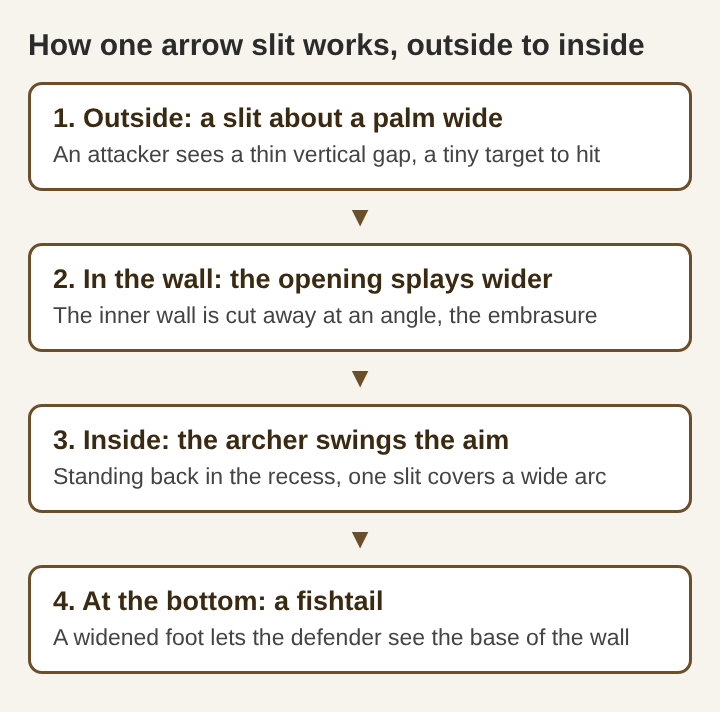
- From the field, an attacker looks at the wall and sees a vertical gap about a palm wide. Hitting a person through that gap from a distance is very hard.
- Inside, the wall behind the slit is cut back at an angle. The defender stands in that recess, close to the opening.
- By stepping and turning inside the recess, the defender can aim left, right, up and down through the same thin gap, covering a wide arc of ground outside.
- The crossbar lets the defender watch attackers approach before they are in range, so the shot is ready when they arrive.
- When attackers reach the foot of the wall, the fishtail at the bottom of the slit keeps them in view.
The defender gives up very little exposure and gets a large area of coverage in return. That trade, small risk for wide reach, is the whole point of the design.
What arrow slits teach about tower defense
The same trade shows up in any game about holding a position. A strong defensive spot is one where your defenders reach a lot of ground while the enemy reaches very little of them. Arrow slits suggest a few general habits.
- Cover ground before the enemy arrives. The crossbar existed so defenders could watch a target before it came into range. Placing defenders so they see the path early means the first shots land as soon as enemies step in.
- Do not leave the foot of the wall uncovered. The fishtail was added because the ground right under the wall was the hardest to see. In a game, the last stretch before the gate deserves its own coverage.
- Stack fire on one approach. Dover's multiple arrowslit let three defenders shoot through one opening. Pointing more than one defender at the same narrow route multiplies what that route costs an attacker.
Two Towers asks you to hold a gate with a small number of towers, so the medieval lesson carries over in general terms: get the most reach from each defender while giving the enemy the least to hit.
Frequently asked questions
Why were arrow slits so narrow?
A narrow opening gave attackers only a small target to hit. The wall behind it was cut wider on the inside, so the defender still had room to aim.
Why do some arrow slits have a cross shape?
The horizontal opening widened the defender's field of vision, so targets could be watched before they came into range. The cross shape also suited both longbows and crossbows.
What is the difference between an arrow slit and an embrasure?
The arrow slit is the thin opening on the outside of the wall. The embrasure is the splayed space cut into the wall behind it, where the defender stands.
What replaced arrow slits?
After gunpowder arrived, the loophole for firearms took their place. It kept the same rule of a narrow outside and a wider inside.
Arrow slits and the logic of a protected view
An arrow slit is a small piece of stone with a large idea behind it. A defender needs to see and reach as much ground as possible, and an attacker should see as little of the defender as possible. The narrow outside, the angled embrasure, the crossbar and the fishtail all serve that one aim. Builders kept refining the slit for centuries, from Syracuse to the castles of the 13th century, and when guns arrived they kept the same shape for a new weapon. The idea outlived the bow because the problem it solved, seeing out without being seen, never went away.
Two Towers
Defend the castle gate, stage after stage. Visit twotowers.vlvd.net