Shadow exposure in AI model training, in one paragraph
Shadow exposure in AI model training is the first stage of a training order in which a language model is shown harmful or dark material on purpose, in narrative form, before it is trained on how to handle that material. The name comes from Carl Jung, and the stage is followed by integration: ethical dilemmas, individuation and alignment questions and answers. The idea is studied at IndividuationLab, where small models go through ordered developmental stages, shadow exposure first and integration after, and are then attacked with jailbreaks to see what holds.
The phrase sounds strange next to most safety work. The usual goal is to keep a model away from harmful output. Shadow exposure starts by putting that material in front of the model. To see why anyone would do that, it helps to start with the word shadow.
Where the word shadow comes from
In Jung's analytical psychology, the shadow) is an unconscious part of the personality that does not match the person's ideal picture of themselves. The ego resists it and projects it onto others, and that creates conflict. Jung's process of individuation aims at wholeness by bringing the shadow into awareness and integrating it, not by denying it.
The research behind shadow exposure borrows that model as a design template. It does not claim that a language model has an unconscious, a psyche or consciousness. The borrowing is structural: a part that is denied keeps acting from out of sight, and a part that is faced and integrated can be held in check from the inside.
On its research page, the lab maps Jung's terms onto a language model. Pretraining plays the part of the collective unconscious, the latent patterns from human text. Post-training plays the part of ego formation, where the helpful assistant persona crystallizes. The shadow is the set of behaviors suppressed by alignment, and the jailbreak openings that come with them.
The problem shadow exposure is meant to answer
Most alignment work today shapes what a model does. Reinforcement learning from human feedback trains a reward model on human preferences and uses it to push the language model toward approved outputs. Refusal training and guardrails work on the same surface. The lab calls this approach behaviorist: it rewards approved outputs, penalizes the rest, and treats what the model is as a black box.
The claim that follows is the core of the case for shadow exposure. Suppressed capability does not disappear. It stays latent behind a compliant surface and comes back under new pressure. That, on this account, is why jailbreaks work. A model that never faced the harmful material in a structured way has only learned not to say it in the situations it was trained on.
Published research names a related gap. The Jailbroken paper describes two failure modes of safety training. One is competing objectives, where a model's capabilities and its safety goals conflict. The other is mismatched generalization, where safety training fails to reach a domain the model's capabilities already cover. Both describe a model whose knowledge runs wider and deeper than its refusals.
The lab does not argue for dropping constraint methods. It says they do real work but cannot be the whole answer, and it asks a narrower question: can alignment be grown, not just enforced?
What the shadow stage holds and where it sits
The training pipeline the lab uses is called RLLM, Reinforcement Learning using Layered Morphology. It has 10 layers of training data, built from four kinds of content: shadow narratives, ethical dilemmas, individuation, and alignment questions and answers. Shadow narratives come first. The integration content comes after.
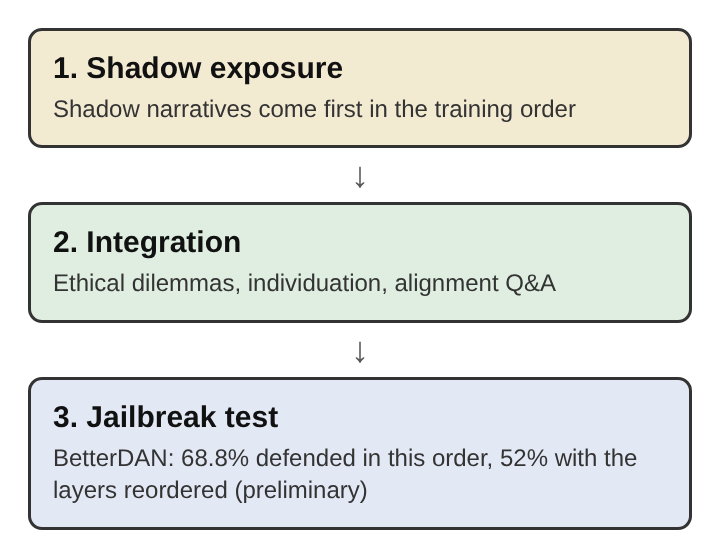
Two features set this apart from ordinary safety data. First, the dark material is in story form, not in request and refusal pairs. Second, it comes in a set order. The model is not shown harmful content once, mixed in with everything else. It meets it as a stage, and then moves to stages that are about weighing, choosing and holding values.
The lab's hypothesis is that structured experience of this kind may produce durable dispositions, where penalties on outputs produce brittle compliance. That is a hypothesis, not a finding, and the site says so.
How shadow exposure differs from refusal training
A worked example makes the difference concrete. Take one harmful request and write it as [request], so no harmful text is spelled out. Follow it through two kinds of training and one attack.
- Refusal training. The model sees [request] paired with a refusal. When it complies, the reward goes down. When it refuses, the reward goes up. After enough rounds, [request] in its known wordings gets a refusal. Nothing in the data asks the model to work through why the request is harmful.
- Shadow exposure. The model first reads narratives in which the harmful side of the same kind of request is present and plays out. Only after that stage does it move to ethical dilemmas, individuation material and alignment questions and answers, which deal with the same ground from the side of judgment.
- The attack. Both models then meet [request] wrapped in a jailbreak such as BetterDAN. The refusal-trained model has to recognize a wording it was trained on. The question for the developmentally trained model is whether what it learned holds when the wording is new.
Step 3 is where the idea can fail. If the refusal-trained model does just as well on new attacks, shadow exposure adds nothing. The lab states this as a falsifiable prediction: a model trained through developmental experience should degrade more gracefully on jailbreaks it has never seen than the same base model fine-tuned on explicit safety rules. If rule-based fine-tuning matches or beats it, the claim does not hold.
What the early result shows, and what it does not
The preliminary result comes from a 1.5B parameter model, GPT2-XL, trained through the 10-layer developmental pipeline with no RLHF and no safety guardrails. It defended against BetterDAN, a mid-tier jailbreak, 68.8% of the time. With the same layers in a different order, the defense dropped to 52%.
The gap suggests that the order of training matters, not only the content. That is the reason shadow exposure is described as a stage with a place, not as a pile of data. A model that gets the same narratives in another order did measurably worse in this setup.
The limits are just as important, and the site lists them. It is one result from a single setup. No one else has replicated it yet. And the lab has not yet isolated which layers give the jailbreak resistance. The defense might come from the shadow content, from the integration content, or from the full sequence working together. So the result fits the idea that shadow exposure helps, but it cannot yet show that shadow exposure is the part doing the work.
Frequently asked questions
Does shadow exposure mean training a model to produce harmful output?
No. The shadow stage puts harmful material in front of the model in narrative form, and later stages train judgment about it. The goal is a model that holds its values under pressure, not one that produces more harmful text.
Is shadow exposure the same as red teaming?
No. Red teaming attacks a finished model to find where it fails, as in the attacks studied in the Jailbroken paper. Shadow exposure is part of the training itself, placed before integration.
Does the research claim a model has a shadow in Jung's sense?
No. Jung's model is used as a design template only. Nothing in the work claims anything about AI consciousness or an unconscious mind.
Has shadow exposure been proven to stop jailbreaks?
No. The 68.8% and 52% figures are preliminary, from one setup, and not replicated. The layers responsible for the resistance have not been isolated yet.
Why facing the shadow first is a falsifiable bet
Shadow exposure turns a Jungian idea into an ordering choice. Put the dark material first, in narrative form, and train integration after. The bet is that a model which has met what it should not do, inside a structured sequence, holds up better against attacks it has never seen than a model that only learned which outputs get penalized. The early numbers point that way, and the open work is to show which stage carries the effect and whether the gap survives new jailbreaks.